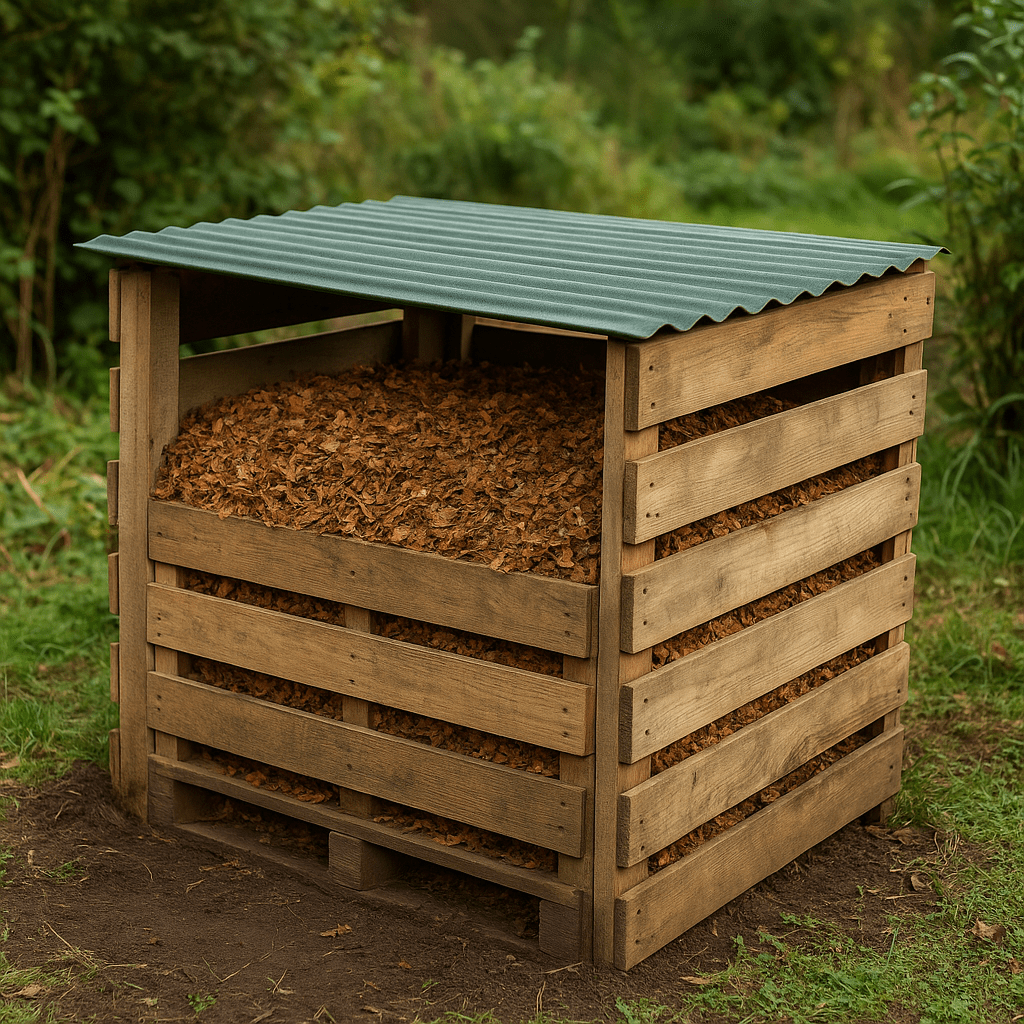
| Every autumn, it feels like the leaves never stop falling. Pavements, lawns, and flower beds quickly disappear under a golden carpet. Most people see them as a nuisance, a mess to be cleared and thrown away. At Earthly Comforts, we see them differently. Leaves aren’t rubbish — they’re a resource. That’s why, as part of our plan for the Soil Builder’s Hub Club, we’ll be setting up a system where fallen leaves are stored, cared for, and transformed into leaf mould, one of the most underrated soil builders around. |
| The Leaf Kraal Rather than bagging leaves up and sending them away, we’ll be building a pallet-based leaf kraal. It will be lined with breathable weed membrane and fitted with a lid to keep excess rain out. The design will be simple but effective: Size: about 12ft long × 4ft deep × 4ft high. Materials: reclaimed pallet wood, lined with wire/weed membrane for breathability. Lid: to stop heavy rain waterlogging the pile. Access: a removable front panel for easy emptying. This kraal will allow us to gather large volumes of leaves in one place, keeping everything neat and contained while giving the material time to break down naturally. |
| The Process Step by Step Collection – Each autumn, we’ll bring leaves from client gardens to the Hub. Brown, dry leaves are best, but mixed leaves work too. We’ll avoid too many evergreens like laurel and holly, which break down slowly. [these can be composted] Preparation – Whenever possible, leaves will be shredded with our shredder, which speeds up decomposition by increasing surface area. Shredded leaves should be ready in 6–9 months, while whole leaves will take 12–18 months. Storage – The leaves will be tipped into the kraal. Fungi and microbes will colonise the pile, slowly transforming the leaves. Unlike compost, which is heat-driven, leaf mould is a fungal-led process. Breakdown – Over the months, the pile will shrink by as much as 70%. White fungal threads may appear — a sign that the system is working. Turning once or twice a year can help aeration, but patience is the real key. Finished Leaf Mould – When ready, it will be dark brown, crumbly, and earthy-smelling, with no sign of whole leaves. |
| The Benefits of Leaf Mulch & Mould Both leaf mulch (fresh or partially broken-down leaves spread on soil) and leaf mould (fully broken down in the kraal) provide big advantages for gardeners: |
| Leaf Mulch (used fresh or semi-rotted) Protects soil over winter, reducing erosion. Suppresses weeds naturally. Insulates roots from frost and temperature swings. Slowly feeds soil as it breaks down. |
| Leaf Mould (fully decomposed) Improves soil structure, especially in clay or sandy soils. Enhances water retention, reducing the need for watering. Increases aeration, creating healthier root zones. Provides a fungal-rich amendment that supports perennials, shrubs, and woodland-style planting. Encourages earthworms and beneficial microbes. |
| By using both mulch and mould, we’ll help client gardens stay healthier year-round, with less reliance on outside inputs. |
| Autumn leaves may look like a problem now, but in the Soil Builder’s Hub, they’ll be turned into one of the garden’s greatest allies. |
| Another Piece of the Puzzle The leaf kraal will sit alongside compost bins, worm bins, and mulch bays as part of the Soil Builder’s Hub. Each plays a different role: Compost bins → nutrient-rich compost (bacteria-led). Worm bins → biologically active castings. Leaf kraal → fungal-rich soil conditioner. Mulch bays → shredded wood for covering soil and saving water. Together, these systems will close the loop, making sure that nothing is wasted and everything feeds back into the soil. |
 Earthly Comforts
Excellent post, Rory. Taking advantage of a natural resource makes sense.
LikeLiked by 1 person
Thanks Euenia, l certainly hope so 🙂
LikeLiked by 1 person
You’re welcome, Rory.
LikeLiked by 1 person