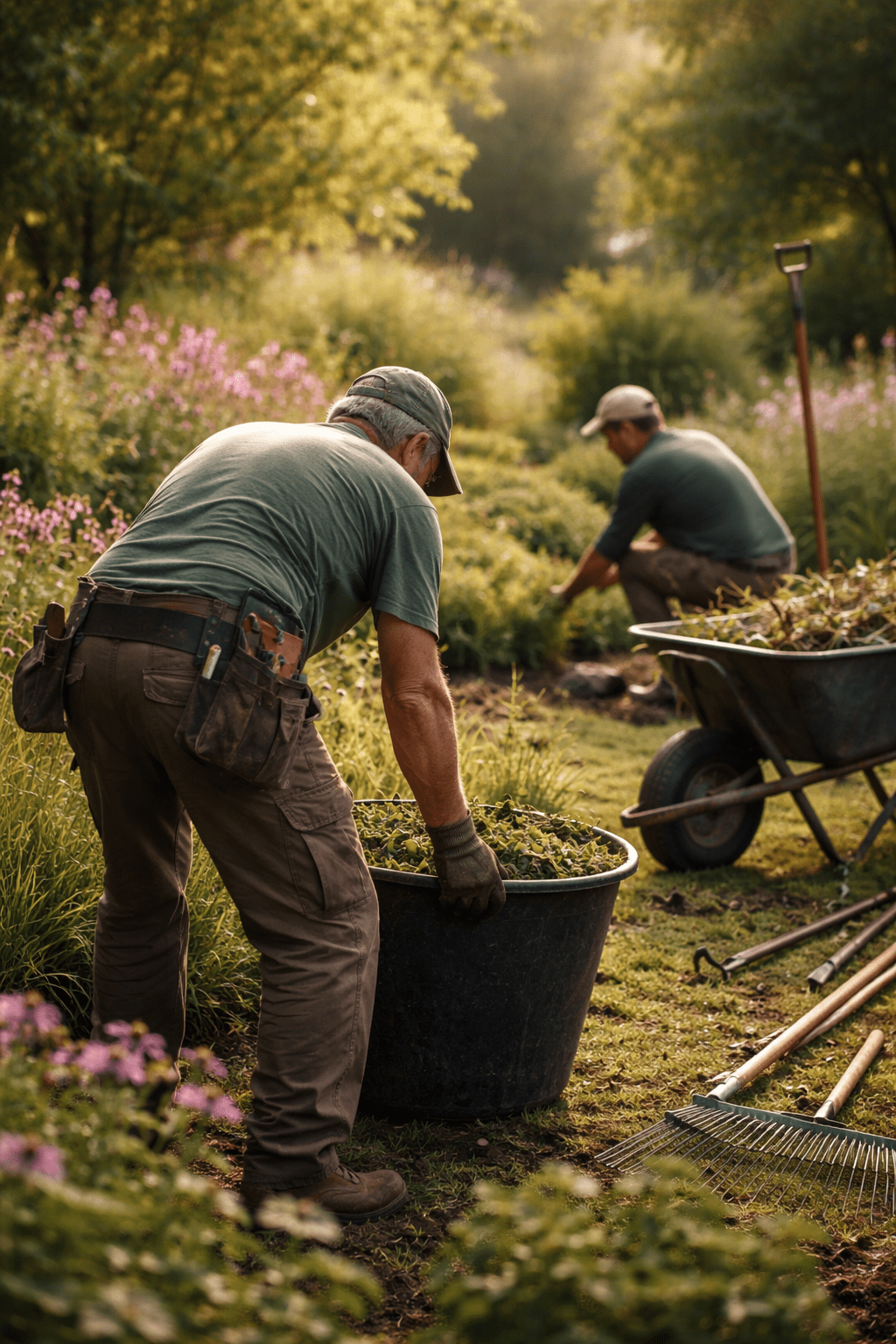
| Gardening can physically break you. That’s not drama — it’s simply an observation that comes from doing it day in, day out, for years. From the outside, gardening often looks calm. People imagine fresh air, birdsong, and a bit of gentle pottering. And sometimes it is like that. But professional gardening is something else entirely. It’s physical in a way that’s hard to explain unless you’ve lived inside it — not just lifting and digging, but constantly adapting your body to awkward spaces and unpredictable conditions. Gardeners are always bending, kneeling, and crouching. Digging, lifting, carrying, carting, lugging, heaving, throwing, cutting, and bolstering. Much of the work happens close to the ground, often on uneven surfaces, in all weathers. Loads are rarely balanced. Tools vibrate through hands and arms. Movements repeat, but never in quite the same way. It demands strength, flexibility, coordination, and stamina all at once—and asks for them again the next day. When you’re younger, you have bounce. You recover without thinking about it. You compensate without noticing. As you get older, there’s less bounce. Recovery takes longer, and small things don’t stay small for long. I started Earthly Comforts in October 2022, when I was 59. By the time I turned 60 the following year, I had already decided that by 65 I wanted to be maintaining fewer gardens — only the ones I truly wanted to keep — and begin stepping back from the daily physical grind. I gave myself five years to build something solid enough that I could eventually hand over the managing reins and work more as a consultant. That wasn’t about giving up. It was about staying in the work without being broken by it. In the week before Christmas, something small but telling happened. My second gardener arrived for work, stepped out of his car, and I heard it immediately — that unmistakable grimace of discomfort. I laughed and said, “I know that noise all too well. That’s the gardening groan.” He has been with me for just three months and was already making that sound. I have been building this business for over three years now — and I groan like that every single day. It was said lightly, but it landed heavily. This past Christmas was a reminder of how thin the margins can be. Back in November, I twisted my knee while gardening. That twist travelled up into my back and aggravated an old sciatica injury. It “healed naturally” — or at least I convinced myself it had. That’s what gardeners do. We adapt, adjust, and carry on. Christmas was meant to be a break. Officially, I had four days off. In reality, it became five, six, seven — not because I was resting, but because my body finally demanded it. I have now admitted that my body is forcing me to recover slowly and l will not go back to work [hoping] till the 5th January. On Christmas Eve, I twisted my back getting out of an ornamental bed. My foot slipped on a wet leaf and stretched my knee again. Christmas Day itself was lovely, spent with Suze’s family, but I also did some light spraying to help keep their weeds at bay. I didn’t realise the sprayer was faulty. The pressure valve wasn’t working, so I spent 25 minutes in a half-crouched position, putting strain straight through my back without realising it. None of it was dramatic. There was no single accident — just one small thing after another. By that evening, I had eaten too richly. On Boxing Day and the 27th, my back flared badly, my stomach turned, and on top of that, I had a major blepharitis flare-up. By Sunday — my last day off — I was still unwell. On Monday morning, I dressed for work in pain and finally had to admit what I didn’t want to: I couldn’t work. All of that from what felt like four small errors. That’s how it happens. It’s rarely one big injury that stops you. It’s the accumulation of tiny, ordinary moments — a twist, a slip, a crouch held too long, a tool that doesn’t work as it should. Individually, they seem insignificant. Together, they take you out. What plays tricks on the mind is the thought that follows: If I had just worked normally instead of taking time off, would this have happened? It’s a familiar thought for anyone who is self-employed. But the truth is this: rest doesn’t cause the damage — it reveals it. When you stop, the adrenaline fades, and the body finally gets a word in. This is also why prices in gardening — like those in many other raw, physical, productivity-based jobs — have to evolve. Gardening isn’t light work. It is punishing over time. Fair pricing isn’t just about fuel, tools, or inflation; it’s about making the work sustainable for the people doing it. It allows for recovery, safer pacing, better equipment, and a working life that doesn’t end early through injury or burnout. Gardening isn’t easy on the ageing body. That isn’t a weakness. It’s reality. It’s the quiet cost of years of care, consistency, and physical competence. I still love this work. I still believe deeply in what Earthly Comforts stands for. But I also know now that protecting the gardener is just as important as tending the garden. Longevity in this profession doesn’t come from pushing harder. It comes from listening earlier. And that’s a lesson I’m still learning — one careful step at a time. |
Gardening Isn’t Gentle on the Ageing Body
 Earthly Comforts