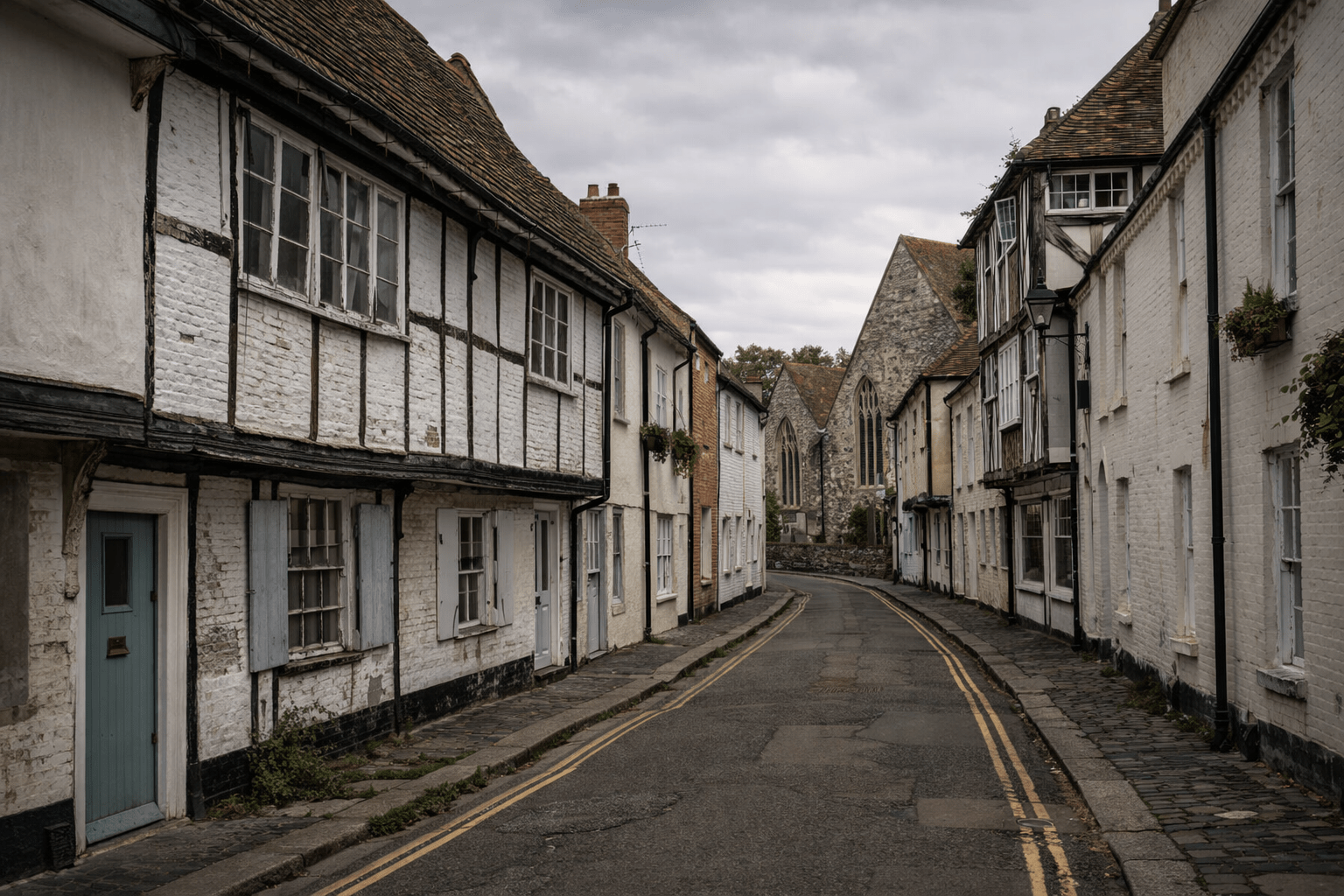
| Watching Sandwich Slip Through the Cracks It’s a strange kind of grief, isn’t it—watching a place you love slowly lose its grip on itself, not through some dramatic disaster, but through a steady drip of small neglects. The sort of neglect that doesn’t make the news because it’s not one big event, it’s a thousand little ones. A cracked kerb that stays cracked for years. A historic frontage that looks like it’s quietly giving up. A shop window papered over again, and nobody even bothers to speculate what might go in there next, because the guessing feels naïve now. People outside Sandwich still talk about it as if it were a jewel. They come for the medieval lanes and the sense of time layered in brick and timber. They take photos, they have a nice lunch, and they tell you how lucky you are to live somewhere so pretty. And you smile, because it is pretty, and because you don’t want to be the person who ruins the postcard. But then you look down at the crumbly road surface, the patched repairs that don’t quite meet each other, the uneven pavements that feel like they’ve been tolerated rather than cared for, and you think: pretty is not the same as looked after. What makes it harder in a place like Sandwich is that the decline doesn’t feel accidental. It feels bureaucratic. It feels like the town has been put into a slow administrative spin-cycle where responsibility is always just slightly out of reach. You can say “the council,” but in Sandwich, the council is a trio. Kent County Council. Dover District Council. Sandwich Town Council. KCC, DDC, STC—three sets of roles, three sets of budgets, three sets of priorities, three sets of constraints. And if you live here long enough, you start to notice how that structure can act like a soft shield against accountability. Not because anyone is malicious, but because fragmentation makes it easier for problems to drift. Roads and pavements are one domain; planning and town centre strategy, another; and local civic projects, another. The result on the ground can look like everyone is involved and no one is in charge. Money is part of it, obviously. You can’t maintain heritage stock, improve the public realm, support a fragile high street and keep essential services running without funding. And local government finance has been battered for years. But money isn’t the whole story, because you can still feel the difference between a place that’s underfunded but loved and a place that’s underfunded and… emotionally unattended. Love shows up in little choices: quick fixes that are done properly, street furniture that doesn’t feel like an afterthought, paintwork that’s refreshed before it flakes away, a sense that somebody walks the town with eyes open and pride intact. Neglect shows up the same way: in the long pause before anything is repaired, in the temporary solution that becomes permanent, in the sense that no one feels embarrassed enough to hurry. Sandwich is old in the way few places are. Not “old buildings here and there,” but old as a whole atmosphere. It has the kind of fabric that should make stewards of everyone who touches it, public or private. Yet you can walk through and spot buildings that look tired in a way that isn’t charming. You can feel the slow decay: the damp lines, the peeling, the cracked render, the sagging confidence. Heritage doesn’t just survive because it once mattered. It survives because people keep deciding, repeatedly, that it still matters now. That ongoing decision is what feels weak at the moment. And then there’s the town centre itself—the question of what it’s for. The UK high street story is well known now: online shopping, changing habits, higher costs, fewer anchor stores, and less casual browsing. But in Sandwich, the pressures have an added flavour. The remaining footfall is often seasonal or weekend-heavy, which means businesses are trying to survive on peaks and troughs. There’s a difference between being a town that’s lived in and a town that’s visited, and Sandwich sometimes feels like it’s being nudged toward the second category, whether residents like it or not. You notice it in the way the short-term lets have multiplied. “Overrun” is a strong word, but it’s also the word that comes naturally when you feel outnumbered. The Airbnb effect isn’t just about housing availability—it’s about the texture of everyday life. A street of residents has rhythms: bins out on certain days, familiar faces, somebody who notices if a window has been smashed, someone who brings a parcel in for a neighbour, small conversations that stitch the place together. A street of keypads and suitcases has a different rhythm. It’s not hostile. It’s just… thin. Transient. Quiet in the wrong places. And when too many properties shift that way, you don’t just lose homes, you lose a kind of social pressure that keeps a town centre upright. You lose the people who fight for the everyday things because they need them. Add an older population into the mix, and it becomes more complicated —not because older residents are the problem—far from it—but because demographics shape demand and energy use. If the town centre is harder to navigate because the pavements are poor, if benches are scarce or poorly placed, if crossing points feel like an afterthought, if public toilets are uncertain, then the centre becomes less usable for the people who most need it to be easy to use. An ageing population also means the town needs services and community infrastructure as much as it needs retail. When the high street is treated as a retail strip first and a living place second, it misses the point of what small towns need to become now. That’s where the frustration about “a lack of creative thought” really lands. Because when you stand in a historic town and watch units sit empty, you can’t help feeling that the imagination has collapsed before the buildings have. Empty shops aren’t just a retail issue; they’re a civic signal. They say: we have space, but no plan. Or worse: we have space, but we’re waiting for something that will never return. The old idea of the high street—rows of conventional shops selling conventional things at conventional margins—doesn’t fit modern reality, especially in a small town with constrained footfall. Waiting for it to come back is like waiting for the tide to reverse. What would creative thought look like here? It wouldn’t be one grand regeneration brochure. It would be practical, local, and visible. It would be trying things, making space cheaper and more flexible, using empties for pop-ups and shared studios, encouraging repair and craft, creating reasons for residents to come in midweek that aren’t just “buy something.” It would be treating the centre as a place for services, skills, community and experience—not only retail. It would be a strategy that aligns with Sandwich’s actual strengths: heritage, walkability, human scale, charm, and an environment where small businesses can thrive when the conditions are right. And “conditions” doesn’t just mean marketing. It means rents that reflect reality, buildings kept in good order, streets that feel cared for, and a clear sense that local authorities are not simply managing decline. Because the danger isn’t that Sandwich becomes less busy. The danger is that it becomes less believable. Once that happens, everything accelerates. Landlords invest less. Shopkeepers take fewer risks. Residents stop expecting better. Visitors come for the photos but don’t spend much beyond the easy options. The town centre becomes a kind of gentle museum—still attractive, but hollowed out, all surface and no pulse. That’s the part that hurts, because Sandwich doesn’t need saving from time. It’s survived time. What it needs is saving from the modern habit of letting things slide because nobody wants to own the problem. It needs a return of guardianship. A medieval town should feel like someone is proud to be responsible for it. Even if budgets are tight, even if progress is slow, you should be able to feel the intent. And maybe the most honest thing to say is this: people don’t talk like this unless they care. This isn’t a moan for sport. It’s the voice of someone looking at their own town with clear eyes and saying, “This could be better, and it deserves to be.” Sandwich isn’t a lost cause. But it is at risk of becoming a place where beauty is mistaken for wellbeing, where visitors confuse charm with health, and where the people who live here year-round quietly absorb a message that their town centre isn’t worth the fuss. If there’s a turning point, it probably won’t arrive as a big announcement. It will arrive with a different feeling on the street. In small repairs, done quickly and properly. In a building that’s cared for before it becomes an emergency. In an empty unit, becoming something unexpected. In councils—KCC, DDC, STC—working in a way that looks joined-up from the outside, not just on paper. In the sense that the town is not being tolerated, but treasured. Because that’s what Sandwich is asking for, really. Not miracles. Not perfection. Just love made visible. |
| The headline image is a street in Sandwich – St Mary’s, however, this is AI doctored, it doesn’t look entirely like this … yet! |
 Earthly Comforts
I’m sorry that a place you love is getting hit by time and change.
LikeLiked by 1 person
Morning Sadje, l don’t mind the gradual ageing of an area, l mind that the authorities in charge seemingly are not prepared to put money into a town that brings in an [or used to but not as much] an incredible amount of tourism income to the county.
LikeLiked by 1 person
Yes, that’s sad. It’s a very famous place, history wise.
LikeLiked by 1 person
Yes, it upsets a lot of the residents, but the councils in charge seemingly ignore us.
LikeLiked by 1 person
Very sad.
LikeLiked by 1 person
How sad, Rory. I’ve seen this happen in cities in the US. Those in charge of the city where we live do a good job. It’s a very attractive city, with thriving shops, and with frequent events that draws merchants and crowds. I hope your councils in charge get their act together before it’s too late.
LikeLiked by 1 person
So do l Eugenia, so do l.
LikeLiked by 1 person