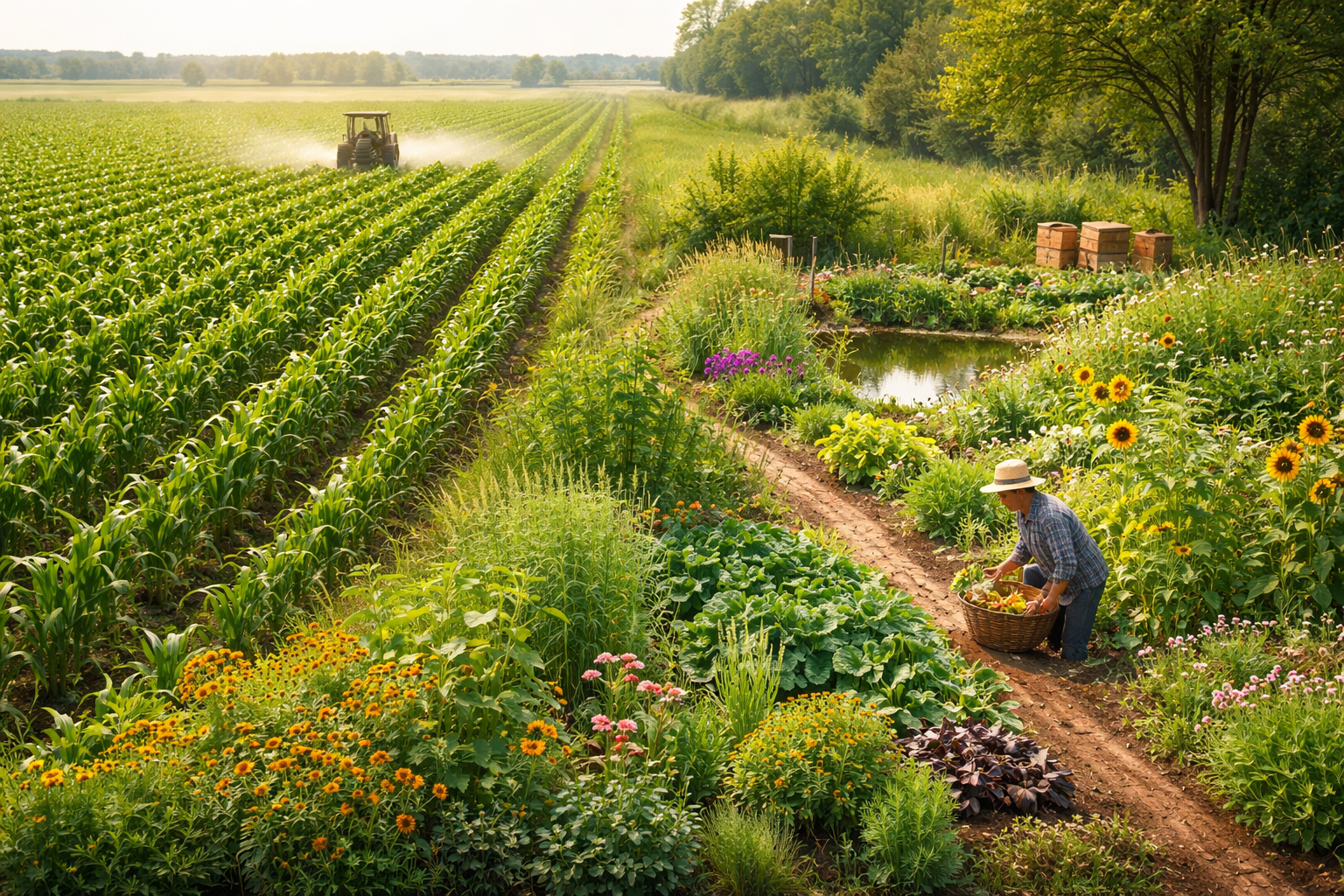
| Rethinking Productivity in a Living System For much of modern history, “yield” has been the primary measure of success in land use. How much food can be grown, how quickly, and how reliably has shaped agriculture, horticulture, forestry, and even urban green spaces. Ecology, by contrast, has often been treated as a secondary concern: something to be managed later, mitigated, or protected in isolated pockets. Today, that separation is increasingly showing its limits. Yield and ecology are not opposing forces, but they do operate on different timescales and values. Yield focuses on short-term outputs; ecology focuses on long-term function. When the two are placed in conflict, yield often appears to win in the moment, while ecology quietly absorbs the cost. Over time, however, those hidden costs begin to surface, usually as declining productivity, rising inputs, or system failure. The tension between yield and ecology is not a philosophical debate. It is a practical one, playing out in fields, gardens, allotments, and landscapes across the world. Understanding this relationship is essential if productivity is to remain possible at all. What Yield Really Measures Yield is a narrow metric. It measures quantity, not resilience. A high-yielding system is one that delivers a large output under specific conditions, often with heavy support from fertilisers, irrigation, pest control, and mechanisation. These systems can look impressively efficient, especially when judged over a single season or financial year. What yield does not measure is dependency. Many high-yield systems rely on continuous external inputs to maintain performance. Soil structure, microbial life, pollinator presence, and water cycles are often degraded in the process, but these losses are invisible in yield statistics until they reach a tipping point. At that stage, yields begin to fall, inputs increase, and the system becomes more fragile rather than more productive. Yield also tends to favour uniformity. Monocultures are easier to measure, manage, and harvest, but uniform systems are inherently vulnerable. They trade ecological complexity for short-term predictability, a bargain that rarely holds over the long term. What Ecology Actually Provides Ecology is often misunderstood as “nature left alone.” In reality, it is about relationships: between soil organisms, plants, insects, animals, water, and climate. A healthy ecological system regulates itself. It builds soil, buffers extremes, recycles nutrients, and suppresses pests through balance rather than force. From a productivity perspective, ecology provides services that are rarely accounted for in economic terms. These include natural fertility through organic matter cycling, pest control via predator species, pollination, water retention, and disease suppression. When these services are intact, yields may be slightly lower in peak conditions but far more stable across variable years. Ecology also creates redundancy. In a diverse system, if one crop struggles, another compensates. If one season fails, the system recovers more quickly. This resilience is not accidental; it is a direct result of biological diversity and functional overlap. The False Choice Between the Two The idea that we must choose between yield and ecology is false. It arises from measuring success over too short a timeframe and too narrow a set of indicators. When productivity is assessed only by immediate output, ecological investment looks inefficient. When productivity is assessed over decades, ecology becomes a prerequisite rather than a luxury. In gardens and small-scale systems, this is often easier to observe. A bed managed with compost, mulches, mixed planting, and minimal disturbance may not outperform an intensively fed bed in its first year, but by year three or four, it often requires less work, fewer inputs, and delivers more consistent results. The yield becomes steadier, not necessarily higher, but far more reliable. The same principle applies at larger scales. Systems that integrate ecological thinking tend to trade maximum yield for optimal yield: the level of output that can be sustained without degrading the system itself. Short-Term Gain, Long-Term Cost Many of the ecological challenges we now face are not the result of ignorance, but of prioritisation. Yield has been rewarded economically, while ecological stability has been treated as an external concern. Soil erosion, water pollution, biodiversity loss, and climate vulnerability are not failures of nature; they are accounting errors. When ecological systems are degraded, maintaining yield becomes increasingly expensive. More fertiliser is needed to replace lost soil function. More pesticides are required to control imbalanced pest populations. More irrigation compensates for poor water retention. Eventually, the system reaches a point at which additional inputs no longer yield proportional returns. At that stage, the question is no longer “How do we increase yield?” but “How did we lose the foundations that made yield possible?” Productivity Redefined True productivity is not about extracting the maximum possible output from a system in the shortest time. It is about aligning output with regeneration. A productive ecological system is one that leaves the soil richer, the water cleaner, and the biological community more stable than it found it, while still meeting human needs. This requires a shift in mindset. Instead of asking how much can be taken, the better question is how much can be grown while improving the system itself. Yield becomes a result of good ecology, not a replacement for it. In practice, this often means accepting slightly lower peak outputs in exchange for lower risk, lower costs, and greater longevity. Over time, these systems often close the yield gap, as their resilience enables them to perform better under stress. Gardens as Learning Grounds Gardens offer a valuable testing ground for this balance. They are small enough to observe closely and flexible enough to adapt quickly. Gardeners who work with soil life, seasonal rhythms, and plant diversity often discover that effort shifts from constant correction to gentle guidance. Weeding decreases as ground cover improves. Watering requirements decrease as soil structure develops. Pest outbreaks become less dramatic as predators establish. Yield becomes less erratic and more dependable. These are ecological gains translating directly into practical benefits. The lesson is simple but profound: when ecology is strengthened, yield becomes easier, not harder. Moving Forward The future of productive landscapes does not lie in choosing between yield and ecology, but in understanding their relationship. Ecology sets the ceiling for sustainable yield. Exceed it, and the system declines. Work within it, and productivity becomes something that can endure. As pressures on land increase, the systems that survive will not be those that extract the most, but those that adapt the best. Yield will still matter, but it will be measured alongside soil health, biodiversity, and resilience. In that context, ecology is not the opposite of productivity; it is its foundation. |
| About our writing & imagery Many of our articles are written by us, drawing on real experience, reflection, and practical work in gardens and places we know. Some pieces are developed with the assistance of AI as a drafting and research tool. Featured images may include our own photography, original AI-generated imagery, or—where noted—images kindly shared by other creators and credited accordingly (for example, via Pixabay). All content is shaped, edited, and published by Earthly Comforts, and the views expressed are our own. |
 Earthly Comforts