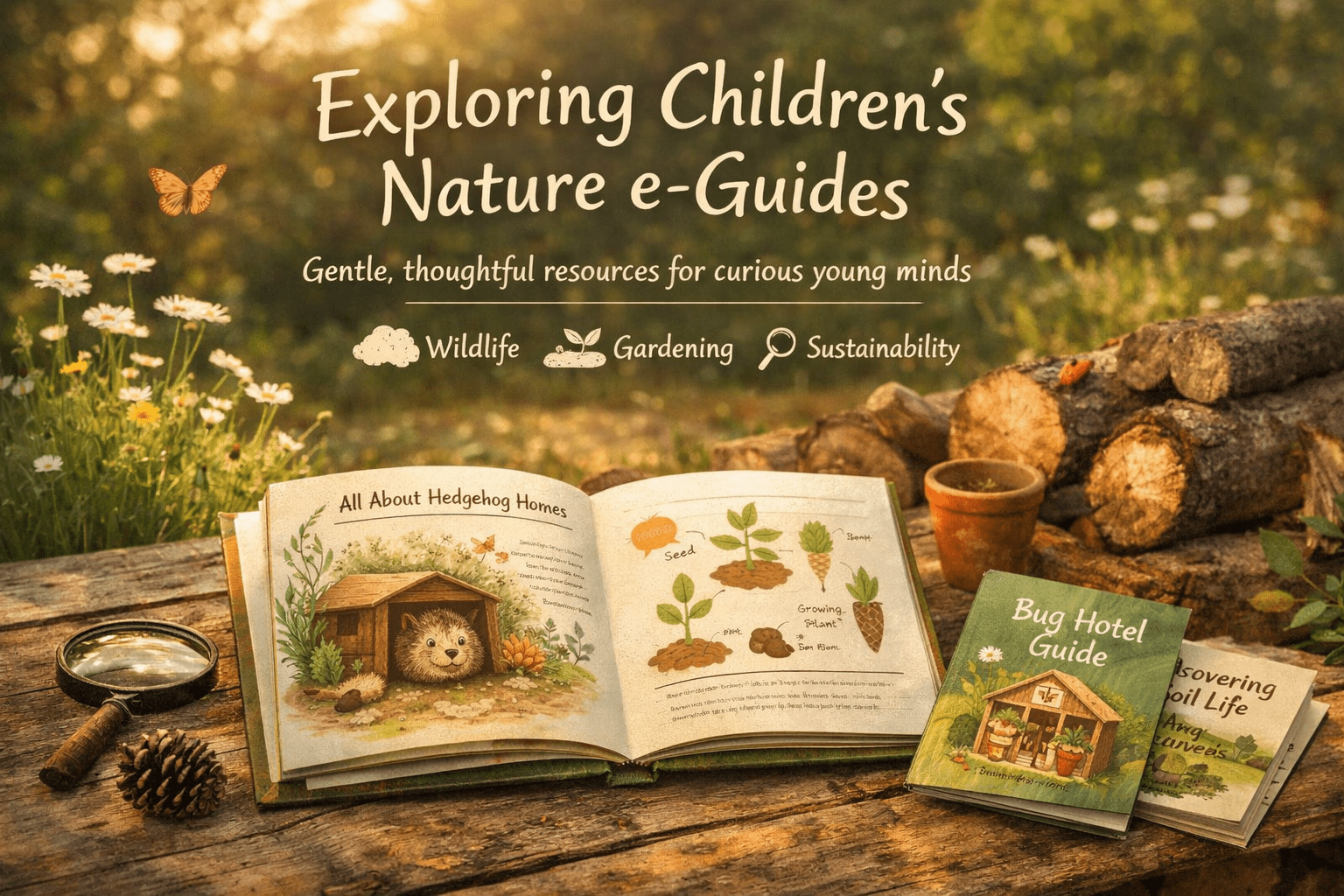
| Exploring Children’s Nature Guides At Earthly Comforts, ideas tend to surface slowly. They’re usually shaped by observation rather than intention — by time spent outdoors, noticing how people interact with land, wildlife, and each other. One idea we are currently exploring is whether there is space for a small collection of children-friendly nature and gardening e-guides, written with care and designed to be genuinely useful for children, parents, and schools alike. This article isn’t an announcement. It’s an exploration. Some of this thinking was inspired by time spent volunteering at the Gaza Salts Nature Reserve. Beyond the conservation work itself, what stayed with me most was watching how children responded when field wardens talked through wildlife projects — hedgehog homes, bug hotels, wildlife gardens, habitat restoration. Children listened closely. They asked thoughtful questions. They engaged not because the information was simplified or dressed up, but because it was shared calmly, clearly, and with purpose. It was a reminder that curiosity often emerges most strongly when children are treated as capable observers rather than passive learners. That observation has stayed with me. When we began thinking about children’s nature guides, the first step was to look carefully at what already exists in the UK. In fact, there is a great deal available. Organisations such as the Royal Horticultural Society, the RSPB, and various Wildlife Trusts provide high-quality downloadable resources for families and schools. Many of these focus on specific actions — building a bug hotel, growing food, spotting birds — or are structured as activity packs and curriculum-linked materials. These resources are valuable and well-used. They tend, however, to fall into two broad categories: structured educational toolkits, or single-topic activity sheets. What feels less common is something quieter. The gap we think exists is not about information but about tone and cohesion. Rather than producing worksheets, challenges, or “how-to” tasks, we are wondering whether there is room for a small, calm library of e-guides that focus on introducing ideas rather than instructing them. Guides that: Speak respectfully to children aged roughly five to eleven. They are readable and useful for parents and teachers as well. Encourage noticing rather than testing. Sit comfortably alongside school learning without trying to replace it. Not textbooks. Not lesson plans. Not loud, overstimulating content. But thoughtful, well-written guides that help children become familiar with ideas like soil health, insects, food growing, and wildlife habitats — opening doors rather than defining outcomes. There is also something appealing about the format itself. Downloadable e-guides can be returned to again and again. They can be read slowly, printed if needed, shared between home and school, and used without time pressure or supervision requirements. If this strand were to develop further, the intention would be to make these guides downloadable directly from the Earthly Comforts website in the future. This would allow families and schools to engage with them at their own time and in their own way. They would not be positioned as products to push, but as resources to offer — part of a broader commitment to thoughtful, sustainable gardening and a deeper relationship with nature. This idea is not about doing what large national organisations already do well. It’s about offering something different in scale and feel: a local voice, a gardener’s perspective, and a calm editorial approach that values observation as much as information. For now, this remains an idea under consideration. We’re interested in whether a small, values-led collection of children’s nature e-guides feels useful or welcome — particularly for parents, carers, and educators who want to introduce sustainability and wildlife thoughtfully, without pressure or noise. As with all things connected to land and learning, some ideas are worth sitting with before deciding whether they should grow. If you have thoughts, experiences, or ideas you’d like to share — whether as a parent, teacher, or simply someone who cares about how children encounter nature — we’d genuinely love to hear them. |
| Unless stated, featured images are my own work, created independently or with the assistance of AI. |
 Earthly Comforts