
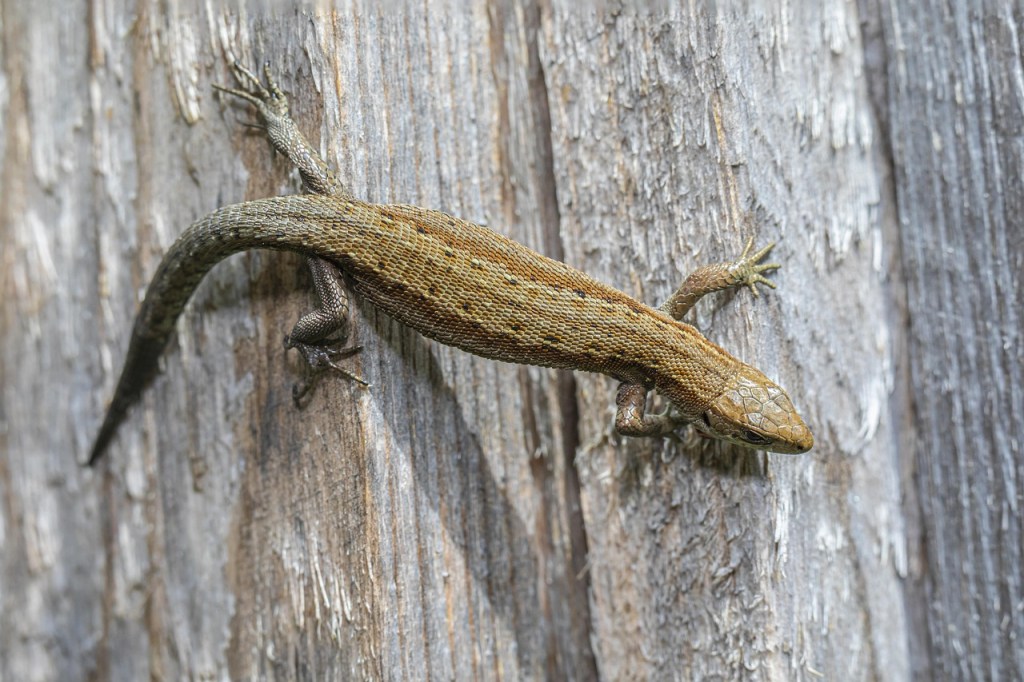
| The Small Reptile That Lives Between Sun and Shadow Quietly warming itself on a stone, slipping through grass like a moving shadow, or vanishing the instant footsteps approach — the common lizard is one of the most overlooked wild animals in the UK. Many people live their entire lives without realising they have shared paths, gardens, or countryside with a reptile at all. And yet the common lizard is here, resilient and understated, living at the margins of warmth and cold, sunlight and shelter. It is a creature shaped by balance — between exposure and concealment, activity and stillness, survival and restraint. To understand the common lizard is to understand how life persists in quiet, marginal spaces. |
| A Modest Appearance with Purpose The common lizard is small, slender, and beautifully understated. Its body is usually brown, grey, or olive, often marked with darker lines, spots, or subtle patterns that break up its outline against soil, stone, and vegetation. Males are often darker and more strongly patterned, while females tend to be slightly larger and paler. Some individuals show hints of copper or bronze in good light, especially when basking. Its legs are short but strong, its tail long and flexible. Everything about the common lizard’s body is designed for quick bursts of movement rather than endurance. It is not built to fight. It is built to disappear. Britain’s Most Widespread Reptile Despite being rarely noticed, the common lizard is the most widespread reptile in the UK. It occupies a remarkable range of habitats, including: Heathland and moorland Grassland and rough pasture Sand dunes and coastal areas Woodland edges and clearings Railway embankments Brownfield land Large, wildlife-friendly gardens What links these places is not beauty or order, but variation — patches of sun and shade, shelter and openness, warmth and cool. The common lizard thrives where landscapes are uneven and imperfect. Living by the Sun As a reptile, the common lizard is cold-blooded, meaning it relies on external heat to regulate its body temperature. This shapes its entire life. Each day begins with basking — soaking up warmth from the sun on stones, logs, bare ground, or south-facing slopes. Only once warm enough can it hunt, move, and react effectively. When temperatures rise too high, it retreats into the shade. When they fall, they seek shelter again. This constant adjustment makes the common lizard highly sensitive to microclimates — small changes in ground cover, vegetation height, or exposure can determine whether a place is usable. A Life of Short Bursts and Long Pauses The common lizard is not continuously active. Instead, its day is broken into phases: Basking to warm up Short foraging periods Retreating to cover Re-emerging as conditions allow Movement is quick and precise. When threatened, it darts for cover, often freezing completely once hidden. This stop-start rhythm allows it to survive in environments where energy must be carefully managed. Nothing is wasted. What Common Lizards Eat Common lizards are insect-eaters, feeding on whatever small prey is locally abundant. Their diet typically includes: Beetles Spiders Flies Ants Caterpillars Other small invertebrates They hunt visually, watching for movement rather than actively searching. A sudden flick of the head, a short sprint, and the prey is gone. By controlling invertebrate populations, common lizards quietly contribute to ecological balance — especially in open habitats. Shelter Is Everything For a common lizard, shelter is not optional. They rely on: Dense grass Heather and scrub Log piles Stone walls Brash piles Tussocky vegetation These features provide protection from predators, insulation from temperature extremes, and safe places to rest or hibernate. Overly tidy landscapes — short grass, cleared edges, uniform planting — are often unusable for lizards, even if food is present. Mess equals survival. Reproduction: Born Alive, Not Hatched One of the most remarkable aspects of the common lizard is its reproductive strategy. Unlike many reptiles, it gives birth to live young rather than laying eggs. This adaptation allows it to survive in cooler climates where eggs might not develop successfully. Young lizards are born fully formed, miniature versions of adults, and must fend for themselves immediately. There is no parental care. Survival depends on shelter, warmth, and instinct from the very first moment. Winter: Life Slowed Almost to Stillness As temperatures drop, common lizards enter hibernation. They retreat to frost-free places such as: Beneath tree roots Deep in grass tussocks Under stones Inside old walls During this time, metabolism slows dramatically. They remain inactive for months, relying on energy stored during warmer seasons. Disturbance during hibernation can be fatal, forcing them to wake when no food is available. Quiet, undisturbed ground is essential. Predators and Pressure Common lizards are prey for many animals, including: Birds of prey Crows and magpies Snakes Foxes Domestic cats Their survival strategy is avoidance, not confrontation. This works well in natural, complex habitats — but fails in simplified landscapes with limited cover or high disturbance. Roads, heavy machinery, habitat fragmentation, and constant ground disturbance dramatically increase risk. Why Common Lizards Are Often Missed Despite their wide distribution, common lizards are rarely recorded by casual observers. They: Stay low to the ground. Remain motionless when watched. Blend perfectly with the surroundings. Move suddenly and briefly. Most sightings are accidental — a flash of movement on a sunny bank, a shape slipping into grass. Once noticed, they are unforgettable. But they rarely offer second chances. What the Common Lizard Tells Us The presence of common lizards says a great deal about a place. It suggests: Structural diversity Low-intensity land use Tolerance of rough ground Sunlit shelter mosaics They are not animals of manicured nature. They belong to edges, margins, and transitional spaces. When they disappear, it often means landscapes have become too uniform, too tidy, or too disturbed. Lessons from a Quiet Survivor The common lizard teaches us that: Warmth is a resource. Small spaces matter Messy habitats are functional. Survival often depends on restraint. Protecting this species does not require grand interventions. It requires allowing land to remain varied, uneven, and partially unmanaged. Leaving some stones. Leaving long grass. Leaving space for sun and shade to coexist. Life Between the Moments The common lizard lives in the gaps — between footsteps, between mowing cycles, between shadows and sunlight. It does not compete for attention. It simply waits for the right moment to move. And in a world increasingly shaped by speed and efficiency, its continued presence is a reminder that some lives depend not on progress, but on patience — and the willingness to leave room for stillness. |
 Earthly Comforts