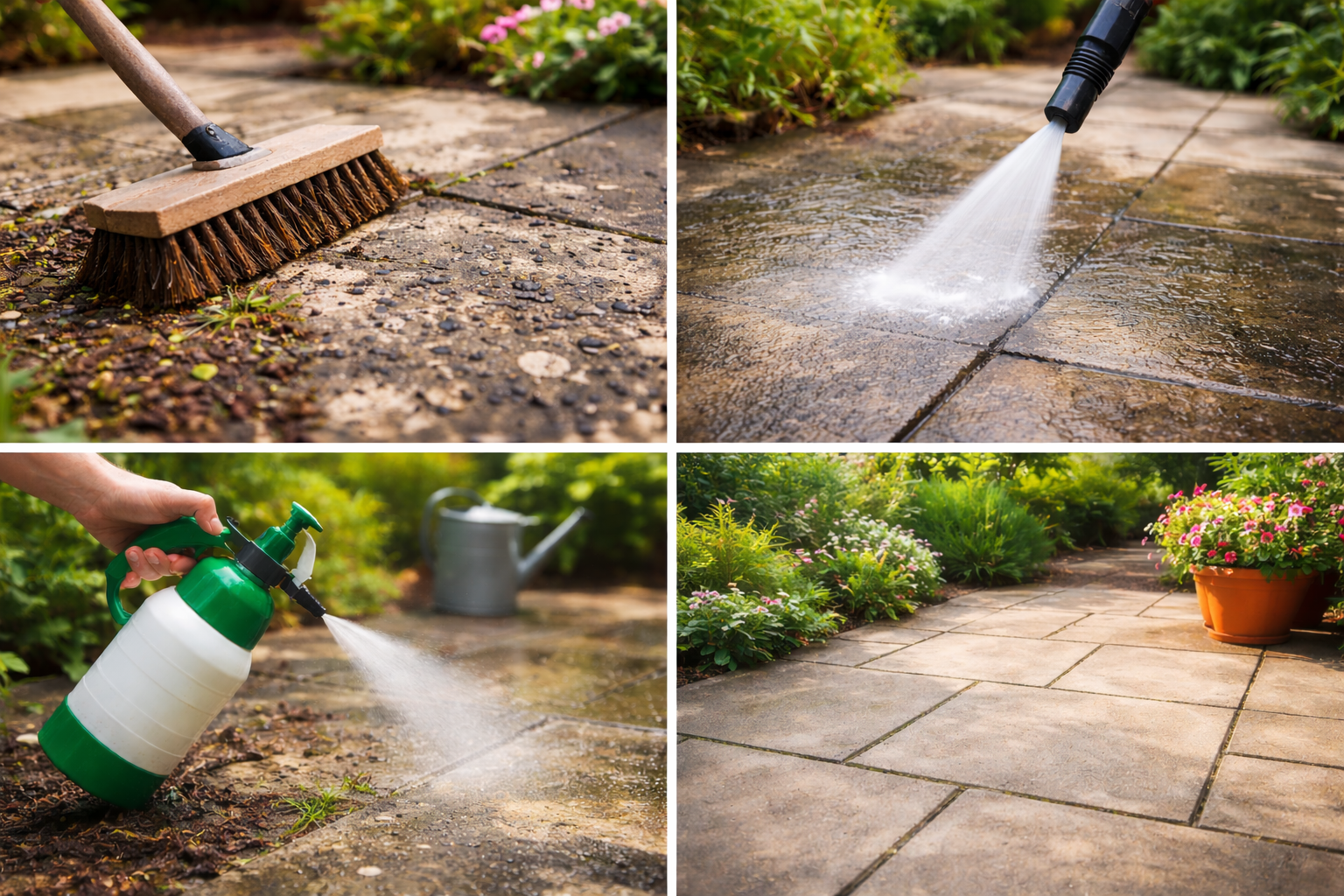
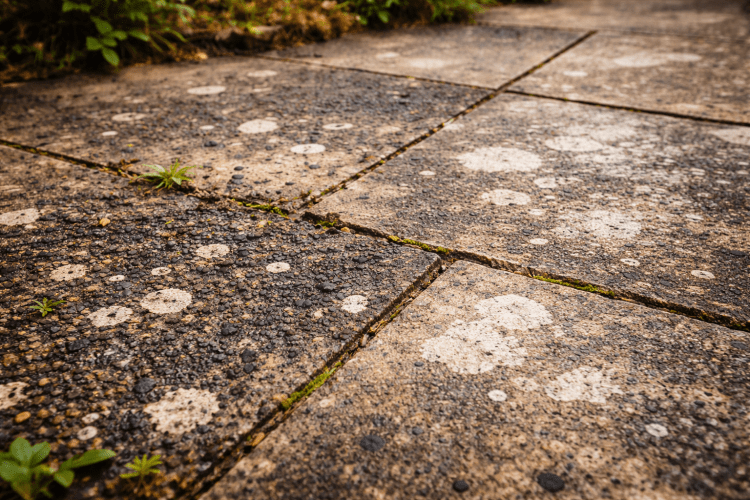
| What White and Black Marks Really Mean … … and How We Choose to Deal With Them There is a moment most gardeners recognise, whether they name it or not. You arrive somewhere familiar — a garden you’ve worked in before, a space you understand — and your attention drifts downward, not to the planting, not to the borders, but to the hard surface beneath your boots. The patio hasn’t moved. No slabs are loose. Nothing has failed. And yet something has changed. Dark freckles have appeared where none existed before. Pale, chalk-like blooms sit on the surface, subtle but unmistakable. They weren’t there last year. Or perhaps they were, but quieter. Either way, the question presents itself gently but insistently: Is this damage? White and black marks on patios provoke more concern than almost any other garden feature. More than leaning fences. More than cracking render. They invite strong opinions, urgent cleaning, and sometimes unnecessary force. And yet, most of the time, they are not signs of failure at all. They are signs of time, moisture, and the quiet interaction between materials and weather. To understand them properly, you have to let go of the idea that a patio is inert. It isn’t. It absorbs, releases, and breathes. It responds to shade, airflow, rainfall, and use. Treating it as a static object — something that should remain visually unchanged year after year — is where most misunderstandings begin. The Difference Between Surface and Structure One of the most persistent assumptions in garden care is that appearance equals condition. If a surface looks marked, it must be compromised. If it looks clean, it must be healthy. This makes sense on an emotional level, but it doesn’t hold up under closer observation. A patio slab can be structurally sound while looking tired. It can carry staining without being weakened. Conversely, a patio can look immaculate while hiding failing joints or poor drainage beneath the surface. Black-and-white marks almost always live on the surface, not within the structure. They tell you about moisture movement, not material failure. When that distinction is missed, cleaning becomes reactive rather than considered — and that’s often when real damage begins. Black Marks: Growth, Not Decay Black spots are the ones people notice first. They spread gradually, favouring shade and damp. They appear more quickly on north-facing patios, beneath trees, or in areas with limited air circulation. Algae, lichen, and similar growths thrive in these conditions not because something is wrong, but because the environment suits them. These organisms don’t attack stone. They don’t undermine slabs. What they do is occupy the surface, holding moisture against it for longer than bare stone would. Over time, this can subtly change the texture of concrete or soften the crispness of some natural stones. The most immediate practical issue is safety — damp, algae-darkened slabs can become slippery underfoot, particularly in winter. But it’s essential to be precise with language here. This is not rot. It is not decay. It is a slow biological occupation of an outdoor surface, doing what biology has always done. White Marks: Moisture Leaving a Trace White staining unsettles people differently. It looks chemical, artificial, almost as though something has leached out that shouldn’t have been there in the first place. In reality, these pale blooms are simply mineral salts carried to the surface as moisture evaporates. It’s a visible record of water moving through stone. This is especially common on newer patios, where concrete and mortar are still curing, or after prolonged wet periods. The process is usually self-limiting. Once the available salts have travelled outward, there is nothing left to migrate. In many cases, the staining fades naturally over time, with rainfall, and with use. Occasionally, repeated wet–dry cycles can leave a surface looking chalky, particularly on lower-quality concrete. Even then, this is aesthetic ageing rather than structural failure. The slab isn’t breaking down — it’s simply revealing its composition. Moisture Is the Common Thread What unites black and white marks is moisture. Not dramatic flooding, but quiet persistence. Water lingering in joints. Shade slows evaporation. Surfaces that never quite dry out. In the UK, this is normal. Our climate rewards patience rather than dryness. We have long seasons of mild damp rather than extremes of heat or cold. These are ideal conditions for biological growth and mineral movement. Expecting patios to remain pristine under these conditions is, frankly, unrealistic. Understanding this shifts the conversation. The question stops being “How do we eliminate this permanently?” and becomes “How do we manage this sensibly?” Cleaning as Intervention, Not Erasure There is a temptation — understandable and common — to treat cleaning as a reset. Bring out the pressure washer, remove every mark, and restore the patio to something close to new. And for a short while, that works. The visual change is immediate and satisfying. But a patio cleaned aggressively is not returned to its original state. It becomes something slightly different. Pressure, even without chemicals, opens the surface of many slabs, removes fine material, and loosens joints. The result is a surface that looks clean now but is more vulnerable to recolonisation later. This is where cleaning quietly becomes counterproductive — not because cleaning is wrong, but because intensity replaces judgement. A More Measured Sequence Our own approach has evolved through observation rather than theory. We don’t treat patios as things to be stripped back repeatedly. We treat them as surfaces that need interruption, not annihilation. The order matters. We start with dry, manual brushing. This breaks the biological film mechanically, without driving it deeper into the surface. It removes loose material, spores, and surface growth before any water is introduced. This step is often overlooked, but it does more work than people realise. Only then do we wash. And even then, washing is not about force. It’s about removal. The pressure used is enough to rinse away what’s been loosened, not enough to carve or scour. Fan nozzles, constant movement, and distance matter here. The washer is a tool for removing debris, not for sculpting stone. After that, where appropriate, we apply a slow-acting, non-caustic treatment. Not to bleach the patio into submission, but to quietly discourage regrowth over time. These treatments don’t offer instant gratification, and that’s part of their value. They work with the weather, not against it. The result is not perfection. It’s a balance. Why This Matters Long-Term Patios cleaned this way tend to age more evenly. They don’t develop the harsh patchwork look that comes from repeated high-pressure intervention. Joints stay intact for longer. Surfaces remain safer underfoot. And perhaps most importantly, the interval between necessary cleansings lengthens. This is the part that often surprises people. Cleaning less aggressively doesn’t mean cleaning more often—quite the opposite. By not opening the surface unnecessarily, you reduce the rate at which it becomes hospitable to staining again. The Role of Joints (Often Missed) If there is one detail that influences patio condition more than staining itself, it is the state of the joints. Failed joints trap moisture. Sound joints allow it to move through. Many staining problems blamed on slabs are, in truth, joint problems masquerading as slab issues. Washing a patio without addressing the joints is like cleaning a roof without addressing the gutters. Water will always find the weak point. Treating joints as part of the surface — not collateral damage — changes outcomes dramatically. Patina, Not Neglect There is an unspoken discomfort beneath many of these conversations: a resistance to visible ageing. We expect outdoor spaces to remain visually static, as though the weather should leave no trace. But gardens are records. They show time passing. A patio with a bit of lichen, a faint mineral bloom, or softened edges is not neglected. It is simply honest. Neglect is not the presence of marks. It is the absence of care, attention, and understanding. A patio that is monitored, swept, and cleaned thoughtfully — even if imperfect — is not failing. When Action Is Necessary None of this suggests doing nothing, always. There are moments when growth becomes hazardous, when surfaces genuinely need intervention. Gardening is not philosophy alone; it is practice. The difference lies in intent. Cleaning should restore safety and slow ageing, not chase a brief illusion of newness. When action is proportionate, it supports the life of the surface rather than shortening it. Letting the Garden Breathe Patios sit at an edge — between the built world and the living one. They are neither entirely architectural nor fully natural. Expecting them to behave like indoor floors leads to frustration. Understanding them as outdoor materials brings calm. White and black marks are not accusations. They are information. They tell you where moisture lingers, where shade dominates, where time has passed. Learning to read them changes how you respond. And in the long run, that calm response preserves patios far better than force ever could. |
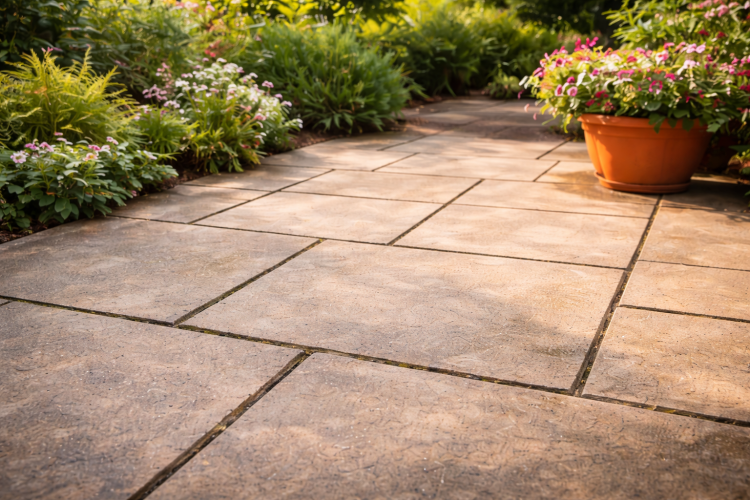
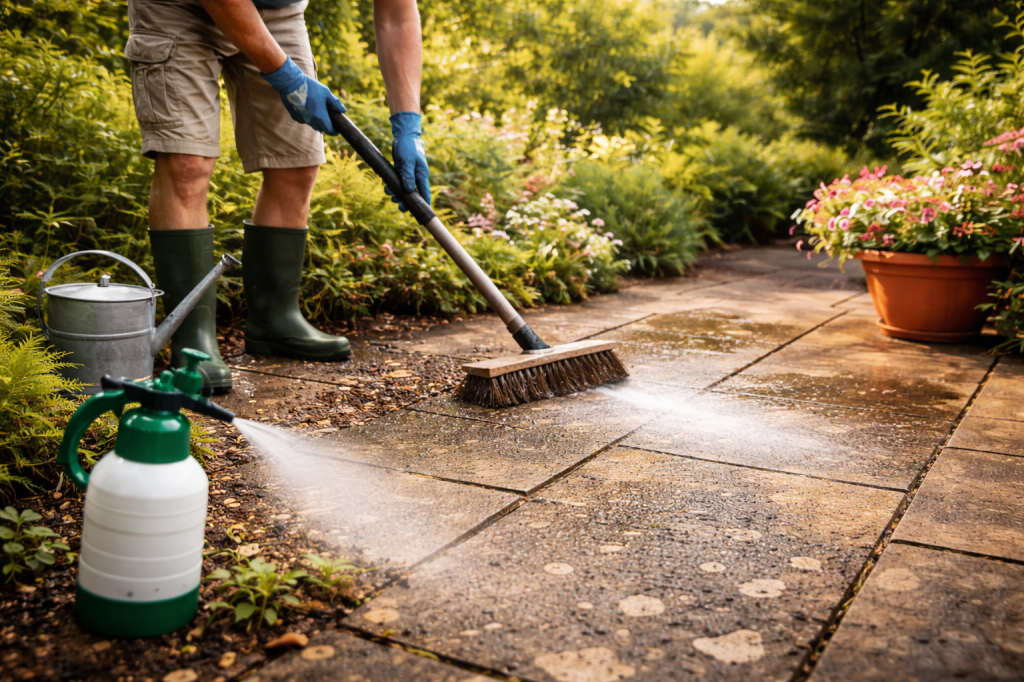
| A note on marks, damage, and cleaning patios Black-and-white marks on paving are common in UK gardens and are rarely signs of structural failure. They usually reflect moisture, shade, and time rather than neglect or poor materials. Black marks are most often algae or lichen. They sit on the surface, holding moisture and sometimes making paving slippery, but they do not rot or weaken slabs. White marks are typically mineral salts brought to the surface as moisture evaporates. They are cosmetic and often fade naturally. Occasionally, bird droppings can leave pale marks, particularly on concrete or limestone. These are caused by mild surface etching rather than staining and are localised rather than spreading. In all cases, the risk is usually aesthetic or practical, not structural. Our approach to cleaning We treat patio cleaning as an intervention, not erasure. Rather than relying on force or harsh chemicals, we work in sequence: *Dry brushing first, to disrupt surface growth without driving it into the stone *Controlled washing, using only the pressure needed to rinse away loosened material *Where appropriate, a slow-acting, non-caustic treatment to reduce regrowth over time This approach restores safety and appearance while limiting long-term surface wear. We avoid chasing a “like new” finish. Outdoor surfaces are expected to age, and excessive pressure or repeated aggressive cleaning often shortens the life of paving by opening the surface and weakening joints. What to expect afterwards Cleaning resets the clock — it does not stop it. Over time, marks may return slowly, depending on shade, drainage, and weather. This is normal. We aim to slow ageing, not fight nature, allowing patios to remain safe, serviceable, and visually settled rather than repeatedly stripped back. |
| About our writing & imagery Most articles reflect our real gardening experience and reflection. Some use AI in drafting or research, but never for voice or authority. Featured images may show our photos, original AI-generated visuals, or, where stated, credited images shared by others. All content is shaped and edited by Earthly Comforts, expressing our own views. |
 Earthly Comforts