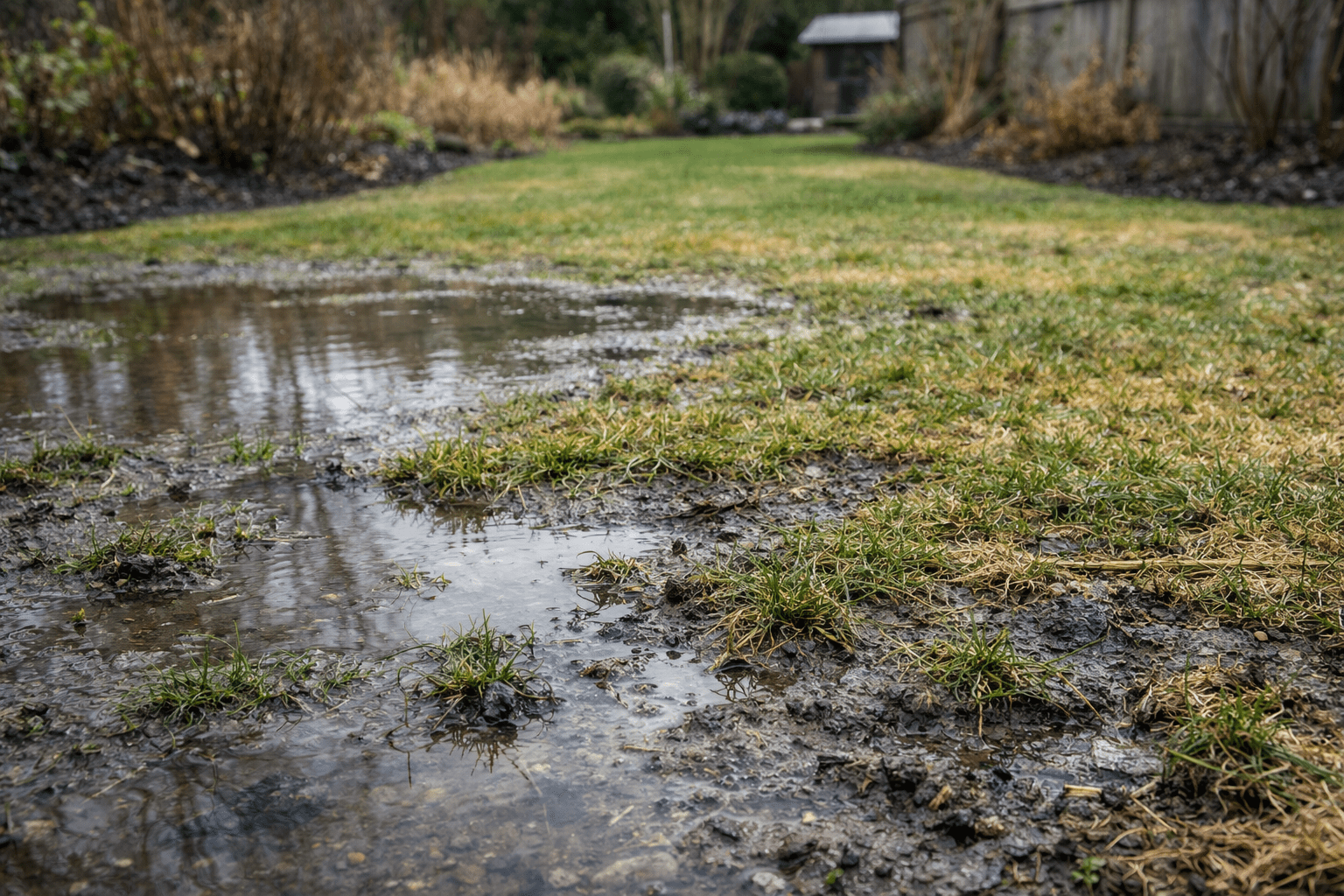
| Reflections on rain, lawns, and a winter that doesn’t know when to stop |
| By the time January slid into February this year, the ground around Sandwich had stopped pretending. Paths stayed dark and slick. Lawns lost that crisp winter firmness and took on a faint, defeated sheen. You could feel it underfoot first thing in the morning — not mud exactly, but a soft, hollow give, as if the soil itself was holding its breath. I’ve been gardening long enough to know the difference between a wet spell and a saturated season. This winter is the latter. The sort of winter where the land doesn’t recover between showers because there are no fundamental gaps anymore — drizzle, then rain, then heavier rain, followed by a few hours of grey pause before it all starts again. Somewhere in the background of this lived experience were the headlines. News bulletins are talking about exceptional rainfall. Articles quietly confirming that January had tipped into record territory in parts of the UK — in some regions, the wettest January since records began. Not dramatic headlines exactly, but steady, factual acknowledgements that something unusual had been unfolding above our heads. February is already starting the same way as January …. Out in the gardens, we didn’t need the confirmation. The lawns told us first. The look of a lawn that’s had enough A new lawn is an optimist. Fresh turf or newly germinated grass believes, instinctively, that conditions will improve. It pushes roots downwards, tests the soil, and reaches. But optimism has limits. This winter, I’ve seen lawns — mainly newly laid ones — take on that unmistakable “drowned” look—colour paling rather than deepening. Growth is slowing when it should still be ticking along gently. Footprints lingering far longer than they should. In the worst spots, a faint sour smell rises when the surface is disturbed, like a cellar that hasn’t been aired for years. It’s tempting to diagnose this as a failure of care. Too much watering. Poor preparation. Wrong soil. And sometimes those things are involved. But this winter has challenged one of gardening’s quieter assumptions: that soil always has time to recover. In a normal year, rain arrives, drains, evaporates, or is taken up by plants. Oxygen returns to the pore spaces. Roots breathe again. This year, the cycle stalled. The soil stayed full. Air never quite made it back in. Rain as a background condition, not an event One of the news stories that stuck with me wasn’t flashy. It simply noted that prolonged rainfall, rather than single dramatic storms, was the defining feature of the winter. That feels important. Gardening culture — especially online — loves extremes. Heatwaves. Droughts. Floods. But what really alters gardens is often the long, unbroken middle weeks of dampness. Persistent cloud. Soil temperatures that never quite drop low enough to reset, never rise high enough to invigorate. In Kent, we’re used to being relatively dry compared to the west. We talk about rain shadows, chalk, and “good drainage” as if they’re permanent traits. This winter quietly undermined that confidence. Clay-heavy gardens that usually cope began to struggle. Even lighter soils lost their advantage once their underlying structure filled up. A lawn doesn’t drown because water touches it. It drowns because water doesn’t leave. The myth of “too much rain means lush growth” There’s a stubborn belief that grass loves rain. A wet winter sets lawns up for spring abundance. It’s only half true. Grass likes moisture and oxygen in balance. What it doesn’t like is stagnation. Roots sitting in cold, saturated soil burn energy just staying alive—microbial activity shifts. Beneficial organisms slow down, while anaerobic processes — the ones that produce those sour smells — take over. I’ve noticed this particularly on newly laid turf this season. Turf farms grow grass in controlled, well-drained conditions. When that turf is laid onto a garden soil that’s already at capacity, the grass doesn’t so much establish as endure. Roots hesitate at the boundary between the turf’s growing medium and the compacted ground beneath. Water collects at that invisible seam. From above, it looks like failure. From below, it’s a standoff. News from above, lessons below Reading the winter rainfall reports alongside daily work has been oddly grounding. The articles talk about millimetres, percentages, and records. Out in the garden, those abstractions translate into very practical realities: wheelbarrows that leave ruts, beds you don’t step into, lawns you learn to walk around rather than across. There was a short piece I read about river catchments struggling because the soil was already saturated before new rain arrived. That phrase — already saturated — feels like the quiet headline of the season. It applies just as much to a suburban lawn as it does to a river basin. Gardening often borrows metaphors from resilience and recovery. “The garden will bounce back.” “Give it time.” Both are usually true. But time only helps if conditions change. When the baseline shifts — when wet becomes the norm rather than the interruption — we have to adjust our expectations. Watching rather than fixing One of the hardest disciplines as a working gardener is restraint. Especially when clients are understandably anxious, a lawn that looks unwell invites intervention. Aeration. Feeding. Reseeding. Drainage solutions. And sometimes those are appropriate. This winter, though, I’ve found myself doing less, not more. There’s a practical reason: working saturated soil often causes more damage than it solves. But there’s also a philosophical one. Gardens are systems, not machines. When an external condition — prolonged rainfall — overwhelms the system, the gardener’s role shifts from fixer to witness. That doesn’t mean inaction. It means choosing actions that respect timing—light aeration rather than heavy machinery—avoiding unnecessary foot traffic and letting grass stay a little longer than usual because leaf area matters when roots are struggling. It also means having honest conversations about what can’t be controlled. The rain doesn’t care about schedules. New lawns and old ground One pattern that’s been especially clear this season is the difference between new grass and old soil. Lawns laid onto long-established ground with decent structure have fared better, even under relentless rain. New lawns on newly worked or imported soils have struggled more. There’s a quiet lesson here about depth. Soil isn’t just a surface to grow things on; it’s a layered history. Compaction from years ago still matters. Drainage decisions made during building work echo decades later. When rainfall increases, those buried choices resurface. Some news commentary has linked this winter’s rain to broader climate patterns — warmer air holding more moisture, rainfall arriving differently than it used to. I’m cautious about drawing significant conclusions from a single season. But as a gardener, I don’t need certainty to notice trends. I need repetition. And repetition is precisely what this winter delivered. What recovery really looks like If there’s a temptation after a wet winter, it’s to rush recovery. To see the first dry spell as a starting gun. But grass that’s been waterlogged doesn’t rebound instantly. Roots need oxygen, warmth, and time. Soil structure needs gentle rebuilding, not force. In practical terms, recovery often begins invisibly—improved drainage before visible growth. Health returning below ground before colour improves above it. It’s not glamorous, and it doesn’t photograph well, which is perhaps why it’s rarely discussed. The news stories will move on. Spring will bring new headlines. But the effects of this winter will linger in subtle ways — lawns that green up unevenly, areas that remain slow, spots that invite moss not because they’re neglected, but because they’ve been through a prolonged stress. Rethinking “normal” One of the quieter shifts I’ve felt this season is a change in what I consider normal. I no longer assume winter rain is something gardens briefly endure before resuming their usual rhythm. It’s becoming part of the rhythm itself. That doesn’t mean despair. Gardens are adaptive, astonishingly so. But adaptation begins with attention. Noticing patterns. Listening to soil. Letting go of assumptions formed in different conditions. If this winter has taught me anything, it’s that lawns don’t drown dramatically. They drown slowly, politely, without fuss. They don’t collapse; they fade. And in that fading, they ask us to look a little deeper than the surface. A final, muddy thought Walking away from a garden on a wet January afternoon, boots heavy, air thick with the smell of damp earth, it’s hard not to feel a strange respect for the land. It absorbs what it can. It signals when it’s full. It carries on regardless. The rain will stop eventually. It always does. What matters is how we respond while it’s falling — whether we fight it, ignore it, or learn to read what it’s telling us. This winter, the message has been clear enough, even without the headlines. |
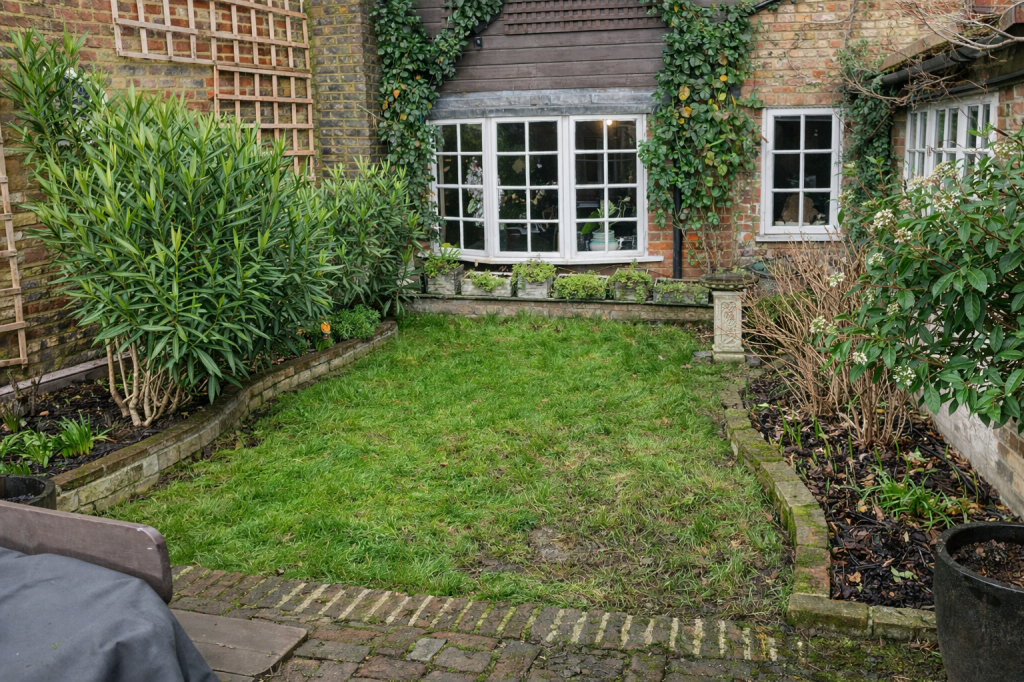
| The photograph above shows a small lawn laid in October last year. By November, it had settled well and looked promising. Then winter arrived properly. Persistent rain through December and January — with little chance for the ground to dry — left the soil saturated. Now, in February, the effects are becoming visible. The lawn feels soft underfoot, footprints linger, and the corners are beginning to thin where water sits longest. What looks at first like surface damage is, in reality, a soil that has taken on more water than it can release. |
| A quiet note on helping a lawn recover (after a winter like this) If a lawn has looked waterlogged or exhausted after a persistently wet winter, the most helpful response is often slower and lighter than instinct suggests. Once the ground begins to dry correctly, not just on the surface, gentle aeration can help reintroduce air into soil that has been saturated for weeks or months. This isn’t about punching holes for the sake of it, but about allowing oxygen back into places where roots have been holding on rather than growing. Foot traffic matters more than people realise. Lawns recover best when they’re spared repeated compression during wet periods, even if that means temporarily changing how a garden is used. Grass blades may look resilient, but the soil beneath remembers every step. It can also help to resist the urge to “green things up” too quickly. Feeding grass before roots have recovered often rewards surface growth at the expense of long-term health. In many cases, colour returns on its own once drainage and soil structure begin to improve. Where water has clearly lingered — especially on newer lawns — light topdressing later in the season can help soften compacted surfaces and encourage better airflow and moisture movement. This works best as a gradual correction rather than a single dramatic intervention. Most importantly, recovery tends to start below ground. When roots can breathe again, the rest usually follows — quietly, and without much instruction. |
| About our writing & imagery Most articles reflect our real gardening experience and reflection. Some use AI in drafting or research, but never for voice or authority. Featured images may show our photos, original AI-generated visuals, or, where stated, credited images shared by others. All content is shaped and edited by Earthly Comforts, expressing our own views. |
 Earthly Comforts