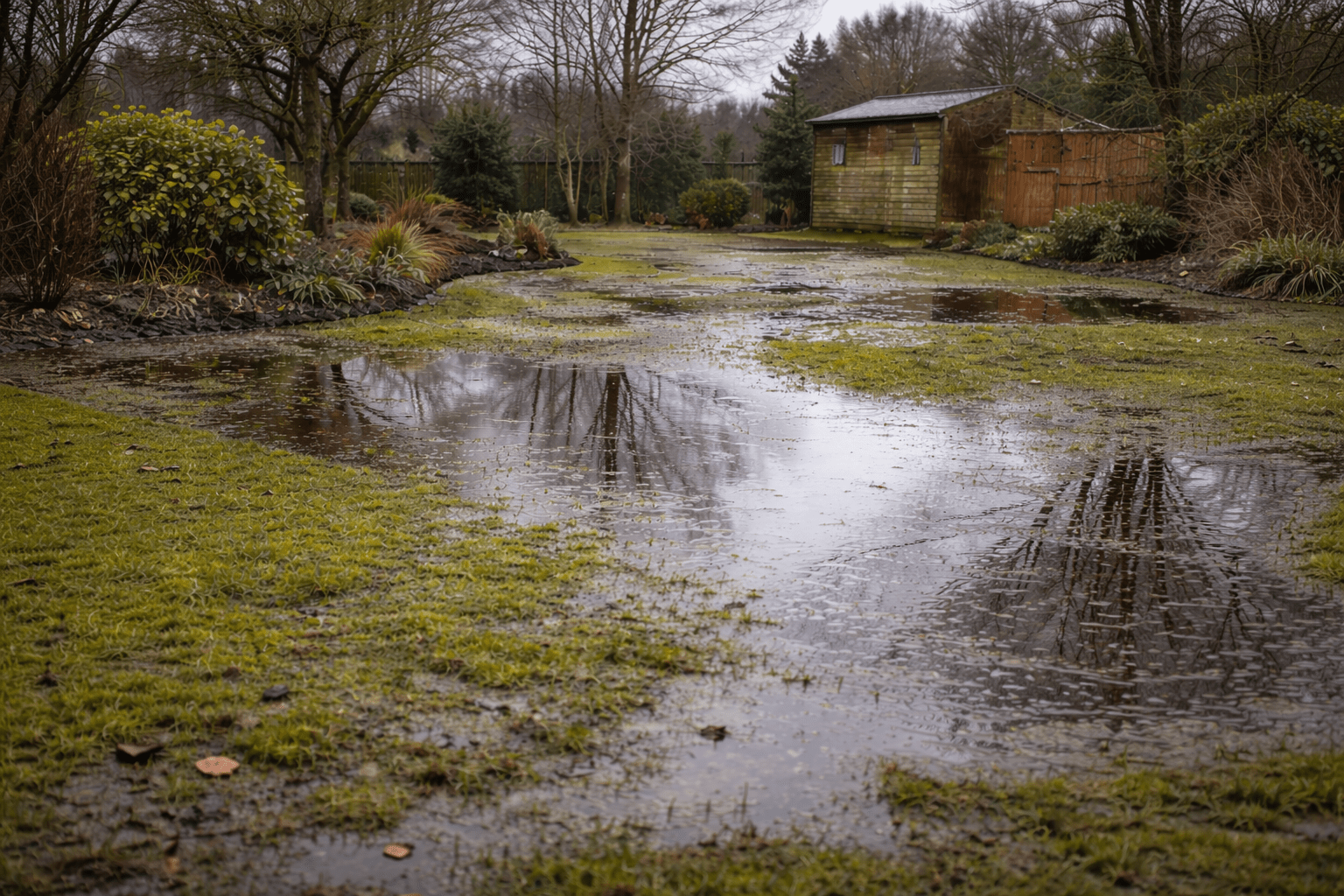
| This piece has been taking shape for a while — not at a desk, but underfoot. Each winter, the same questions come up. They’re rarely asked in quite the same way, but they always circle the same concerns. Why has the lawn suddenly gone off? Why is the ground holding water when it never used to? Why does everything look fine on paper, yet feel wrong once you step outside? Quite often, the question comes with an apology. As if the garden has done something wrong. Or as if the problem must be a mistake — something that shouldn’t really be happening. What I’ve noticed over time is that the answers people are given don’t always match what they’re seeing. Explanations tend to jump straight to fixes: drainage, new turf, a change of product, a comment about the weather. Sometimes those things matter. Often, they don’t tell the whole story. What’s usually missing is a slower, more grounded look at what’s going on below the surface — the sort of patterns that show up again and again in real gardens, not just in theory. This post exists because the same issue keeps appearing in different places, just wearing different faces. A new lawn that never quite settles. A garden that feels heavy all winter. Grass that thins no matter how carefully it’s looked after. These aren’t one-off failures. They’re what happens when water, soil, and time meet clay — especially in UK gardens. It also exists because people often feel that if they’d just done more, spent more, or acted sooner, things would have turned out differently. Sometimes that’s true. Quite often it isn’t. Sometimes the most helpful thing isn’t another solution, but a more straightforward explanation. This isn’t a post that promises a quick fix. It’s here to describe something clearly enough that it can be recognised and worked with — season by season — rather than battled or misunderstood. And if it reads more like noticing than instructing, that’s deliberate. The ground has been doing what it does for a long time. Paying attention to it is usually a better place to start than trying to hurry it along. |
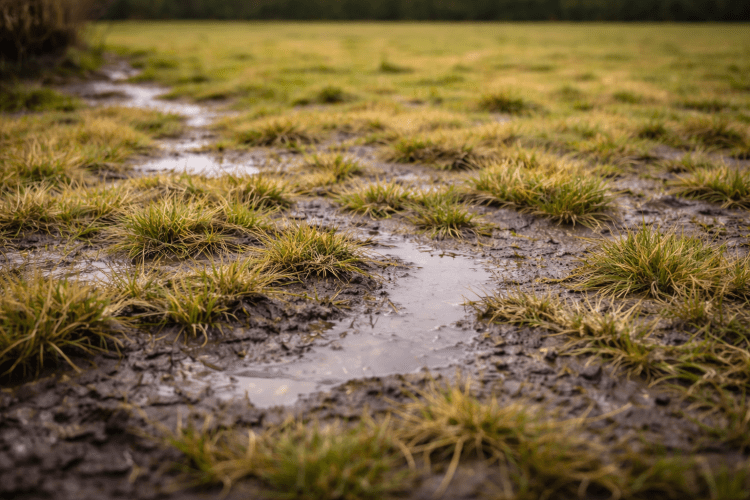
| A gardener’s essay on water tables, clay, and why lawns quietly give up |
| There is a particular look a garden takes on in late winter that most people recognise without quite naming. The lawn loses its spring. Footprints linger longer than they should. Somewhere between rain showers, water appears where it was not invited and refuses to leave. The ground seems tired, swollen, and oddly unresponsive, as if it has reached its limit for taking in anything else. Clients often describe it as flooding, but that word is usually doing too much work. What they are really noticing is a behaviour change: soil that once absorbed now resists; grass that once recovered now sulks; a garden that feels heavy underfoot even when there is no visible standing water. This is not a surface problem in the usual sense. It is a conversation between layers, happening quietly below. As working gardeners, we spend a lot of time thinking vertically rather than horizontally. Not just what is planted where, but what sits beneath what. The trouble with lawns on clay, mainly newly laid ones, is rarely about rainfall alone. Rain is simply the final nudge. The real story is already unfolding underground. This is where the idea of the water table and what gardeners loosely call the clay table becomes useful—not as textbook concepts, but as lived realities that shape what succeeds and what fails in a garden. |
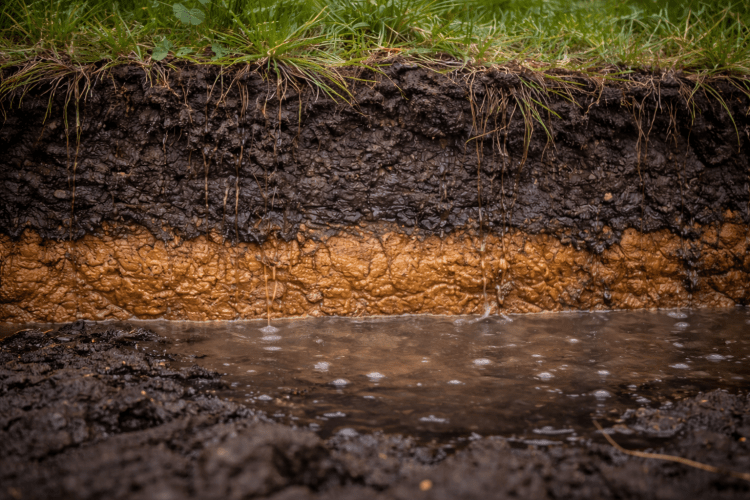
| The water table: the slow presence beneath us The water table is not dramatic. It does not arrive with noise or spectacle. Most of the time, it goes unnoticed entirely. It is simply the level underground at which soil stops being a mix of air and water and becomes fully saturated. Below this line, every pore is filled. Above it, there is at least the possibility of breathing space. In much of the UK, the water table rises and falls with the seasons rather than individual weather events. A single storm does not usually move it very much. Weeks of rain do. Long, damp winters do. So do landscapes with poor outfall, heavy soils, or a history of drainage disruption. What matters for gardens is not the precise depth of the water table, but its relationship to the layers above it. In a free-draining soil, the water table can rise and fall without much drama. Water moves down through sand or loam relatively easily, and plant roots rarely encounter prolonged saturation unless the water table comes very close to the surface. In clay-based landscapes, the story changes. Clay does not transmit water easily. Its structure slows everything down. When groundwater rises beneath a clay layer, it meets resistance. It presses upward, but progress is slow. The clay becomes saturated from below, even if the surface still looks passable. This is the first half of the problem, and it often goes unnoticed because nothing visible has happened yet. The clay layer: not a table, but a lid Gardeners talk about a “clay table” because it behaves like a flat surface on which water sits, even though it is rarely neat or level in reality. What we are really describing is a dense, impermeable, or semi-impermeable clay layer that impedes water movement. Clay is not bad soil. That is a myth worth challenging early. Clay holds nutrients well, supports long-term fertility, and can grow exceptional plants once its structure is respected. The problem is not clay itself, but clay under pressure—wet, compacted, and asked to perform like something it is not. When water reaches clay from above, drainage slows dramatically. When water rises from below, it slows again. The clay layer becomes a meeting point, a bottleneck where water accumulates. In hydrological terms, this creates a perched water table: water that is not part of the deeper groundwater system but is temporarily held above a restrictive layer. In gardens, this perched water can sit exactly where the grass roots want to live. This is why lawns on clay often fail not during rain, but after it. The rain stops, the sky clears, and yet the ground remains saturated. The problem is no longer what is falling, but what cannot leave. When water comes from below and above The situation described—the clay layer saturated from below by a rising water table, then overwhelmed from above by heavy rainfall—is not only accurate but also one of the most common causes of winter lawn failure in the UK. It works like this. During a wet winter, the water table rises gradually. This is not something most gardeners can see, but the clay layer begins to take on water from beneath. Its pores fill. It becomes heavier, colder, and less responsive. Then a period of heavy rain arrives. Surface water drains down through the topsoil until it reaches the clay. At that point, movement slows or stops. The clay is already full. There is nowhere for the water to go. The soil above the clay becomes saturated. Oxygen is displaced. Roots suffocate. Foot traffic further compacts the softened structure. What was once a resilient system becomes fragile almost overnight. This is why lawns can appear to “drown” even on flat ground, even with no obvious drainage problem, and even if they were laid correctly. The failure is not at the surface. It is a consequence of two pressures meeting in the same place. Why do new lawns struggle first? New lawns are often the first casualties in this situation, and not because turf is inherently weak. It is because new lawns live entirely in the most vulnerable layer of the soil profile. Fresh turf has shallow roots. It relies on the upper soil layers for oxygen, anchorage, and moisture regulation. When those layers become saturated for extended periods, the turf has no deeper system to fall back on. There is also a subtle compaction issue. Preparing ground for turf often involves levelling, raking, and walking repeatedly over the soil. Even careful preparation compresses clay slightly. Once waterlogged, that compression becomes more pronounced. Pore spaces collapse. Drainage slows further. This leads to a common misunderstanding: that the lawn failed because it was poorly laid. Sometimes that is true. Often, it is not. The lawn failed because it was introduced into a system that could not yet support it under winter conditions. Older lawns, with deeper root systems and established soil biology, can sometimes ride out the same conditions with less visible damage. Sometimes. Not always. What waterlogging really does to soil. Waterlogged soil is not simply wet soil. It is a fundamentally different environment. In saturated conditions, oxygen levels drop sharply. Beneficial aerobic organisms struggle. Anaerobic processes take over—nutrient availability shifts. Root respiration slows or stops. Grass roots, in particular, are intolerant of prolonged anoxia. They do not die immediately. They weaken. They rot from the tips. They lose their ability to recover from wear. The lawn thins, yellows, and opens up. This is where moss comes into play, often unfairly blamed. Moss is not the cause of lawn failure. It is a symptom. It arrives because the conditions favour it: moisture, low competition, compacted ground, and poor aeration. Removing moss without addressing the underlying saturation is like repainting a wall without fixing the damp. A quiet myth worth questioning One of the most persistent assumptions in gardening is that more drainage is always the answer. Dig a trench. Add gravel. Install a pipe. Problem solved. Sometimes, drainage works beautifully. Where there is a clear outfall, a permeable subsoil, and a defined pathway for water to leave the site, drainage can transform a garden. But in heavy clay landscapes with high seasonal water tables, drainage has limits. You cannot drain water somewhere lower if there is nowhere lower for it to go. Pipes laid into saturated clay often fill and stop functioning. Gravel trenches can become underground ponds. This does not mean intervention is pointless. It means intervention must be honest about context. Managing water on clay is often about slowing, spreading, and accommodating it rather than trying to banish it entirely. What observation teaches, over time After enough winters working on the same ground, patterns emerge. Certain areas always struggle first. Slight dips that look insignificant in summer become saturated zones in winter. Lawns near boundaries, old hedgerows, or former field edges behave differently from those in open centres. You also notice that some failures are mercifully temporary. A lawn that looks lost in February may recover surprisingly well by late April if roots survive long enough. Others never quite come back, not because the grass is wrong, but because the system beneath it remains unchanged. The most helpful lesson is patience. Not passive acceptance, but seasonal patience. Clay does not respond well to being rushed, and working it when wet causes damage that lasts far longer than the inconvenience of waiting. Living with clay, rather than against it The longer I garden on clay, the less interested I become in forcing it to behave like something else. Clay rewards a different approach: lighter foot traffic in winter, organic matter added gradually rather than dug in aggressively, and an acceptance that some surfaces will always be softer in certain months. Lawns on clay can work, but they ask for compromise. So do gardens that try to do too much too early in the year. There is a rhythm to heavy ground that does not align neatly with calendars or the expectations of lighter soils. Understanding the relationship between the water table and the clay layer does not make the problem disappear, but it does remove the sense of mystery. It turns frustration into context. It allows decisions to be made with the grain of the ground rather than against it. And perhaps that is the quiet value of paying attention below the surface: not to control everything, but to work with what is already there, rising and falling in its own time. A final reflection When a lawn fails in winter, it is tempting to see it as a mistake or a setback. Often, it is simply a message. The ground is telling you where its limits are, at least for now. Water does not misbehave. It follows gravity, resistance, and opportunity. Clay does not conspire. It holds, releases, and resists according to its nature. When those forces meet under prolonged pressure, the surface tells the story. If we listen carefully enough, it usually tells us what needs to change—not urgently, not dramatically, but steadily, over time. |
| About our writing & imagery Most articles reflect our real gardening experience and reflection. Some use AI in drafting or research, but never for voice or authority. Featured images may show our photos, original AI-generated visuals, or, where stated, credited images shared by others. All content is shaped and edited by Earthly Comforts, expressing our own views. |
 Earthly Comforts