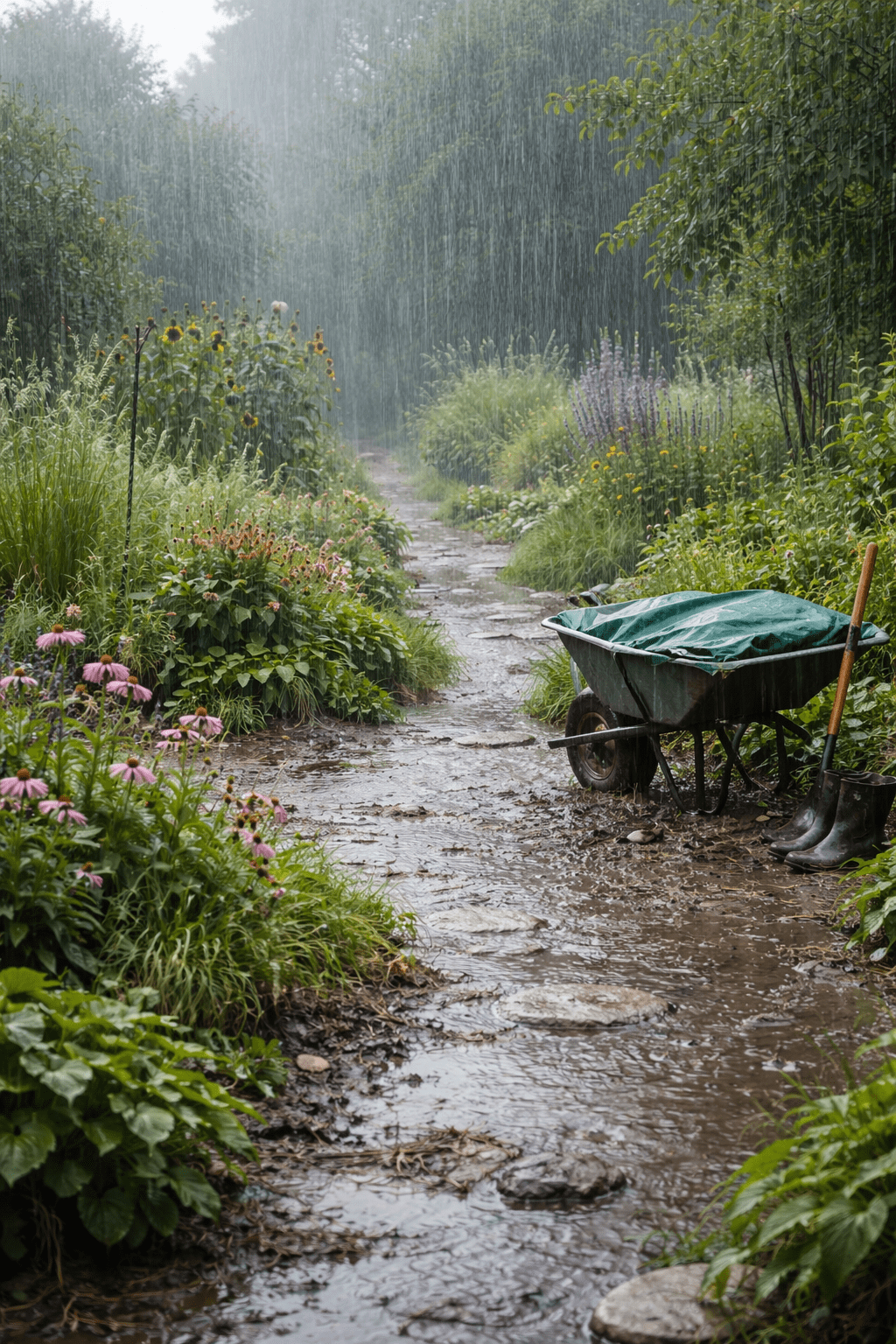
| Do you work in heavy rain or extreme weather? |
| It’s one of the questions we’re asked most often, usually with a half-apology attached. The weather has turned, the forecast looks grim, and the garden—already damp, already leaning into winter or buckling under summer heat—feels like a problem that might be better postponed. The assumption behind the question is familiar: that a gardener either works regardless, battling the elements with stubborn resolve, or doesn’t work at all, retreating indoors until conditions improve. The truth sits somewhere quieter and more complicated than that. We do work in most weather conditions. But never at the expense of soil health, plant welfare, or safety. And that caveat matters more than the yes-or-no that usually frames the question. Gardening, after all, isn’t performed on a stage. In living systems, we remember what we do to them long after the rain has stopped or the heatwave has passed. The ground keeps score. Rain isn’t the problem. Pressure is. There’s a popular image of British gardening that involves stoicism in drizzle: waxed jackets, muddy boots, the romance of it all. Rain itself isn’t the enemy. In many ways, it’s the quiet engine of the whole thing. Soil life wakes up with moisture. Roots extend. Lawns recover their colour. Beds soften and become workable in a way they aren’t in drought. The trouble begins when rain becomes relentless, when the ground no longer has time to breathe between downpours. That’s when weight and timing matter more than effort. Walking repeatedly over saturated soil compresses it, squeezing out the air pockets that roots and microbes rely on. It doesn’t look dramatic at the time. There’s no immediate failure. But weeks later, growth stalls, drainage worsens, and plants behave as if something invisible is holding them back. This is one of the hardest things to explain to clients, because the damage isn’t apparent in the moment. It doesn’t announce itself. But once you’ve seen it enough times—beds that never quite recover, lawns that thin inexplicably—you start to treat wet ground with a kind of caution usually reserved for cracked ice. So yes, we may still come in wet weather. But what we do, how long we stay in one area, and where we step all change. Some tasks pause not because they’re impossible, but because they’d cost more later than they’d achieve now. The myth of “getting it done while it’s quiet” There’s a persistent idea that bad weather is the perfect time to push through big jobs. Fewer interruptions. Fewer distractions. A sense of making progress while others wait it out. In practice, this often leads to work that looks productive but quietly undermines itself. Heavy pruning in prolonged wet spells, for example, can increase the risk of disease entering through fresh cuts. Soil that is waterlogged rarely settles well. Lawn work done under pressure—literally and figuratively—can set back recovery by months. The temptation comes from treating gardens as static spaces, as if time passes at the same rate whether we intervene or not. But gardens aren’t clocks. They respond to conditions, not schedules. Sometimes the most skilful decision is to do less, or to shift focus sideways rather than forward. That can feel counterintuitive, especially in a culture that prizes visible effort. But restraint is part of good gardening. Knowing when not to interfere is as learned a skill as knowing how to sharpen a blade. Heat changes everything, especially the gardener. Extreme heat brings its own set of illusions. Dry soil looks manageable. Plants appear intact—until suddenly they aren’t. Growth slows before it stops. Stress accumulates quietly. In hot periods, our working day often shifts. Earlier starts, longer pauses, shorter stints in exposed areas. Not because we’re precious about comfort, but because tired gardeners make poor decisions. They over-prune. They tread where they shouldn’t. They miss signs of stress in plants because everything looks equally tired. There’s also the issue of water. Watering during heat can help, harm, or evaporate into futility depending on timing and method. Working soil in high heat exposes moisture that the ground can’t afford to lose. Even routine maintenance can become extractive rather than supportive if done at the wrong moment. One of the stranger assumptions is that gardeners are somehow immune to weather because we’re used to being outside. In reality, familiarity breeds attentiveness, not invincibility. We feel the limits sooner because we’ve crossed them before. Safety is not a side issue. Slippery slopes, unstable ladders, tired bodies, overheating, reduced concentration—extreme weather magnifies risks that are already present. Gardening involves sharp tools, moving machinery, and uneven ground. Pretending otherwise doesn’t make the work nobler; it just makes injuries more likely. This isn’t about wrapping everything in rules. It’s about acknowledging that a garden doesn’t benefit from a gardener being injured halfway through a job. Nor does a client benefit from work rushed under conditions that encourage mistakes. There’s a quiet professionalism in knowing when to stop. Not dramatically. Just decisively. What changes, rather than stopping altogether In prolonged wet or extreme conditions, we rarely disappear completely. Instead, the work reshapes itself. Focus shifts to tasks that are lighter on the ground, or to areas that drain better. Observation becomes part of the job: noticing where water sits, how plants respond, which areas struggle first and which cope without fuss. Those observations feed future decisions. They inform planting choices, soil improvements, and long-term maintenance plans. In that sense, brutal weather is not lost time. It’s information, if you’re willing to read it. This is where project gardens differ from weekly maintenance. Projects allow for adaptation—pauses, sequencing, changes in emphasis. They ask for judgment rather than repetition. And judgment is only sharpened by paying attention to conditions rather than overriding them. A garden is not an emergency. Perhaps the most difficult assumption to gently challenge is the idea that gardens need immediate action simply because something looks untidy or stalled. Most gardens have far more resilience than we give them credit for. They’ve survived years of neglect, sudden freezes, droughts, and storms without collapsing entirely. Urgency often comes from human discomfort rather than horticultural need. We want things resolved, neat, finished. Weather doesn’t share that preference. Learning to work with the weather rather than against it means accepting that some progress is seasonal, some cyclical, and some deferred. That isn’t failure. It’s alignment. Working with limits, not pretending they aren’t there Every choice in gardening involves trade-offs. Work now and risk compaction, or wait and risk delay. Cut back before a storm or let plants ride it out. Push through the heat or pause and return fresher. There are no universal answers, only contextual ones. What experience offers isn’t certainty, but calibration. A sense of what this garden, on this soil, in this weather, can tolerate. That sense doesn’t come from manuals or forecasts alone. It comes from watching outcomes over the years, and remembering when impatience cost more than it gained. We work in most weather. But we don’t work unthinkingly. And we don’t confuse presence with progress. If there’s a philosophy running through it all, it’s this: gardens are long conversations, not urgent instructions. Weather is part of that conversation, not an obstacle to shout over. When we listen properly, it tells us not just when to act—but how, and when to wait. |
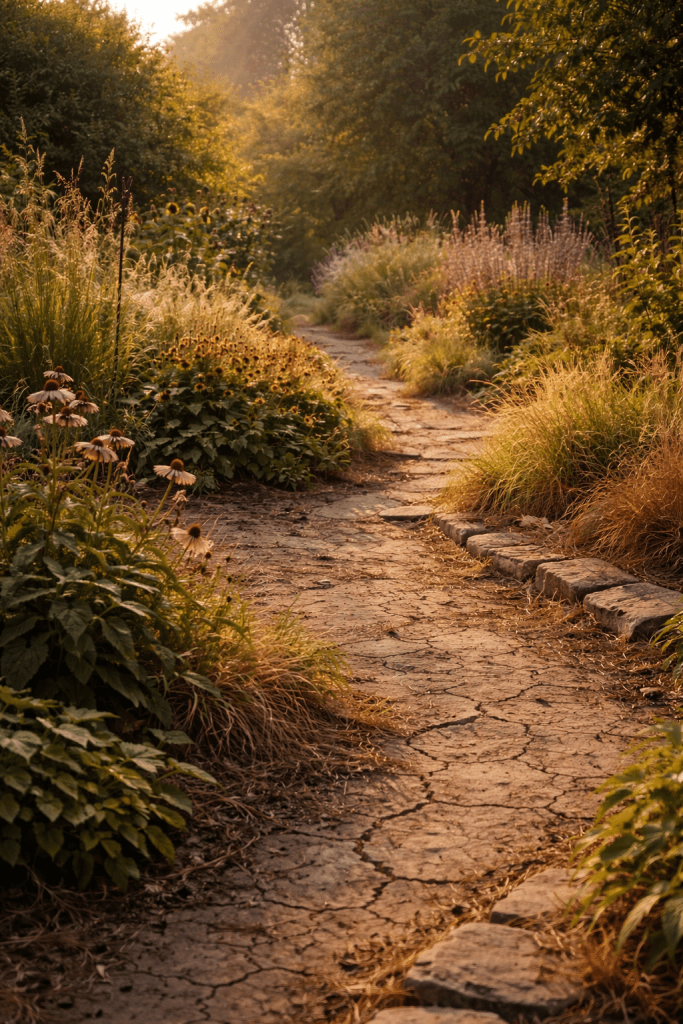
| Do you work in extreme heat? |
| Heat asks a different kind of question than rain. Rain challenges the ground. Heat challenges judgment. When temperatures rise sharply, gardens don’t fail all at once. They hesitate. Growth slows. Leaves dull before they scorch. Soil holds on for a while, then suddenly lets go. From the outside, it can look deceptively manageable, especially to anyone used to thinking of summer as the productive season: long days, dry ground, predictable conditions. But extreme heat quietly rewrites the rules, often after the point at which most people think the danger has passed. We do work in extreme heat. But we do it differently, and sometimes far less than expected. Not because gardens can’t tolerate heat, but because the way we intervene during it has consequences that don’t show up until much later. Heat doesn’t announce itself as a limit. One of the difficulties with heat is that it rarely feels like a clear stopping point. There’s no sudden saturation, no apparent collapse underfoot. You can walk on dry soil. You can lift tools easily. You can keep going. That’s where mistakes begin. Dry soil often appears structurally sound, but under prolonged heat, it becomes brittle rather than resilient. Surface disturbance exposes the moisture on which the plant relies. Repeated foot traffic fractures the fine soil structure that took months to build. Plants may not wilt immediately, but they still register stress. The effects stack rather than explode. Heat also alters perception. Tasks feel quicker, so we underestimate how much we’re doing. Fatigue creeps in without ceremony. Decisions become slightly less careful, then noticeably less precise. Gardening relies on attentiveness more than force, and heat erodes attentiveness first. Time of day becomes a tool. In extreme heat, the clock matters more than the task list. Early starts are not about bravado or efficiency; they’re about working when the garden is least exposed to the sun. Morning air is heavier, cooler, and more forgiving. Plants are hydrated from overnight recovery. Soil is at its most cooperative without being fragile. By late morning, the balance shifts. Even if the temperature hasn’t peaked, the ground begins to lose moisture rapidly. Leaves turn to face the sun or away from it. What looked robust at eight o’clock can look brittle by eleven. Finishing earlier isn’t a concession. It’s an acknowledgement that gardens, like people, have thresholds. Pushing past them rarely achieves more; it simply costs more later. In some cases, we return in the evening for light observation or watering checks, but the core work is already done—or deliberately deferred. Not all work is equal under heat. There’s a temptation to “make use of the good weather” by tackling bigger jobs during hot spells. In reality, heat makes some types of work disproportionately expensive in biological terms. Pruning exposes tissue that struggles to recover under thermal stress. Soil improvement work can undo itself within hours if moisture is lost too quickly. Lawn intervention during extreme heat often creates vulnerability rather than resilience, even if it looks tidy at first glance. By contrast, some forms of work benefit from restraint rather than action. Leaving mulch intact. Observing rather than correcting. Allowing plants to adapt rather than forcing them into shape. Heat is not a moment for refinement; it’s a moment for protection. This runs counter to the idea that summer is the season for progress. In reality, extreme heat turns summer into a holding pattern. The garden’s priority shifts from growth to survival, and good gardening follows that lead. Water is not a simple solution. The most persistent assumption around heat is that water solves it. Water helps, certainly, but timing, depth, and method matter far more than volume. Surface watering during heat often benefits evaporation more than roots. Frequent light watering trains plants to rely on shallow moisture that disappears first. Deep watering, done less often and at the right time of day, supports resilience—but even that has limits when temperatures remain high overnight. Working a garden while relying on water to compensate for disturbance is a losing equation. Each intervention increases demand at the very moment supply is most fragile. That’s why heat often asks gardeners to step back rather than step in. The aim becomes conservation, not correction. The gardener’s body is part of the system. There’s an unspoken culture in outdoor work that treats physical strain as proof of commitment. Heat quickly exposes the flaws in that thinking. Dehydration dulls awareness before it causes collapse. Overheating shortens patience. Even minor lapses—misjudged cuts, uneven footing, forgotten steps—become more likely. Gardens don’t benefit from exhausted caretakers, and neither do the people doing the work. Adjusting hours, reducing scope, and allowing pauses isn’t indulgence. It’s part of working responsibly within a living system that includes the gardener. Letting the garden speak for itself. Extreme heat is revealing, if you allow it to be. It shows which plants cope without intervention, which areas hold moisture longest, and which soils release it too quickly. It highlights structural weaknesses that no amount of routine care can disguise. These are not failures. They’re data. Project gardens, in particular, benefit from heat-driven observation. Choices made in cooler seasons often look different when tested under stress. Heat clarifies priorities. It tells you where to simplify, where to shade, and where to stop asking the ground to be something it isn’t. Responding well to heat doesn’t mean constant action. It means listening closely enough to know when patience is the correct response. Working with heat, not proving endurance Gardens are not impressed by effort. They respond to timing, sensitivity, and restraint. Extreme heat strips away the illusion that more work automatically means better outcomes. We do work in hot weather. But we don’t chase productivity at the expense of recovery, for the garden or ourselves. Sometimes the most skilled decision is to start earlier, finish sooner, and leave the space to manage its own equilibrium. Heat reminds us that gardening is not about control. It’s about cooperation, especially when conditions are testing. And cooperation begins by accepting that not every day is meant for progress. Some days are meant for holding steady, watching carefully, and returning when the balance has shifted again. |
| About our writing & imagery Most articles reflect our real gardening experience and reflection. Some use AI in drafting or research, but never for voice or authority. Featured images may show our photos, original AI-generated visuals, or, where stated, credited images shared by others. All content is shaped and edited by Earthly Comforts, expressing our own views. |
 Earthly Comforts