| What Wet Weather Reveals About Garden Maintenance Part I |
| A short note on rain, work, and why this series was written This series began with a simple question. One of our gardeners asked why we don’t always work in the rain, not as a challenge — just an honest, practical question. Around the same time, clients began asking something similar: why we sometimes pause work during wet spells when other gardeners appear to carry on regardless. The short answer is that we don’t mind working in light rain. Much of our work takes place outdoors in a country where showers are part of the rhythm. But heavy rain and storm conditions change more than comfort. They change what the land will tolerate, what tools are asked to endure, and what kind of work can be done without leaving harm behind. Since December 2025, the UK has experienced unusually prolonged and intense rainfall. For working gardens, this has not meant a brief interruption followed by recovery, but extended saturation. Lawns have remained soft. Borders have stayed heavy. Access routes have failed to dry between visits. In those conditions, work does not simply slow down — it backs up, waiting for the ground to recover enough to be worked without damage. Gardening is not just about whether something can be done. It’s about whether it should be. Wet ground compacts. Saturated turf tears. Tools wear in ways that don’t show themselves until much later. What looks like determination in the moment can quietly become damage to the garden, the equipment, and the people doing the work. These essays are not an argument against working in the rain. They are an attempt to explain why weather matters, and why choosing when to work is as much a part of maintenance as turning up. Rain has a way of revealing the difference between care and force, and that difference is what this series is really about. |
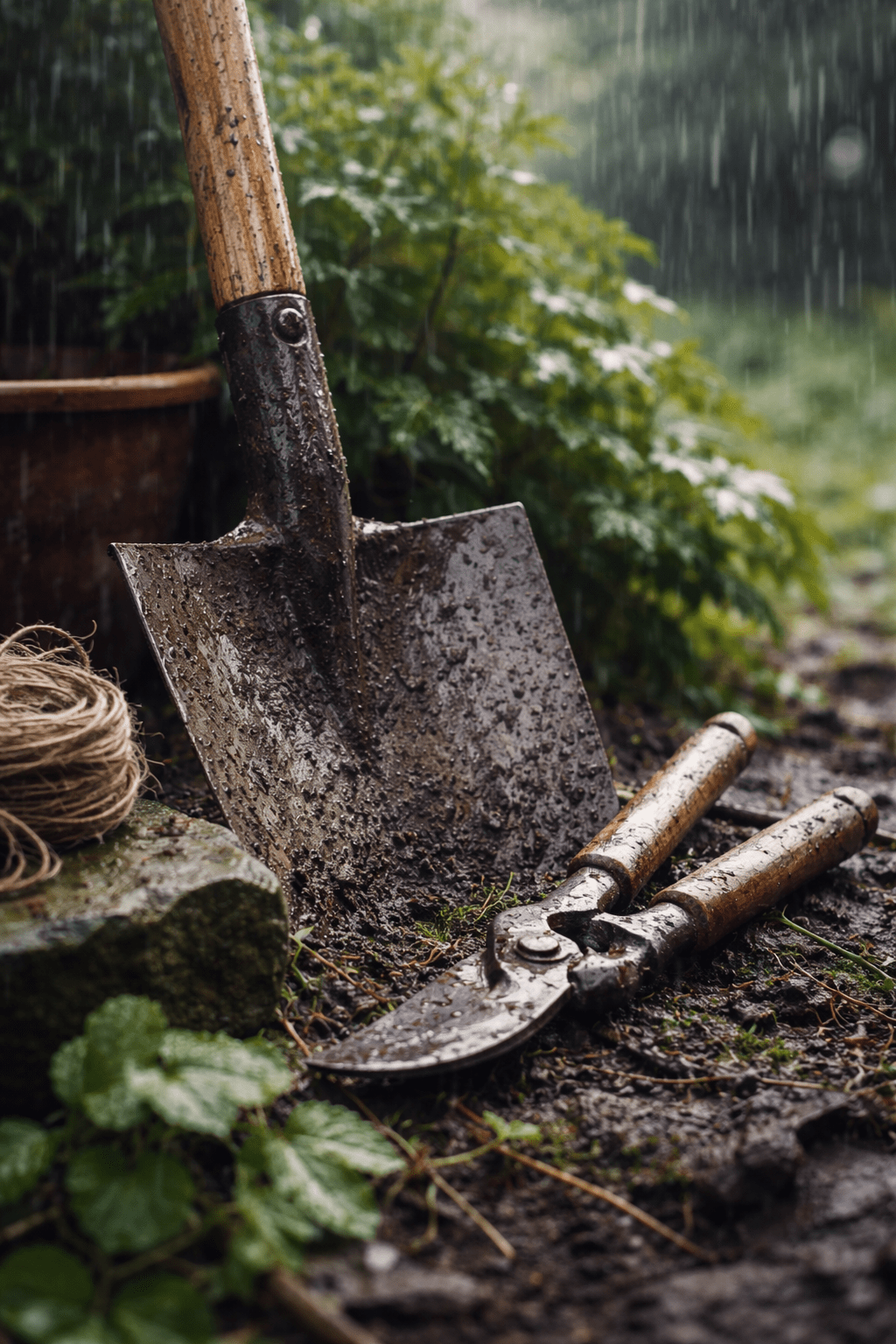
| Rain has a way of stripping things back. Not dramatically, not all at once, but steadily, until whatever remains is closer to the truth than the performance we maintain in dry weather. In a garden, rain removes the illusion of control. Edges soften. Lawns lose their crispness. Soil resists being shaped into neat compliance. Plants stop behaving like illustrations and start behaving like living things. For the gardener still working in those conditions, rain also removes another layer: the idea that effort alone is enough. Most conversations about gardening in the rain revolve around inconvenience. Wet clothes. Slippery paths. Jobs are taking longer than planned. But that framing misses something important. Rain is not just an obstacle to work. It is a condition that reveals how the work is being done in the first place. The garden does not become a different place when it rains. It becomes a more honest one. Wet ground, altered effort One of the first things rain exposes is how much of gardening relies on resistance. Dry soil gives way in predictable ways. Spades cut, forks lift, edges hold. When the ground is wet, that resistance changes—soil clings rather than parts. Clay drags—loam sticks. Even lighter soils develop a suction that wasn’t there the day before. The gardener responds instinctively. Pressure increases. Movements become larger, more forceful. The body leans in where technique might usually suffice. None of this feels careless in the moment. It feels necessary. But over time, this shift matters. Tools are asked to do different work. Shafts flex more. Blades twist slightly under load. Edges are forced through the material rather than guided along it. What rain introduces is not difficulty so much as amplification. Any existing habit becomes more pronounced. A gardener who works with patience notices this and adjusts. One who works by momentum often does not. The illusion of “pushing through” There is a quiet pride attached to working in bad weather, particularly in professional gardening. Turning up regardless and getting the job done, and not letting conditions dictate terms. It’s an understandable instinct, and sometimes a necessary one. Gardens do not pause their growth for rain. But rain has a way of revealing when “pushing through” is no longer professionalism and has become more like stubbornness. Specific tasks change character when the ground is wet. Pruning in drizzle can be fine; structural soil work rarely is. Mowing saturated turf may look productive, but it often trades short-term neatness for long-term damage. The problem is not that gardeners work in the rain. The problem is that rain blurs the line between what can be done and what should be done. Maintenance, at its best, is a conversation with the garden. Rain changes the language of that conversation. Those who continue speaking in the same tone often misunderstand the reply. Tools as witnesses Tools remember rain even when gardeners forget it. A spade used repeatedly in wet ground ages differently from one used primarily in dry conditions. Not just because of rust, but because of stress. Soil packed against the blade creates leverage where none was intended. Wet grit works its way into joints. Wooden handles swell and shrink by imperceptible degrees until the fit is no longer quite proper. Cutting tools tell a similar story. Rain carries sap into the pivots. It dulls feedback. The clean sound of a cut becomes muted, encouraging more brutal squeezes. Edges lose their keenness not in one dramatic moment, but through hundreds of slightly compromised cuts. None of this announces itself. There is no clear failure point. Instead, tools become subtly less precise. The gardener compensates without realising. Grip tightens. Movements become heavier. Fatigue arrives earlier in the day. In this way, rain exposes not just how tools are made, but how attentively they are used. Maintenance beyond cleaning There is a tendency to treat tool care as a separate activity, something done at the end of the day or the end of the week. Rain challenges that separation. It demands attention in real time. A blade wiped briefly before being put away wet will age differently from one left caked in soil. A tool leaned upright to drain will fare better than one sealed into a box. These are not grand acts of maintenance. They are moments of noticing. What rain teaches, if allowed, is that maintenance is not an occasional ritual. It is an ongoing relationship. Tools respond to being acknowledged. They suffer when treated as anonymous extensions of effort. This is not sentimentality. It is a practical observation. Gardeners who work year-round in wet climates either learn this or replace tools far more often than they need to. The garden’s refusal The most crucial lesson rain offers is refusal. Certain things do not cooperate when conditions are wrong. Soil smears instead of crumbling. Turf tears rather than lifts. Plants bruise rather than bend. These refusals are often subtle but consistent. The garden is saying, quite clearly, that this is not the moment. Professional maintenance does not mean ignoring that message. It means recognising it and adjusting accordingly. Sometimes adjustment means doing a different task. Sometimes it means stopping altogether. Neither option is exceptionally comfortable in a culture that prizes output and reliability. But over time, gardeners who listen to these signals tend to produce better results with less strain—both on themselves and on the gardens they care for. Rain makes it harder to pretend otherwise. Wear, neglect, and honest ageing. There is an essential distinction between wear from use and damage from neglect. Rain makes this distinction visible. A tool that shows even wear, a softened edge, a handle darkened by years of contact, carries a sense of continuity. It has been used with awareness. A tool that rusts deeply in awkward places, seizes unexpectedly, or fails suddenly often tells a different story. It has been ignored between moments of effort. Rain accelerates both outcomes. It does not discriminate. It simply shortens the time between cause and effect. Gardeners who work primarily in dry conditions can afford a certain amount of inattention. Those who work through wet seasons cannot. Rain insists on consequences. What rain teaches about pace The quietest lesson rain offers is about pace. Everything slows down. Movements require more thought. Surfaces demand caution. Mistakes cost more to correct. This slowing is often framed as inefficiency, but it can also be read as information. The garden is setting the tempo. When gardeners match it, work tends to become cleaner, lighter, and more considered. When they resist it, effort increases while results often decline. Maintenance is not just about keeping things tidy. It is about sustaining a relationship over time. Pace matters. Rain makes that unavoidable. Not an enemy, but a measure It is tempting to talk about rain as something to be managed, mitigated, or endured. But seen differently, rain functions as a measure. It reveals the strength of systems, the suitability of tools, and the quality of judgement. In dry weather, many things work. In the rain, only those that are correctly aligned continue to do so gracefully. The garden does not punish the gardener for working in the rain. It simply removes the margins for error. Tools respond in the same way. What remains is a clearer picture of how maintenance is really being approached. Rain, then, is not the problem. It is the condition that tells the truth. |
| About our writing & imagery Most articles reflect our real gardening experience and reflection. Some use AI in drafting or research, but never for voice or authority. Featured images may show our photos, original AI-generated visuals, or, where stated, credited images shared by others. All content is shaped and edited by Earthly Comforts, expressing our own views. |
 Earthly Comforts