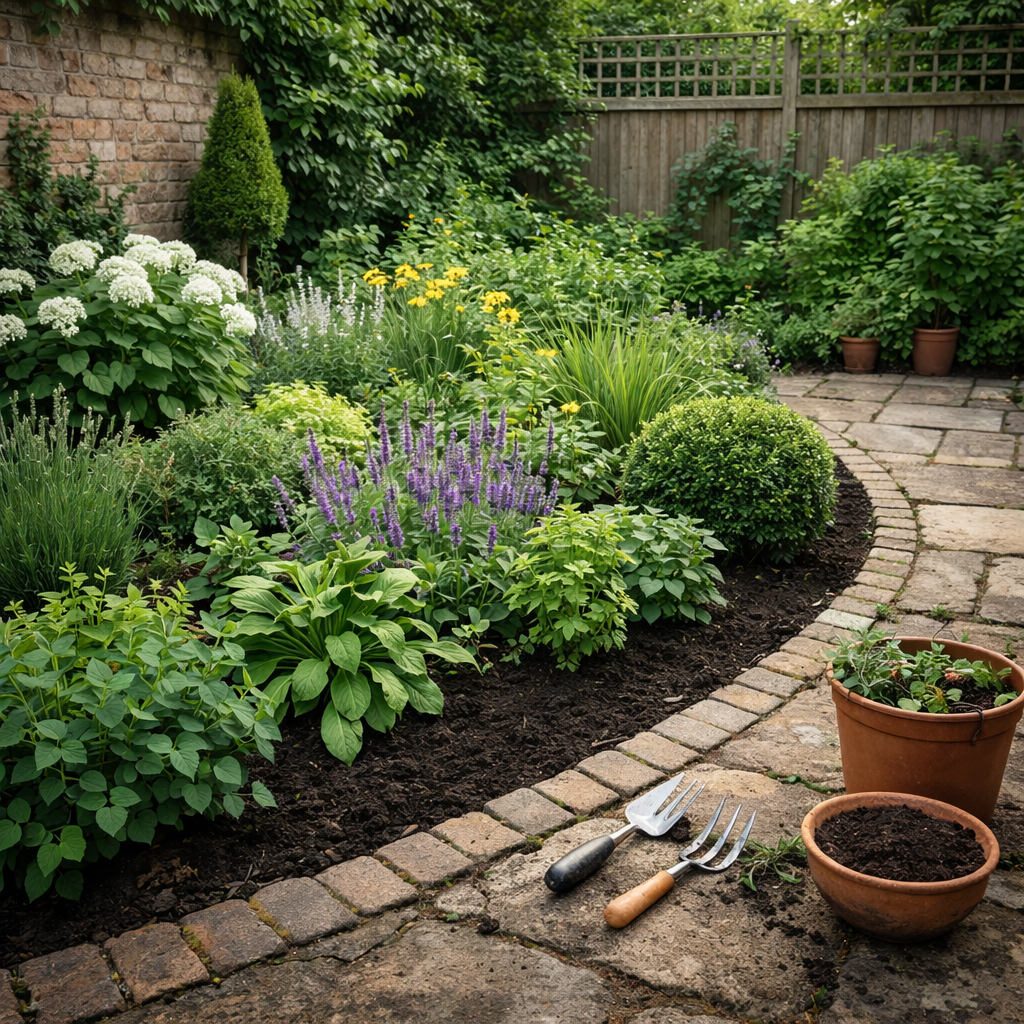
| Part 2 One Border, Treated Properly In small gardens, it’s very easy to scatter effort. A bit of weeding here. A plant moved there. A pot was added to “lift the corner.” None of it is wrong — but in a compact space, spreading attention thin often creates a garden that feels busy without ever feeling finished. One of the simplest ways to make a small garden feel settled is also one of the most overlooked: Pick one border and treat it properly. Not as a makeover. Not as a weekend frenzy. Just as a steady act of respect — for the space, the plants, and the person who has to live with it. Why one border can change the whole garden A small garden doesn’t need every area to be impressive. It needs one area to feel right. When one border is healthy, coherent, and clearly cared for, it changes the tone of the whole space. It creates a visual anchor — something your eye can land on. It also sets a standard. Even if other areas are still in progress, the garden begins to feel intentional rather than neglected. One well-treated border often does more for a small garden than a dozen new plants dotted around the edges. “Treated properly” starts with the ground In compact spaces, the ground is often the real issue — especially in courtyards and town gardens where soil can be tired, compacted, shaded, or full of old rubble and roots from years of patchwork planting. Treating a border properly usually means beginning with basics that don’t look exciting, but make everything else easier: Clearing what’s genuinely underperforming Removing weeds at the root (not just tidying the top) Improving soil structure and moisture-holding ability Adding organic matter or mulch to protect and feed the soil This is the difference between a border that needs constant fussing and one that slowly starts to look after itself. Removing is often the first real improvement. Most small borders aren’t short of plants. They’re short of space. A border becomes calmer when it isn’t packed to the edges with half-working ideas. If everything is competing for light and air, nothing looks its best — and maintenance becomes a never-ending cycle of cutting back, rescuing, and rearranging. Treating one border properly often begins with a hard but helpful question: What’s here because it’s thriving — and what’s here because it’s simply been allowed to stay? Removing the right things does not make a border emptier. It makes it readable. And once it’s readable, it becomes manageable. Choose a simple planting “spine” A small border works best when it has a quiet backbone — a “spine” of plants that carry the shape across the season. This doesn’t need to be formal. It just needs to be consistent. A good spine might be: A small number of dependable shrubs Repeated clumps of the same perennial A limited palette of leaf shapes and colours Plants chosen for long life and good behaviour The point is not to impress. The point is to reduce decision-making, reduce visual noise, and give the border a stable identity. In small gardens, coherence is more powerful than variety. Space is not wasted — it’s functional. One of the biggest mistakes in small borders is treating every gap as a problem. Gaps are not failures. They are breathing room. They are access points for maintenance. They are the difference between a border that can be lightly maintained and a border that demands constant intervention. Spacing plants for how they will look in two years — not two weeks — is one of the most “grown-up” things you can do in a small garden. And it pays you back every season. A properly treated border reduces work everywhere else. This is the quiet benefit people don’t expect. When one border is well-structured and healthy: Weeds have fewer opportunities. Plants grow more predictably. The border requires fewer emergency interventions. The garden feels calmer, even if the rest is still evolving. It also builds confidence. Once you’ve created one area that truly works, you have a reference point. You can repeat the method elsewhere, slowly and without overwhelm. One border is enough to begin. Small gardens improve best through focus, not intensity. If you only do one thing in a season, treating one border properly is one of the most reliable choices you can make. It creates visible progress without creating chaos, and it establishes a rhythm that a small space can actually sustain. In the next post, I’ll move into the next layer of this: how to choose plant types that behave well in compact spaces — plants that earn their place rather than constantly demanding attention. Because a small garden done properly isn’t built by adding more. It’s built by choosing well and carrying it through. |
The Small Garden
 Earthly Comforts
Lovely post – I’m very interested and write a lot about growing edible gardens in small, urban spaces!
LikeLiked by 1 person
I love the idea of mini allotment gardens and am currently working on a project similar to this. I will pop by your blog 🙂
LikeLike