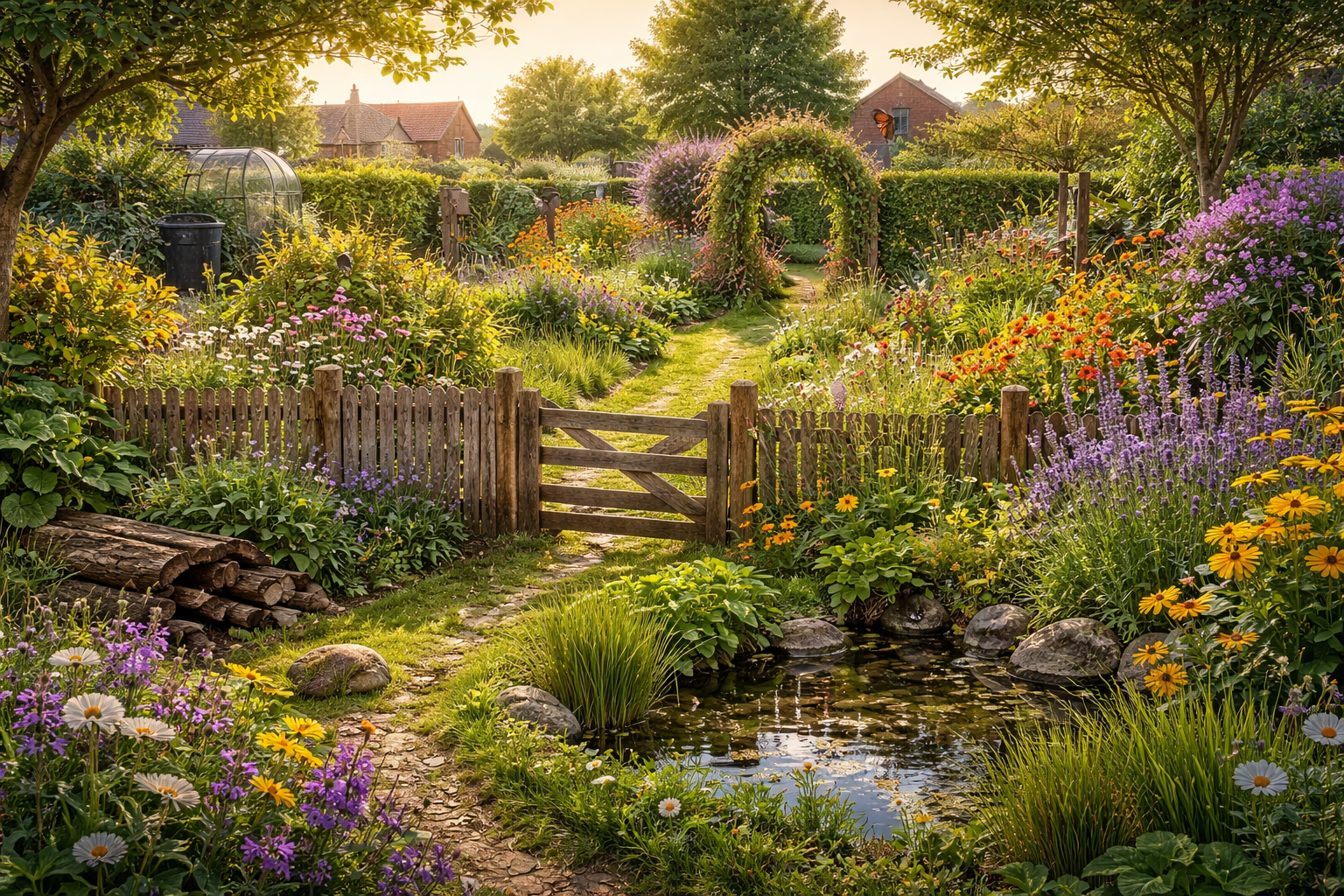
| Why connected gardens matter more than perfect ones Modern gardens are often treated as isolated spaces: a lawn here, a border there, fences tight to the ground, and everything neatly contained. Yet wildlife does not recognise boundaries, and many of the pressures facing nature today are made worse by fragmentation. Joining habitats in gardening is about reversing that fragmentation, one garden at a time, by allowing life to move, feed, shelter, and recover across connected spaces. Habitat joining does not require large land ownership, countryside access, or dramatic rewilding. It works just as powerfully in small town gardens, courtyards, and suburban plots. The goal is simple: create continuity. When gardens link habitats rather than interrupt them, they become stepping stones rather than dead ends. What does “joining habitats” actually mean? Joining habitats means designing and managing your garden so it connects ecologically with the surrounding spaces. This can be vertical, horizontal, seasonal, or underground. A hedgerow that continues across neighbouring gardens, a line of pollinator plants that flower in sequence, or soil that remains alive and undisturbed all form part of the same principle. A joined habitat allows species to move safely. It reduces the energy wildlife expends searching for food or shelter and increases the chances of breeding success. In practical terms, it turns many small gardens into a single large, functioning ecosystem. Why fragmentation is a hidden problem Fragmentation is one of the quietest threats to wildlife. A single garden might look green and healthy, yet if it is surrounded by hard fencing, artificial turf, or sterile planting, it becomes an island. Insects may arrive but fail to thrive. Birds may visit but not nest. Mammals may attempt to pass through, only to be blocked. When habitats are disconnected, populations weaken even when food is available. Movement is essential for genetic diversity, seasonal survival, and resilience to change. Gardening with connection in mind addresses this problem without sacrificing beauty or order. The power of small links One of the most important things to understand is that habitat joining works cumulatively. One gap under a fence may seem insignificant, but when repeated across a street, it becomes a wildlife corridor. One garden pond may attract life, but several ponds within walking or flying distance create a viable network. Gardens do not need to look wild to be ecologically useful. Even neat, traditional gardens can contribute when they share elements such as hedges, trees, flowering sequences, and soil life. Ground-level connections Some of the most critical habitat connections happen at ground level. Hedgehogs, amphibians, beetles, and slow-moving insects rely on uninterrupted access. Solid fencing, gravel boards, and paved edges often block these routes entirely. Simple changes make a difference. Leaving small access gaps beneath fences, reducing hard edging, and allowing leaf litter to remain in corners create movement paths. Log piles, compost heaps, and dense planting provide shelter nodes that link otherwise open areas. Above-ground and aerial joining Birds, bats, and pollinators rely on aerial pathways. Trees, shrubs, climbers, and tall perennials act as navigational guides and feeding stations. A line of flowering plants can be just as important as a hedge when it comes to pollinators crossing urban spaces. Planting in layers strengthens this effect. Groundcover supports insects, shrubs provide shelter and berries, and trees offer nesting and roosting opportunities. When neighbouring gardens follow similar layering patterns, the sky itself becomes a joined habitat. Seasonal continuity matters Habitats are not only joined in space but also in time. A garden that flowers heavily in summer but offers nothing in spring or autumn creates seasonal gaps. Wildlife needs reliable resources year-round. Joining habitats means thinking in sequences: early pollen, summer nectar, autumn fruit, winter shelter. When gardens collectively cover these cycles, species are less likely to disappear during lean periods. This is especially important in towns, where alternative food sources may be scarce. Soil as a shared ecosystem Soil is often overlooked in habitat discussions, yet it is one of the most interconnected systems of all. Healthy soil hosts fungi, microbes, worms, and insects that form the foundation of above-ground life. Excessive disturbance, chemical inputs, and compaction break these networks. Gardens that prioritise soil health contribute to wider underground continuity. Mulching, composting, and minimal digging allow fungal networks to extend beyond property lines. In effect, neighbouring gardens can share the same living soil system even if they look very different above ground. Water as a linking element Water joins habitats naturally. A small pond, rain garden, or damp planting area acts as a magnet for wildlife and connects dry spaces into a functioning whole. Even shallow water sources support insects that form the base of food chains. Where multiple gardens manage rainwater thoughtfully, runoff becomes a resource rather than a problem. Water slows, sinks, and spreads life rather than rushing away through drains. Social joining: gardening beyond the boundary Habitat joining works best when people talk to each other. Conversations with neighbours about shared hedges, fence gaps, or planting choices amplify individual efforts. This does not require formal coordination; it often begins with simple observation and quiet alignment. Community awareness turns private gardens into shared ecological infrastructure. Over time, streets and neighbourhoods develop their own living identities, shaped by the collective choices of those who tend them. A quieter form of impact Joining habitats is not about a dramatic transformation. It is subtle, patient work. It values continuity over perfection and connection over control. It allows gardens to function as parts of something larger without losing their individuality. In a world facing rapid environmental change, joined habitats offer stability. They create resilience not through scale, but through cooperation. One garden matters. Several connected gardens matter far more. Gardening with intent, not isolation The future of wildlife will not depend solely on reserves or countryside restoration. It will also depend on how everyday gardens are managed. When gardens stop acting as isolated displays and start behaving as linked living systems, they regain ecological purpose. Joining habitats in gardening is not an extra task. It is a shift in perspective. The moment a garden is seen as part of a wider web, its potential expands beyond its boundaries. |
Joining Habitats in Gardening
 Earthly Comforts