| Petrol, Battery, and the Myth of Indifference: Why Some Tools Feel Safer Than They Are Part II |
| A short note on rain, work, and why this series was written This series began with a simple question. One of our gardeners asked why we don’t always work in the rain, not as a challenge — just an honest, practical question. Around the same time, clients began asking something similar: why we sometimes pause work during wet spells when other gardeners appear to carry on regardless. The short answer is that we don’t mind working in light rain. Much of our work takes place outdoors in a country where showers are part of the rhythm. But heavy rain and storm conditions change more than comfort. They change what the land will tolerate, what tools are asked to endure, and what kind of work can be done without leaving harm behind. Since December 2025, the UK has experienced unusually prolonged and intense rainfall. For working gardens, this has not meant a brief interruption followed by recovery, but extended saturation. Lawns have remained soft. Borders have stayed heavy. Access routes have failed to dry between visits. In those conditions, work does not simply slow down — it backs up, waiting for the ground to recover enough to be worked without damage. Gardening is not just about whether something can be done. It’s about whether it should be. Wet ground compacts. Saturated turf tears. Tools wear in ways that don’t show themselves until much later. What looks like determination in the moment can quietly become damage to the garden, the equipment, and the people doing the work. These essays are not an argument against working in the rain. They are an attempt to explain why weather matters, and why choosing when to work is as much a part of maintenance as turning up. Rain has a way of revealing the difference between care and force, and that difference is what this series is really about. |
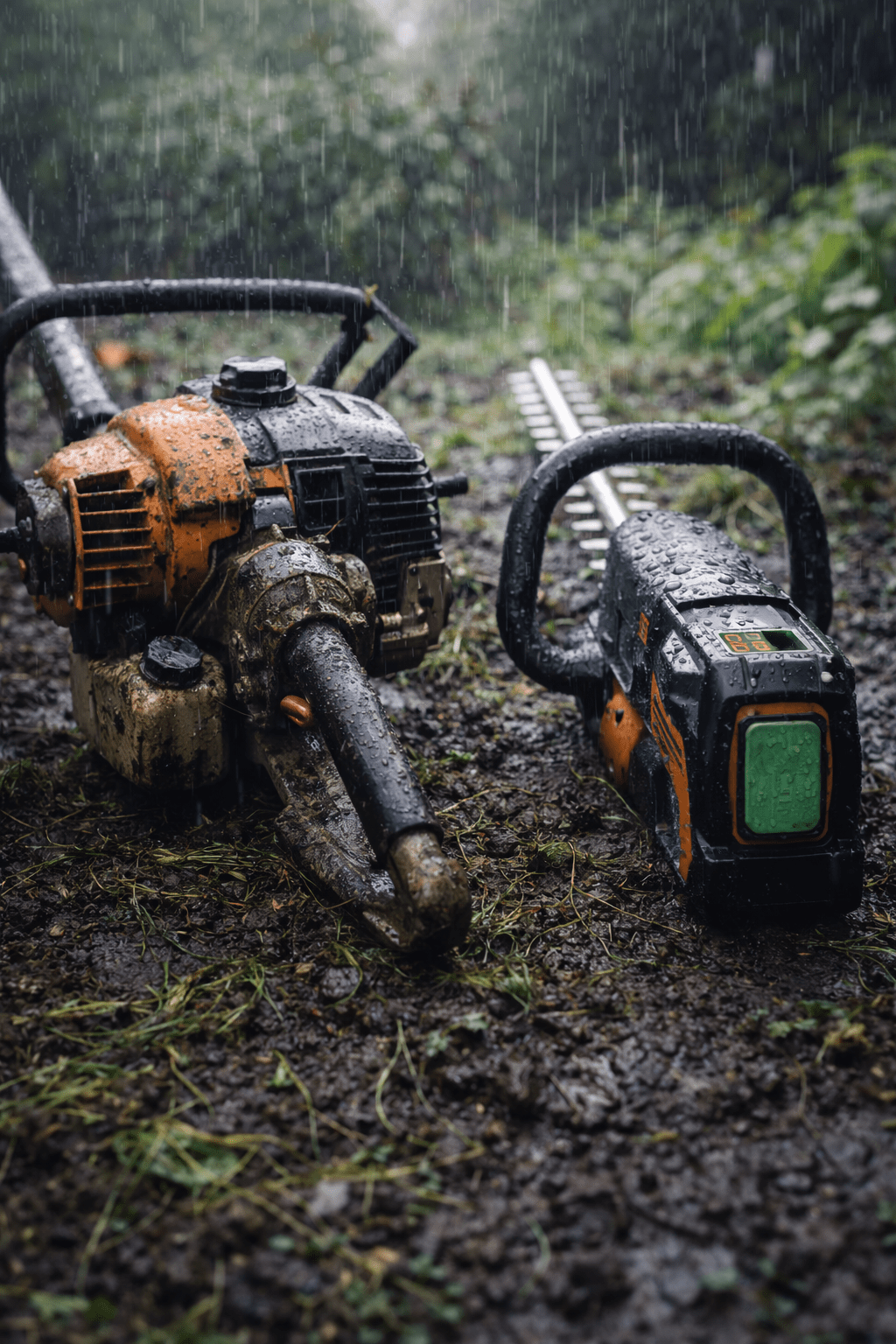
| There is a moment, usually early in a gardening career, when tools stop feeling like equipment and become allies, not in a sentimental way, but in a practical one. You learn what you can rely on when the weather turns, when the ground is heavy, when time is tight. Over the years, those small judgements harden into preferences, and preferences quietly become beliefs. One of the most persistent beliefs in professional gardening is that petrol tools are better suited to British weather. Not faster, not cleaner, not kinder — just more dependable when conditions are poor. They are often described, sometimes affectionately, as “not fussy”. They start when it’s wet. They keep going. They don’t complain. Battery tools, by contrast, are often spoken about in more cautious terms. Sensitive. Temperamental. Something to watch out for when rain is forecast. This difference in attitude has less to do with engineering than it does with how feedback is delivered and what gardeners are taught to trust. The comfort of delayed consequence Petrol tools feel safe in the rain because they rarely object immediately. You can run a petrol mower in drizzle without warning lights or sudden shutdowns. A hedge trimmer will keep cutting even as water beads on its casing. There is no visible negotiation taking place. The machine does the work it has always done. This lack of immediate feedback creates confidence. Rain stops feeling like a factor. Work continues at a pace. And for many years, this seemed to prove that petrol tools were the right choice. What is less often acknowledged is that petrol tools absorb damage quietly. Moisture does not short-circuit them, but it does settle into cables, bearings, tanks, and housings. Rust forms slowly, often out of sight. Performance declines gradually. Starting becomes “a bit awkward”. Power delivery feels uneven. These changes are rarely attributed to rain. They are written off as age. In this way, petrol tools do not avoid the cost of wet working. They defer it. Battery tools and early honesty Battery tools behave very differently. They monitor themselves constantly. Temperature, current draw, and voltage stability — all are watched, and limits are enforced. In wet or cold conditions, those limits are reached sooner. The result is familiar to anyone who has worked through a damp winter: batteries flatten faster, tools reduce output, and work pauses whether you like it or not. To some gardeners, this feels like fragility. To others, it feels like interference. But it is also honesty. Battery tools do not allow the gardener to ignore increased resistance, heavier cutting, or environmental strain. They reflect those conditions immediately, in lost runtime and enforced breaks. Where petrol tools conceal stress, battery tools display it. This difference has shaped reputation more than reality. Cultural memory and trust Much of the loyalty to petrol tools is cultural rather than technical. Many experienced gardeners learned their trade at a time when battery tools were either nonexistent or unfit for sustained professional use. Petrol machines were heavy, loud, and imperfect, but they were known quantities. They worked in the rain because they had to. That memory still carries weight. It informs what feels “proper” or “professional”. Newer tools, however capable, are measured against a past that had different constraints and expectations. Battery tools arrive without that history. They are judged not just on performance, but on whether they align with inherited ideas of toughness. Rain becomes a test not only of the tool, but of identity. Behaviour follows belief The choice of tool shapes behaviour in subtle ways. Gardeners using petrol equipment in wet conditions often work harder and faster. Noise and vibration encourage momentum. There is less temptation to pause. Machines are run hot, put away damp, and expected to recover on their own. Battery tools tend to interrupt that flow. When power drops, the gardener must stop. Batteries are swapped, tools are wiped, and time is taken, whether it was planned or not. This can feel inefficient, but it also introduces moments of reflection that petrol tools rarely enforce. Neither approach is inherently virtuous. But they produce different kinds of wear on tools, gardens, and bodies. The myth worth challenging The idea that petrol tools are better in the rain persists because it contains a grain of truth. They are less likely to stop abruptly. They are less visibly affected by moisture in the short term. But this does not make them better suited to wet conditions. It makes them quieter about the cost. Battery tools appear to struggle because they refuse to absorb stress silently. They reveal the extra work rain creates — heavier grass, denser hedges, colder air — by consuming energy faster. They make limits visible. Seen this way, battery tools are not failing in the rain. They are reporting honestly on the conditions. Trade-offs, not absolutes This is not an argument for abandoning petrol tools, nor for pretending battery tools are perfect. Each has contexts where it excels. Petrol tools offer long continuous runtime and consistent power under heavy load. Battery tools offer clarity, lower vibration, and a forced attentiveness to conditions. Rain exposes the strengths and weaknesses of both. What matters is not which tool is chosen, but whether its behaviour is understood. Problems arise when gardeners mistake silence for resilience, or interruption for inadequacy. Learning to read the feedback The most experienced gardeners tend to move beyond allegiance. They read feedback rather than resisting it. When a battery tool flattens quickly in the wet, they recognise that the work is heavier than it appears. When a petrol machine labours on regardless, they listen for changes in sound and feel. In both cases, rain becomes information rather than an inconvenience. This shift takes time. It requires letting go of the idea that professionalism is defined solely by endurance. Maintenance, after all, is not about forcing outcomes. It is about sustaining them. A quieter kind of reliability Reliability is often confused with indifference. Tools that ignore rain appear reliable because they demand nothing from the user. Tools that respond to rain ask for adjustment, planning, and restraint. Over long seasons, the second kind of reliability tends to prove more sustainable. Not because it is easier, but because it encourages alignment between effort, conditions, and outcome. Rain does not ask gardeners to choose sides. It asks them to pay attention. |
| About our writing & imagery Most articles reflect our real gardening experience and reflection. Some use AI in drafting or research, but never for voice or authority. Featured images may show our photos, original AI-generated visuals, or, where stated, credited images shared by others. All content is shaped and edited by Earthly Comforts, expressing our own views. |
 Earthly Comforts