| What the Drowned Worms Taught Us |
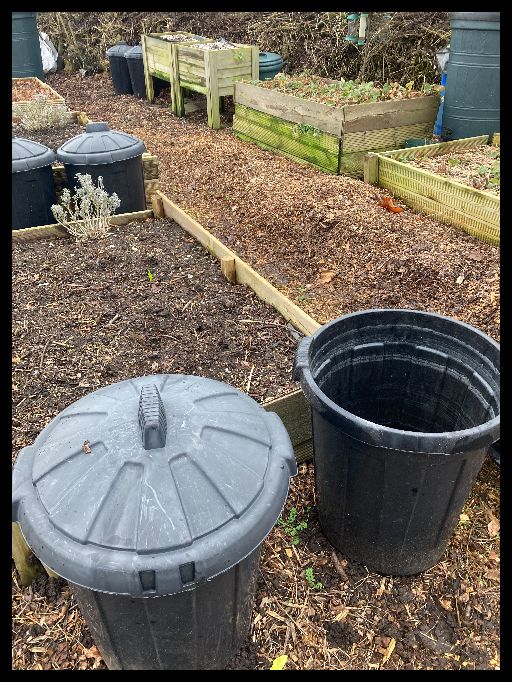
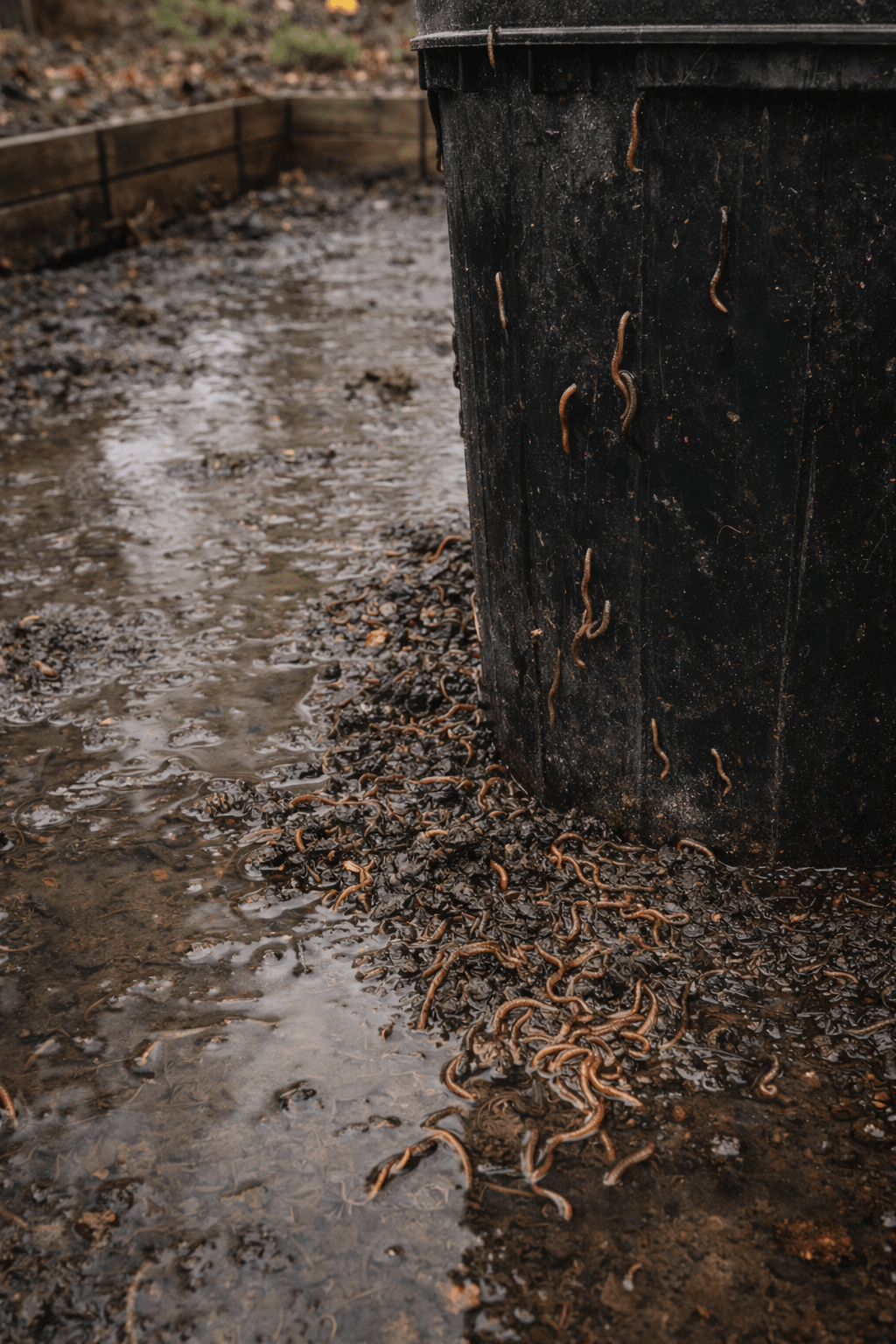
| Before any of this happened, the ground had already been telling its own story. This part of Kent has taken a sustained amount of rain over recent weeks — since mid-December – and not just dramatic downpours, although we have those as well, but steady and continuous rainfall, which is resulting in, for many gardens, long, saturation periods with no respite. The kind that never quite leaves. Beds are holding water longer than they should. Paths that don’t fully dry. Soil that feels heavier with each step. For plants, it’s tiring. For worms, it’s exhausting and death-dealing. They live in the thin margins of air and moisture, and when those margins collapse, movement becomes a necessity rather than a choice. What we found in the tubs didn’t begin there. It began in soil under quiet, prolonged stress. |
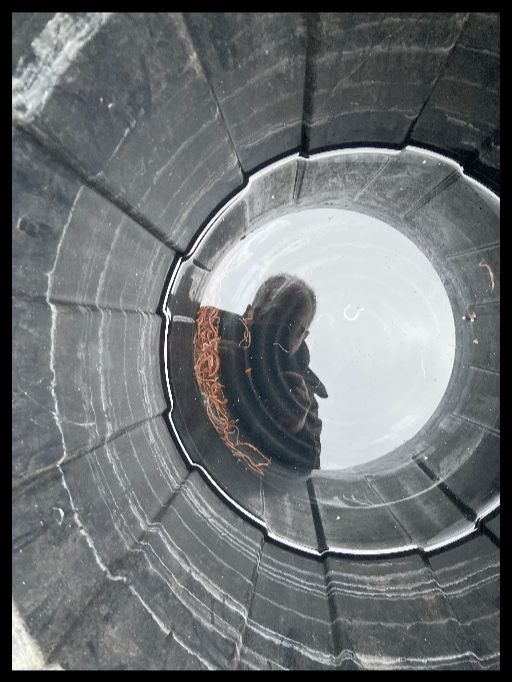
| The first thing that strikes you isn’t the sight. It’s the stillness. You lift the lid of a water tub expecting the usual quiet reassurance — stored rainwater, a small hedge against dry weeks, a practical gesture toward continuity. Instead, you’re met with a pale scatter at the bottom. Thin lines, curved and overlapping, gathered where nothing should be gathering. Worms. Many of them. Most of them are unmistakably dead. It stopped both of us. Suze stood back; I crouched. Neither of us spoke straight away. There’s a particular kind of sadness that comes with unintended harm — especially when it lands in a place you thought you were tending, not threatening. These tubs weren’t careless. They were deliberate. Put here because dry spells are getting longer. Because resilience now has to be planned. Because gardens don’t forgive complacency anymore. And yet here they were: drowned worms at the bottom of a container built in the name of survival. I’ve kept worms before. Properly. I’ve farmed them, relied on them, watched them transform waste into something quietly miraculous. I’ll be doing it again later this year. So this wasn’t abstract for me. It wasn’t theoretical. It felt personal — like finding casualties in a system you believed was benign. The temptation, when faced with something like this, is to reach immediately for explanation. To tidy it up. To turn it into a lesson with a neat moral. But that wasn’t my first response. My first response was grief — small, maybe, but real. A recognition that good intentions don’t exempt us from consequence. That even careful gardeners can build traps without realising. Only later did the thinking begin. |
| A behaviour misunderstood There’s a persistent myth that worms “love water,” or that they’re drawn to it in some simple, almost affectionate way. It’s one of those half-truths that sounds right until you sit with it. Worms don’t seek water. They seek oxygen, moisture, and safety — in that order, though not always consciously. Their bodies require dampness to breathe, but immersion is lethal. They drown like anything else that breathes through skin. So why climb into water tubs? The answer isn’t curiosity or error. It’s stress. When soil becomes saturated — really saturated — the air spaces collapse. Oxygen disappears. Worms, suddenly unable to respire, do what evolution has taught them to do: move. Upwards. Sideways. Anywhere that might offer relief. Rain amplifies this instinct. Moist surfaces reduce the risk of desiccation, allowing them to travel across ground they’d usually never attempt. In a field or woodland, this movement is temporary and largely safe. In a garden — particularly a worked garden full of smooth, vertical, artificial forms — it becomes dangerous. A plastic tub, cool and damp, reads to a worm as refuge. Darkness. Consistent moisture. Shelter from surface disturbance. The problem only becomes apparent once they’re inside. Smooth walls offer no grip. Water levels rise quietly. Escape becomes impossible. There’s no intention in it. No choice, really. Just instinct colliding with infrastructure. The quiet cruelty of useful things We talk a lot in gardening about harm when it’s obvious: pesticides, over-pruning, compacted lawns. But there’s another category that’s harder to face — the harm caused by sensible, responsible decisions taken slightly out of context. Water storage is one of them. We’re encouraged, rightly, to capture rainwater. To buffer against drought. To reduce reliance on the mains supply. On the plot, the tubs are part of that thinking. They sit near beds, close enough to be practical, low enough to collect runoff. They’re useful. They’ve earned their place. But usefulness isn’t the same as neutrality. The more we intervene — even thoughtfully — the more we create edge cases—places where natural behaviour meets unnatural design. Most of the time, nothing happens. Sometimes, something does. What unsettled me wasn’t just the loss of the worms. It was the reminder that gardening at this scale is no longer passive. We’re not simply caretakers of a static system. We’re designers of dynamic ones. And design, however modest, carries responsibility. Worms as indicators, not victims There’s a temptation to frame what we saw as an accident — a one-off. But that would be too easy. Worms don’t appear in numbers unless something else is happening. Their presence, even in death, is diagnostic. They were moving because conditions elsewhere had shifted. Perhaps the beds were holding too much water after prolonged rain. Perhaps a layer of organic matter was breaking down anaerobically. Perhaps temperature swings had unsettled them. The exact trigger matters less than the signal itself: the soil was telling us something, and the worms were responding. In that sense, they weren’t just victims of the tubs. They were messengers. Unfortunate ones, yes — but informative all the same. This is something working gardeners understand instinctively, even if we don’t always articulate it. You don’t read soil by numbers alone. You read it by smell, by structure, by what lives in it — and what tries to leave. Healthy soil doesn’t just host life; it holds it comfortably. When organisms start emigrating en masse, something has tipped the balance. The emotional weight of unintended harm I think it’s important to acknowledge how this felt, rather than rushing past it. There’s a cultural habit — especially in practical trades — of brushing off small losses. “That’s nature,” we say. And sometimes it is. Predation, disease, and weather — these are part of the system. But this wasn’t that. This was harm created by a structure we introduced. And even if the scale is small in the grand scheme of things, the emotional response matters. Gardening isn’t just an economic or aesthetic activity. It’s relational. We notice. We care. We feel the weight of responsibility, even when no one else sees it. Suze was genuinely upset. I was too, though in a different register — quieter, perhaps, but no less present. There’s a particular discomfort in knowing you’ve created a problem without intending to, especially when your identity is bound up in doing things carefully. That discomfort is useful. It keeps you attentive. Design blind spots One common assumption in sustainable gardening is that “natural” equals safe. That anything aligned with ecological thinking will automatically benefit wildlife. But ecosystems are context-specific. A feature that supports life in one setting can endanger it in another. Water is a good example. Ponds are lifesavers. Open troughs are hazards. A shallow dish with stones is helpful; a deep, smooth-sided container is not. The distinction is subtle but crucial. We often underestimate how smooth surfaces are. Plastic doesn’t weather in the way stone or wood does. It offers no micro-texture, no chance of purchase. Once something falls in, it stays in. That finality is rarely apparent until it’s tested. The tubs weren’t wrong to be there. But they were incomplete. Missing an exit and missing a margin. Learning without turning it into a lesson I’m wary of turning this into a set of instructions. That’s not the point. Anyone can say “put a stick in the tub” or “keep the lid on.” Those responses are apparent once you’ve seen the problem. What matters more is the shift in attention. We now look differently at every container, every edge, every threshold between systems. Where does water go when it rains hard? Where does life move when conditions change? What assumptions are we making about behaviour that might not hold? This is where experience matters more than advice. You don’t really understand these questions until you’re confronted with a consequence. Until something that matters to you is lost quietly, without drama. The larger context: climate, compression, and movement There’s also a broader frame here, one that extends beyond worms and tubs. We’re gardening in a time of compression. Weather events are sharper, more concentrated. Wet spells saturate soil quickly; dry spells follow hard on their heels. Organisms that once moved slowly now move urgently. Migration, even at the scale of worms, is accelerating. Infrastructure that was once benign — a tub, a path, a raised edge — can suddenly become a barrier or a trap simply because movement has increased. The system is more dynamic than it used to be, but many of our garden designs haven’t caught up. This isn’t about blame. It’s about adaptation. Returning to care Nothing was resolved that day. The worms are still there. Most of them are unmoving at the bottom of the tubs. The ground around us remains saturated, heavy with weeks of rain that hasn’t yet found a way out. Emptying the containers isn’t an option — not without tipping that water straight back into soil already holding more than it can carry. Doing so would move the problem elsewhere, spreading stress rather than easing it. So we wait. Waiting is an uncomfortable position for gardeners. We’re conditioned to intervene, to adjust, to correct. But sometimes the conditions don’t allow it. Sometimes care looks like restraint rather than action. The error is recognised, but the remedy has to be delayed until the ground can receive it without harm. Knowing the worms are there — knowing why they’re there — sits heavily. It’s not a mistake you can tidy away before lunch. It lingers. A quiet reminder that good intentions don’t always arrive at the right moment, and that timing, as much as knowledge, shapes outcome. The tubs haven’t been altered yet. No surfaces are roughened. No escape routes added. Not because the lesson hasn’t been learned, but because the soil hasn’t given permission. Everything is paused, held in suspension by water and weather. This, too, is part of care. Not the satisfying kind. Not the kind you post about or wrap up with a solution. The kind that involves noticing a problem, naming it honestly, and sitting with it until the land allows you to act. What stayed with me What lingers isn’t guilt. It’s humility. Gardening has a way of reminding you that control is partial at best. That even the most considered systems have blind spots. That care isn’t a static achievement but a continual practice of noticing, responding, revising. The worms didn’t drown because we were careless. They drowned because we were human — designing for one need while missing another. The work now is not to punish ourselves for that, but to let it refine our attention. If there’s a conclusion here, it’s not prescriptive. It’s simply this: living systems will always test the edges of our thinking. They will reveal what we’ve overlooked, often quietly, sometimes painfully. Our task is not to pretend we can anticipate everything, but to remain open to being corrected. That is what good gardening actually looks like. |
| About our writing & imagery Most articles reflect our real gardening experience and reflection. Some use AI in drafting or research, but never for voice or authority. Featured images may show our photos, original AI-generated visuals, or, where stated, credited images shared by others. All content is shaped and edited by Earthly Comforts, expressing our own views. |
 Earthly Comforts
Not that I like worms, but they shouldn’t die needlessly. Interesting post, Rory.
LikeLike
I think many people misunderstand the role of worms, they are like the bees, just under ground. 🙂
LikeLiked by 1 person
True! 🪱
LikeLiked by 1 person