| Hedge Cutting, Nesting Season, and the Practice of Restraint |
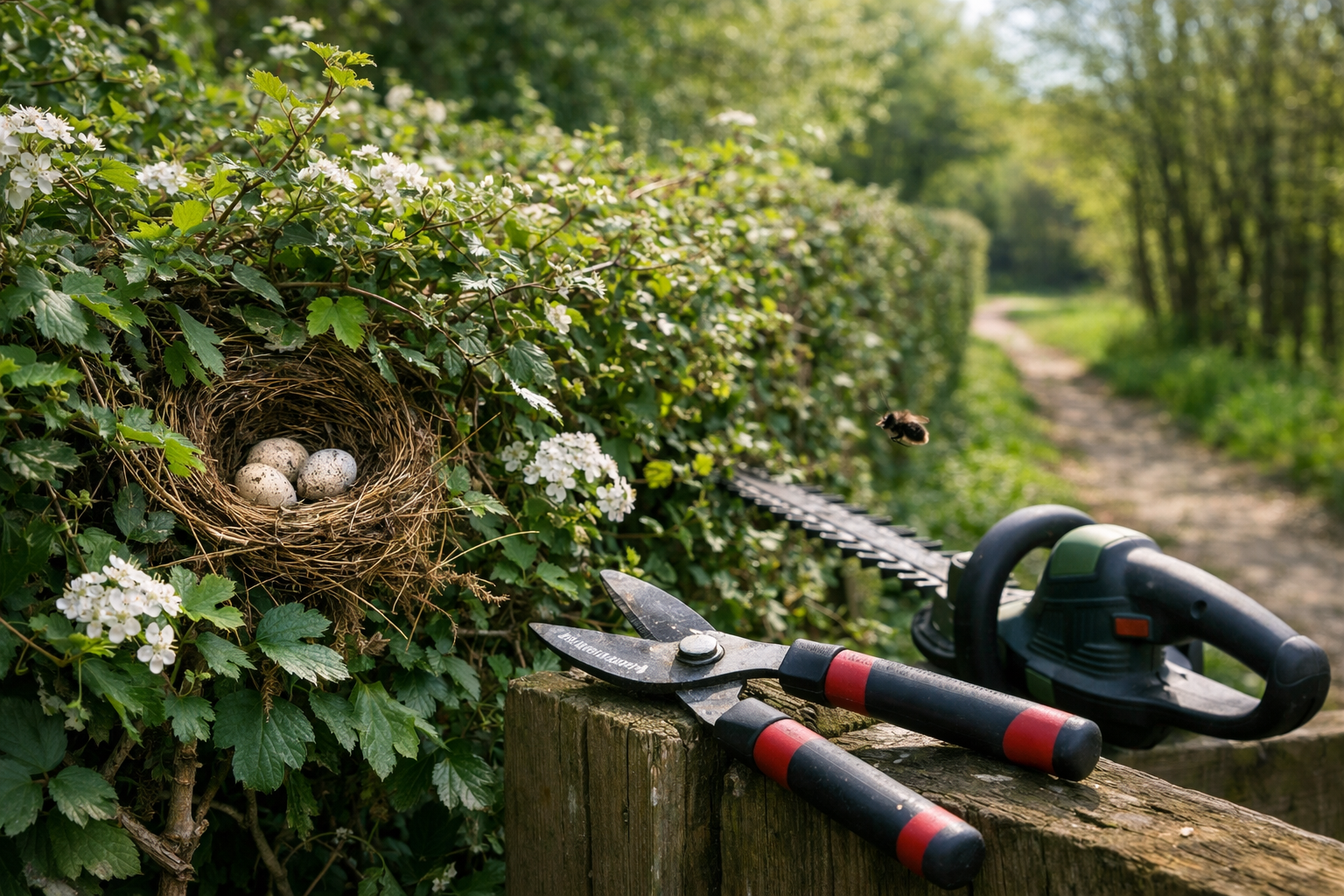
| For much of the year, hedge cutting feels like one of the simplest jobs in the garden. It sits comfortably in the background of routine maintenance: trim, shape, contain, repeat. There is a satisfaction in restoring a clean line, in bringing something back under control. And then, somewhere around late winter, that certainty begins to dissolve. The hedge starts to change character. Growth softens. Buds swell. The interior thickens. What had been a surface becomes depth. And with that shift comes a different kind of responsibility — one that cannot be managed by habit alone. This is where hedge cutting stops being just hedge cutting. The Law, and Why Dates Are Misleading A common belief is that hedge cutting becomes illegal on the 1st of March. In reality, the law is both broader and more subtle than that. UK wildlife legislation does not ban hedge cutting by date. Instead, it protects active bird nests year-round. The offence is not cutting a hedge; it is damaging or destroying a nest that is in use or being built. The reason March matters is practical rather than legal. By early spring, nesting activity becomes widespread, overlapping, and unpredictable. Some species begin earlier, others later, and many re-nest multiple times. From this point on, it becomes increasingly unrealistic to guarantee that a hedge is unoccupied simply because nothing is visible from the outside. That is why organisations such as the RSPB and Natural England advise avoiding routine hedge cutting from March through late summer. This guidance reflects not a hard prohibition, but a recognition of uncertainty. It accepts the limits of what gardeners can reasonably know before disturbance occurs. In other words, March marks a shift in risk, not a switch in legality. Why “Just Checking” Isn’t Always Enough One of the most persistent misunderstandings is the idea that careful inspection resolves the issue. If no nest can be seen, surely cutting is acceptable. In practice, this assumption rarely holds. Bird nests are designed to be concealed. They are built deep within the hedge structure, often well back from the outer growth. Visual checks tend to reveal nests only after they are established, and sometimes only after disturbance. Equally important is the fact that nest failure does not always require direct damage. Noise, vibration, repeated cutting passes, or the sudden thinning of cover can be enough to cause abandonment, particularly in early stages of breeding. This is why guidance emphasises precaution over detection. The absence of evidence is not evidence of absence, especially in dense, layered vegetation like hedges. The Grey Area of “Light Trimming” If there is one phrase that generates more debate than any other in this context, it is “light trimming”. The difficulty is that the term has no fixed meaning. For some, it implies a few careful snips with hand tools. For others, it extends to superficial shaping with powered equipment, provided the hedge is not dramatically reduced. From an ecological standpoint, intent matters less than effect. A trim that alters the overall shape or density of a hedge, even slightly, can still introduce disturbance at a critical time. Powered tools increase this risk through vibration and noise, regardless of the intended cut length. This does not mean that all hedge work is automatically inappropriate during nesting season. It means the threshold for intervention changes. Work undertaken solely for appearance carries a very different justification from work required for access, safety, or damage management. The problem with “light trimming” is not that it is always wrong, but that it is often poorly defined. Do Some Hedges Carry Less Risk? Another common question concerns hedge type. Are some hedges effectively exempt? The short answer is no. The legal protection applies to nests, not plants. That said, risk is not evenly distributed. Dense, mature, mixed native hedges are clearly a more attractive nesting habitat than low, open, frequently trimmed boundaries. Thorny species offer particular protection. Older hedges provide a layered structure. However, birds are opportunistic. In urban and suburban settings, nesting occurs in a wide range of hedge types, including privet, laurel, yew, and even tightly managed formal hedges where alternatives are limited. Acknowledging differing levels of likelihood is sensible. Treating any hedge as categorically exempt is not. Safety, Access, and Proportionality It is important to recognise that hedge cutting during nesting season is not entirely prohibited in practice. There are circumstances where intervention is justified: blocked footpaths, obscured sightlines, storm-damaged branches, or genuine safety risks. In these cases, inaction can create harm of a different kind. The key principle is proportionality. Necessary work should be limited to the specific issue, carried out with restraint, and use the least disruptive methods available. Selective hand work addressing a clear hazard is fundamentally different from routine seasonal trimming undertaken for visual uniformity. This distinction allows gardens to remain functional without collapsing into either negligence or over-management. What Happens When Hedges Are Left Alone A quiet anxiety often underpins resistance to pausing hedge cutting: the fear that a single missed season will undo years of care. In most cases, experience suggests the opposite. Left uninterrupted through spring and summer, hedges often develop more even growth. Weak areas fill. Structural tendencies become clearer. By the time winter arrives, the hedge is no longer chaotic, but more legible. From a horticultural perspective, this aligns with plant physiology. Winter cutting, undertaken while growth is dormant, generally produces stronger regrowth and places less stress on woody plants. The hedge responds better because the timing respects its natural cycle. In this context, observation becomes a form of management rather than its absence. The Questions Beneath the Questions Many of the questions people ask about hedge cutting are not really about birds or legislation. They are about reassurance. Clients want to know they are being reasonable. They want to know that restraint does not mean neglect. They want clarity that feels fair, not arbitrary. This is why explanation matters as much as policy. Saying “we pause hedge cutting during nesting season because hedges become active habitat” communicates intent and respect. Saying “we’re not allowed” invites challenge and mistrust. Gardening has always involved judgment. The nesting season makes that judgment more visible. A Defensible Position A balanced approach to hedge cutting recognises both ecological responsibility and practical necessity. Routine hedge cutting is best carried out during the dormant season, typically late autumn through late winter, avoiding periods of hard frost. From early spring onwards, hedges should be treated as potentially occupied habitat, with intervention limited to genuine access or safety needs and undertaken with care. This approach does not rely on rigid rules. It relies on informed judgement, professional restraint, and an acceptance that uncertainty is part of working with living systems. The hedge itself is not the object of protection. The life it temporarily supports is. Why This Matters Hedges occupy a quiet but important position in gardens. They are neither fully wild nor purely ornamental. They connect spaces, soften boundaries, and provide continuity in landscapes that are otherwise increasingly fragmented. How they are treated reflects how comfortable we are with sharing space — and with stepping back when stepping in is not required. Learning when not to cut is as much a gardening skill as knowing when to cut. And once that pause is understood, it tends to reshape how the rest of the garden is seen as well. |
| Hedge Cutting: Common Questions, Straight Answers Hedge cutting is one of those gardening jobs that look simple from the outside but become surprisingly complex the moment you start asking questions. Most people aren’t trying to bend the rules or ignore wildlife; they want to know where responsibility actually sits. These are the questions gardeners are asked most often — and the answers we give. Is hedge cutting actually banned from March? No. No law says hedge cutting is banned from a specific date. What is illegal, at any time of year, is damaging or destroying an active bird nest. March matters because it marks the point when nesting becomes widespread and unpredictable. From then on, it becomes increasingly difficult to guarantee that a hedge is unoccupied before work begins. That’s why most responsible gardeners stop routine hedge cutting from early March. It’s a precaution, not a prohibition. So what’s the actual law? UK wildlife law protects wild birds while they are nesting. The protection applies to the nest, not to the hedge itself, and it applies regardless of whether the hedge is in a garden, a field, or on private land. Guidance from bodies such as the RSPB and Natural England reflects this by advising against hedge cutting during the main nesting season, rather than setting hard calendar rules. The law expects reasonable care, not perfection — but it does not excuse avoidable disturbance. If I can’t see a nest, surely it’s fine? This is the most common assumption, and it’s understandable. The difficulty is that bird nests are deliberately hidden. They are usually built well inside the hedge structure, not at the surface. By the time a nest is clearly visible, disturbance may already have occurred. Visual checks alone can’t reliably confirm that a hedge is unused, particularly once nesting season is underway. That’s why guidance focuses on avoiding routine cutting during this period rather than relying solely on inspection. What about just a light trim? “Light trim” doesn’t have a legal definition, and that’s where problems arise. To one person, it means removing a single shoot with hand tools. To another, it means a quick pass with a hedge trimmer to keep things tidy. From the hedge’s point of view, those are very different interventions. Noise, vibration, repeated cutting passes, and changes to hedge density can all cause disturbance, even if no nest is directly touched. During nesting season, work done purely for appearance is difficult to justify. That said, limited, careful intervention may be appropriate where there is a genuine need, such as access or safety. The key question is not how small the cut is, but why it’s being done. Does this apply to all hedges, even laurel or box? Yes. The protection applies to birds, not hedge species. Some hedges are more likely to be used for nesting than others — dense, mature, mixed native hedges carry a higher risk — but birds will nest wherever suitable shelter exists, including evergreen and formal hedges. There are no legally exempt hedge types. What if the hedge is on private property? Wildlife protection law applies regardless of ownership. Being on private land does not exempt a person from the responsibility to avoid damaging or disturbing an active nest. This often surprises people, but the law is concerned with protecting wildlife, not regulating property boundaries. What if the hedge is blocking a pavement or driveway? This is one of the few situations where hedge work during nesting season may be justified. If a hedge is causing a genuine safety or access issue — for example, blocking a footpath or obscuring sightlines — limited intervention may be necessary. In these cases, the expectation is that work is: proportionate to the issue, limited to the affected area, and carried out using the least disruptive methods possible. Routine shaping or general tidying should still be deferred. Can I cut one side but leave the other? Sometimes, but not always. Cutting one side of a hedge still disturbs the hedge, particularly if nests are present within it. Boundary hedges can be especially complex, as nesting may occur away from the side being worked on. Each situation needs to be judged individually, with caution. Partial cutting is not automatically a workaround. Won’t leaving it uncut make it harder to manage later? In most cases, no. Allowing a hedge to grow uninterrupted through spring and summer often results in more even growth and clearer structure. When winter cutting resumes, the hedge is often easier to shape, not harder. From a plant health perspective, winter cutting generally causes less stress and encourages stronger regrowth. When can hedges be cut again properly? For most garden hedges, the preferred period for routine cutting is late autumn through late winter, avoiding hard frost. By this point: nesting has finished, plants are entering dormancy, and the risk to wildlife is minimal. Exact timing can vary depending on species, weather, and location, but winter remains the safest window overall. Do all gardeners follow this? Practices vary, but the guidance is widely accepted across professional gardening and land management. Gardeners who follow it are not being unusually cautious; they are aligning their work with current wildlife guidance and legal responsibility. Differences usually reflect interpretation, experience, or pressure rather than disagreement about the underlying principles. What happens if someone ignores it? Enforcement is not the main focus of wildlife law, but serious or deliberate disturbance can carry legal consequences. More often, the issue arises in neighbour disputes or complaints, where misunderstanding escalates into conflict. Clear communication and seasonal restraint usually prevent this far more effectively than confrontation. So what can be done instead during nesting season? Although routine hedge cutting pauses, garden care does not stop. During spring and summer, gardeners can focus on: observation rather than intervention, base maintenance and soil care, addressing genuine access or safety issues, planning future hedge work based on how the hedge actually grows. This shift is not inactive. It is a seasonal adjustment. A final word Most people asking these questions are not looking for loopholes. They are trying to do the right thing without losing control of their garden. Clear answers matter. So does acknowledging uncertainty. Hedge cutting during nesting season isn’t about rigid rules; it’s about recognising when restraint is part of responsible care. That understanding tends to settle most concerns — and often changes how people look at their hedges long after the conversation ends. |
| About our writing & imagery Most articles reflect our real gardening experience and reflection. Some use AI in drafting or research, but never for voice or authority. Featured images may show our photos, original AI-generated visuals, or, where stated, credited images shared by others. All content is shaped and edited by Earthly Comforts, expressing our own views. |
 Earthly Comforts