| When the Battery Flattens Early: Energy, Limits, and Learning When to Stop Part III |
| A short note on rain, work, and why this series was written This series began with a simple question. One of our gardeners asked why we don’t always work in the rain, not as a challenge — just an honest, practical question. Around the same time, clients began asking something similar: why we sometimes pause work during wet spells when other gardeners appear to carry on regardless. The short answer is that we don’t mind working in light rain. Much of our work takes place outdoors in a country where showers are part of the rhythm. But heavy rain and storm conditions change more than comfort. They change what the land will tolerate, what tools are asked to endure, and what kind of work can be done without leaving harm behind. Since December 2025, the UK has experienced unusually prolonged and intense rainfall. For working gardens, this has not meant a brief interruption followed by recovery, but extended saturation. Lawns have remained soft. Borders have stayed heavy. Access routes have failed to dry between visits. In those conditions, work does not simply slow down — it backs up, waiting for the ground to recover enough to be worked without damage. Gardening is not just about whether something can be done. It’s about whether it should be. Wet ground compacts. Saturated turf tears. Tools wear in ways that don’t show themselves until much later. What looks like determination in the moment can quietly become damage to the garden, the equipment, and the people doing the work. These essays are not an argument against working in the rain. They are an attempt to explain why weather matters, and why choosing when to work is as much a part of maintenance as turning up. Rain has a way of revealing the difference between care and force, and that difference is what this series is really about. |
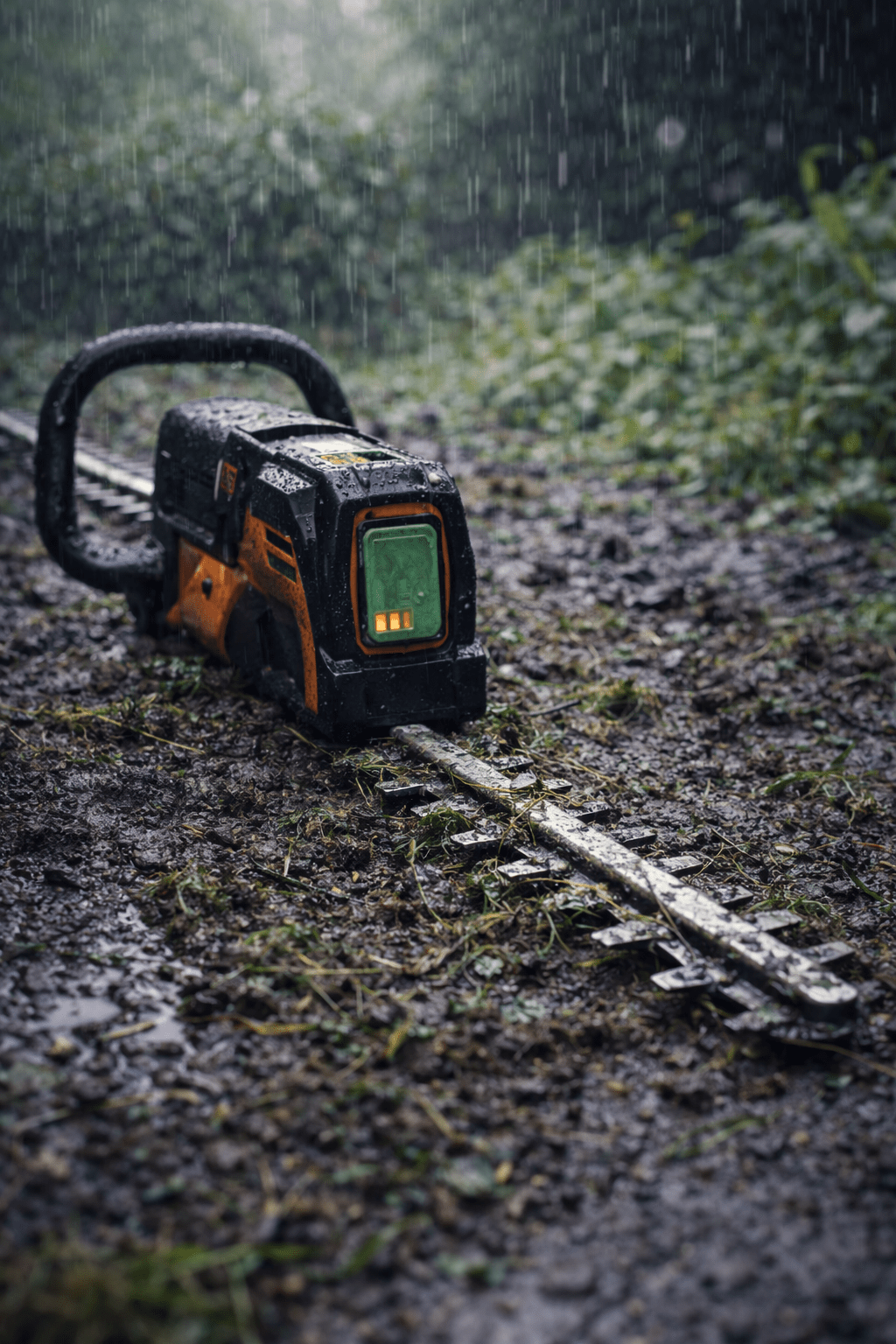
| There is a particular frustration when a battery tool runs out sooner than expected. It arrives quietly at first — a drop in power, a pause where none was planned — and then decisively. The tool stops. Work halts—the rhythm breaks. In dry conditions, this feels like an inconvenience. In wet conditions, it can feel like failure. The grass is heavier than it looked. The hedge has taken more out of the machine than anticipated. The day’s plan begins to unravel. It is tempting, in those moments, to see the battery as the weak link. Petrol tools would have carried on. Older ways would not have objected. Something, surely, has been lost. But that reaction misses what the battery is actually doing. It is not a withdrawal of effort. It is revealing it. Energy made visible In gardening, energy is usually invisible. We sense it through fatigue rather than measurement. A petrol mower consumes fuel without comment. A body tyre without a gauge. Work proceeds until something gives, often long after the cost has been incurred. Battery tools change that relationship. They quantify effort. They translate resistance, density, and drag into a countable quantity: remaining charge. When rain makes work heavier — when wet grass clings, when cold air stiffens materials, when friction rises everywhere at once — the battery responds honestly. It empties faster because more is being asked of it. What feels like early failure is often accurate reporting. Rain does not drain batteries. It exposes the actual energy cost of the task. Cold, caution, and protection Wet weather in the UK rarely arrives alone. It brings cold with it. Lithium-ion batteries do not enjoy cold. They deliver power less freely, protect themselves sooner, and recover more slowly. This is not fragility; it is design. Battery systems are built to preserve their own lifespan. When conditions push them toward stress — sustained high draw, low temperatures, unstable voltage — they intervene. Output drops. Runtime shortens. Work pauses. To a gardener used to petrol tools, this can feel obstructive. But it is worth noticing that the intervention happens before damage occurs. The battery refuses to be drained in a way that would irreversibly shorten its life. Petrol tools do not make this distinction. They will continue until wear becomes damage, and damage becomes repair. What does stopping actually mean? A battery tool stopping in the rain forces a decision. Do you swap batteries and continue? Do you change tasks? Do you stop altogether? That moment — brief, often irritating — is where the more profound lesson sits. The pause invites reflection. It asks whether continuing is necessary, productive, or simply habitual. In prolonged wet conditions, especially those experienced since late 2025, these questions have become unavoidable. Gardens have remained saturated for weeks. Ground has not recovered between visits. Lawns have stayed soft. Borders have never quite dried. In that context, stopping is not a failure of equipment. It is in alignment with reality. The ethic of enough Professional gardening carries an unspoken ethic of completion. You finish the job. You leave things better than you found them. You don’t let the weather become an excuse. But there is another ethic, quieter and less celebrated: knowing when enough has been done for now. Battery tools, particularly in the rain, make this ethic visible. They introduce limits that are not moral or motivational, but physical. Energy has been spent. Conditions have claimed their share. Further effort will cost more than it yields. This runs counter to the culture of endurance many gardeners inherit. It suggests that restraint can be a form of care for the garden, the tools, and the person doing the work. Flattening is not exhaustion. There is a tendency to conflate a flat battery with exhaustion, as if the tool has given everything it has to offer. In reality, modern batteries rarely reach actual depletion. They stop with reserve still intact, preserving cell health. This distinction matters. The battery is not exhausted; it has reached a boundary. One set by temperature, load, and internal chemistry. Boundaries are not weaknesses. They are definitions. Gardens have boundaries, too. Soil structure collapses beyond a specific moisture level. Turf cannot recover if torn repeatedly while wet. Plants bruise and invite disease when worked too hard in the wrong conditions. When battery tools enforce limits, they mirror the garden’s own constraints. Learning a different rhythm Gardeners who work with battery tools through wet seasons often develop a different rhythm. Tasks are shorter. Work is rotated. Expectations are adjusted. There is less emphasis on clearing everything in one visit, more on returning when conditions improve. This rhythm can feel unfamiliar, even uncomfortable, to those trained in more extended, uninterrupted runs of work. But over time, it often proves more sustainable. Tools last longer. Gardens recover more quickly. Bodies accumulate less strain. The work continues, but at a pace shaped by reality rather than insistence. Rain makes this rhythm unavoidable. Battery tools make it visible. Not a manifesto, just an observation This is not an argument that battery tools are morally superior, or that petrol tools are inherently reckless. Both can be used well or poorly. Both respond to rain in their own ways. What battery tools offer, particularly in wet conditions, is clarity. They refuse to absorb stress silently. They turn environmental resistance into immediate feedback. They make energy — usually hidden — explicit. Whether that clarity is welcomed or resisted depends on the gardener. When stopping becomes part of maintenance. Maintenance is often framed as action: cutting, clearing, tidying. But sometimes maintenance takes the form of restraint. Choosing not to work in saturated ground and letting a hedge wait another week. Accepting that backlog is not a failure, but a consequence. Battery tools, by flattening sooner in the rain, make these choices harder to avoid. They insist on a pause. In doing so, they align the gardener more closely with the conditions in which they are working. In a climate of increasing unpredictability and prolonged wet periods, this alignment may prove more valuable than endurance. What the rain leaves behind Across this series, rain has appeared not as an adversary but as a revealer. It shows how tools wear, how habits harden, how limits are reached. When a battery dies early in the rain, it is tempting to see it as inconvenient. Looked at differently, it is information. It tells the truth about effort, cost, and condition. Gardening has always involved reading signs in leaves, soil, and weather. Battery tools add another language to that reading. One that speaks in minutes and percentages rather than aches and breakdowns. Listening to that language does not make the work smaller. It makes it more honest. |
| About our writing & imagery Most articles reflect our real gardening experience and reflection. Some use AI in drafting or research, but never for voice or authority. Featured images may show our photos, original AI-generated visuals, or, where stated, credited images shared by others. All content is shaped and edited by Earthly Comforts, expressing our own views. |
 Earthly Comforts