
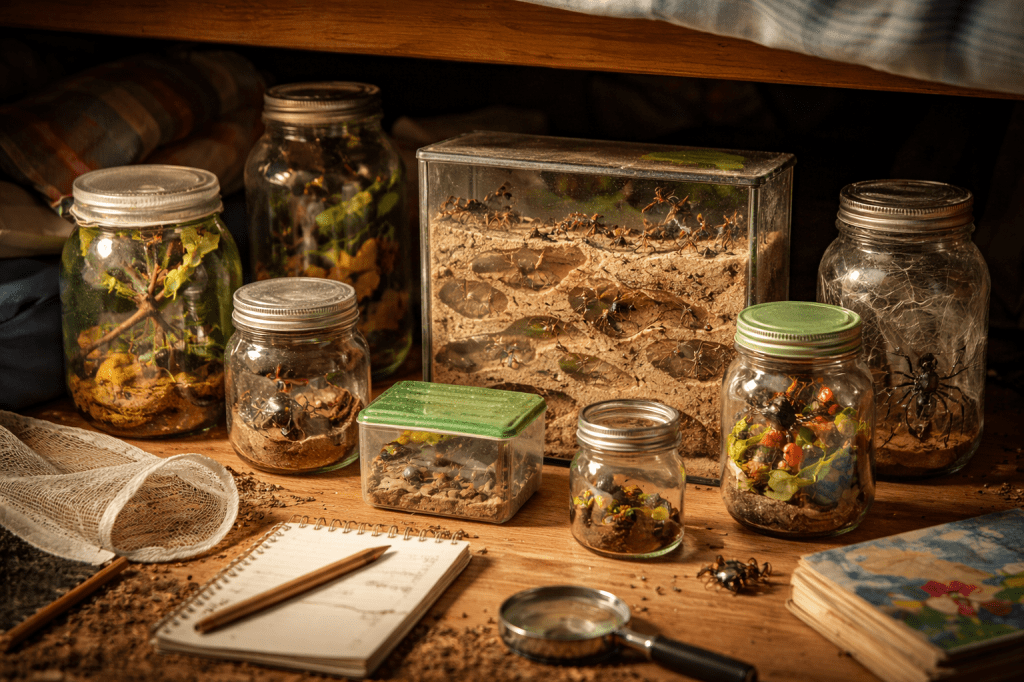
| Under the Bed — The First Insect Zoo Every good zoo needs organisation. Mine just happened to be under the bed. By the time most children were collecting stamps or marbles, I was curating ecosystems. Jam jars lined up like exhibits, each with its own purpose, its own inhabitants, its own rules — loosely enforced, enthusiastically imagined. Ant farms thrived in glass-sided worlds. Caterpillars munched methodically on carefully sourced leaves. Spiders occupied corners of their jars with varying degrees of tolerance for captivity. If I could collect it, I did. What made the whole operation possible was order. My room was immaculate. Beds made. Surfaces clear. Nothing to suggest that beneath that calm domestic scene lived a miniature archive of life, quietly crawling, spinning, chewing, and transforming. The adults never suspected a thing — until something died. Death, it turns out, has a smell that does not respect secrecy. The moment decomposition set in, the zoo announced itself. A sharp, unmistakable pungency that cut through even the most determined tidiness. Jars were discovered. Lids removed. Questions asked. The zoo was temporarily dismantled, only to reassemble later in quieter form. What I didn’t understand then — but do now — is that I wasn’t just collecting insects. I was observing cycles. Growth, change, decay. Ants are building and rebuilding. Caterpillars shedding skins. Spiders are consuming or being consumed. Nothing stayed still for long. It was my first real lesson in impermanence. I learned, slowly and clumsily, that living things are not ornaments. They require conditions. They respond to neglect. They don’t thrive simply because they are interesting. Some of my early “exhibits” failed because I hadn’t yet learned how much space, food, and freedom were necessary for life to continue. And yet, those failures mattered. They taught me responsibility before I had language for it. They taught me that curiosity carries weight. That watching life unfold means accepting when it ends — sometimes because of you. Now, as a gardener, I see the same patterns repeating themselves in healthier ways. Compost heaps teeming with unseen workers. Soil layers function like stacked habitats. Under stones and mulch, whole worlds are operating independently of my plans. Behind the spade, I still feel that old pull to look closer. To lift carefully. To notice who lives where. But I no longer trap or contain. I observe. I allow. The first insect zoo was never really under the bed. It was in the act of paying attention. And once you learn to see the garden that way, you realise you’re not its keeper at all — just a visitor lucky enough to glimpse what’s already there. |
 Earthly Comforts
I remember your ant farm too.
LikeLiked by 1 person