| The Places We Walk Past Without Ever Entering |
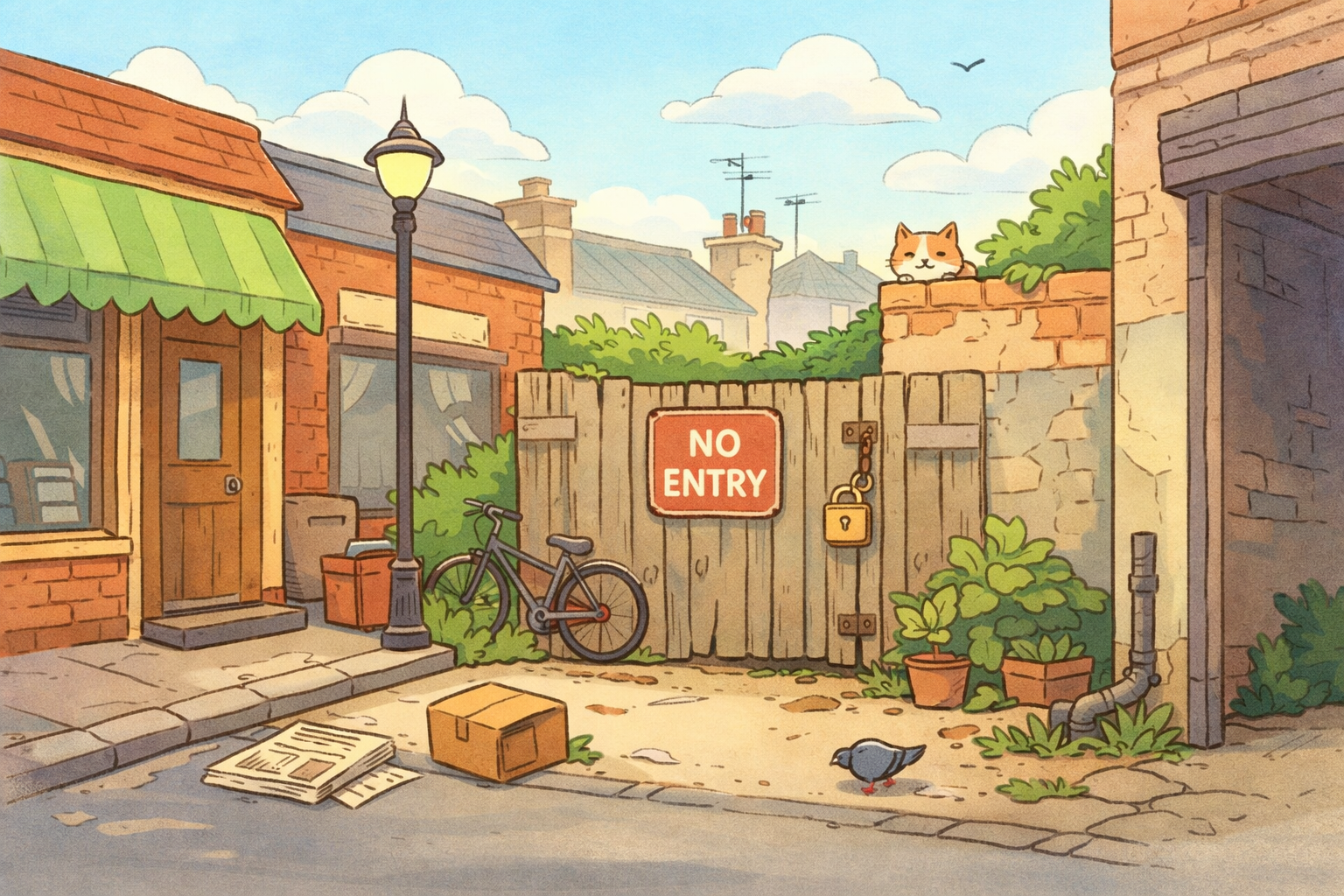
| There are places we pass every day that never quite become places at all. They remain thresholds, edges, blanks in our internal maps. A locked gate on a familiar shortcut. A shopfront that has been closed so long its sign has faded into something more like a memory than a business. A side street that never seems to lead anywhere useful, so we stop testing it. We don’t consciously decide to ignore these spaces. We stop noticing them. They sit just outside our routines, and routine has a way of narrowing vision. As a gardener, much of my work happens in these overlooked zones. Side passages. Back corners. The bit behind the shed where nothing “important” grows. And once you start working in such places, you begin to notice how common they are elsewhere — not just in gardens, but in towns, buildings, and lives. There is often an assumption that unused or unentered spaces are empty. They are not. They are simply unaccounted for. A boarded-up shop is rarely still. Dust gathers. Damp finds a way in. Pigeons discover ledges. Paper accumulates behind doors. The place is changing, just not in a way that benefits anyone. Neglect is not neutral; it is simply unmanaged change. This is true of land, buildings, and habits alike. One of the quiet myths we carry is that if something matters, we’ll naturally engage with it. In practice, the opposite is often true. Things are avoided not because they are trivial, but because they feel ambiguous. An unfamiliar alley. A cupboard that doesn’t quite make sense. A job that isn’t urgent but also isn’t finished. We leave these things alone because they resist quick categorisation. In gardens, this shows up in narrow borders and fence lines. They’re awkward to reach. Too thin for planting plans, too visible to ignore completely. Over time, they become places where “later” lives. And later, as any gardener knows, it has a habit of turning into ‘never’ unless deliberately interrupted. Town spaces behave the same way. Some streets are walked but never used, corridors in public buildings that feel more like afterthoughts than destinations. These places quietly teach us something about how we value efficiency over curiosity. If a space lacks an obvious purpose, we skim past it. Yet when someone does stop — when a shuttered unit is reopened, when a side street gets a café or a workshop — the transformation feels outsized. Not because the change is dramatic, but because attention has been restored. The place hasn’t been “improved” so much as re-entered. Working outdoors sharpens your awareness of this. You learn quickly that edges dictate outcomes. A path that is never swept slowly becomes narrower. A drain that is never checked eventually announces itself at the worst possible moment. Most problems don’t arrive suddenly; they arrive quietly, after long periods of polite neglect. This challenges another assumption: that attention must be constant to be effective. In reality, periodic, thoughtful engagement is often enough. Entering a space — physically or mentally — even briefly, changes its trajectory. The simple act of opening a door, looking behind a structure, or walking a different route can reset how something evolves. There is also a human layer to this. We all have places we don’t enter in our own lives. Conversations avoided. Tasks deferred because they don’t fit neatly into a day’s work. These are not failures of discipline so much as signals of complexity. The world is full of things that don’t present themselves cleanly. Gardening teaches patience with this. You cannot force awkward spaces into compliance without consequences. Overworking a narrow border compacts soil. Ignoring it entirely invites bindweed. The balance lies somewhere in between: light, regular acknowledgement rather than dramatic intervention. This may be why the most satisfying changes are often modest—clearing a path rather than redesigning a garden and opening a door rather than demolishing a wall. Entering, noticing, then leaving things better defined than before. The places we walk past without ever entering are not asking for grand solutions. They are asking to be seen. Once they are, they tend to tell you what they need — or at least what they can tolerate. And that, I’ve found, applies far beyond gardens. |
| About our writing & imagery Most articles reflect our real gardening experience and reflection. Some use AI in drafting or research, but never for voice or authority. Featured images may show our photos, original AI-generated visuals, or, where stated, credited images shared by others. All content is shaped and edited by Earthly Comforts, expressing our own views. |
 Earthly Comforts