| A business reflection from Earthly Comforts |
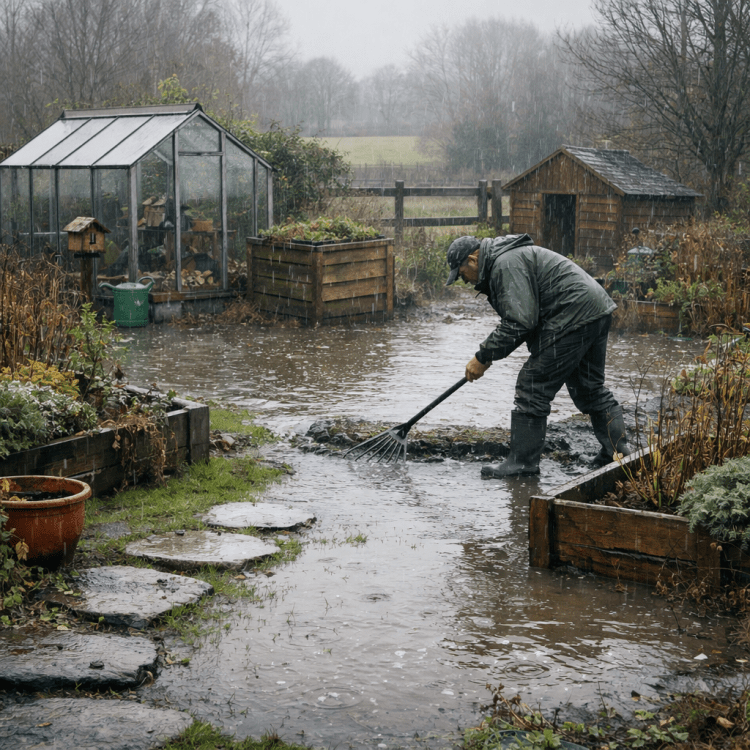
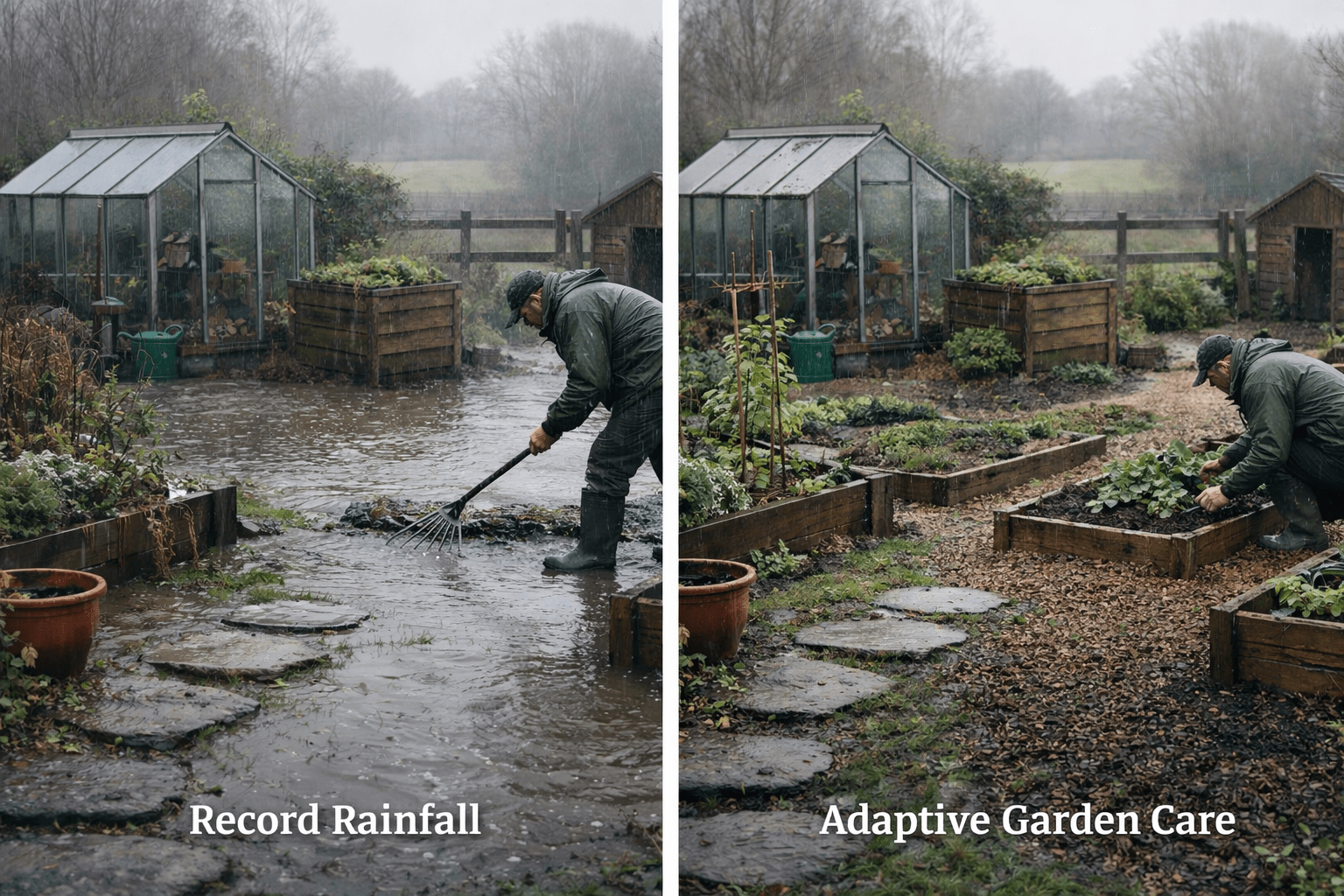
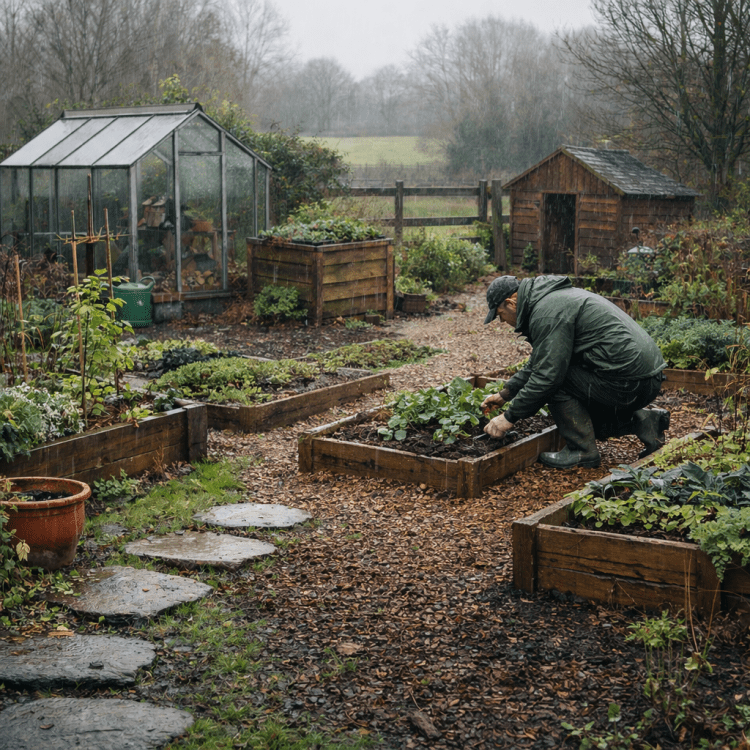
| Over recent weeks, rainfall across parts of the UK has exceeded levels recorded in previous wet years. In Kent, the ground has remained saturated for sustained periods, with little opportunity to recover between systems. Lawns have stayed soft underfoot. Borders have held standing water longer than they should. Drainage has been tested repeatedly. For those who work outdoors every day, this is not an abstract statistic. It is physical. It alters how the soil behaves. It changes what can be done responsibly. Gardening has always depended on rhythm. Winter slows the pace. Spring accelerates it. Summer steadies it. Autumn draws it back. That rhythm has long guided professional maintenance schedules and project planning. Increasingly, however, the calendar alone is no longer sufficient. When rainfall arrives in prolonged, heavy cycles, timing becomes more important than momentum. Saturated soil compacts quickly. Structure collapses under repeated pressure. Roots are more vulnerable to disturbance. Turf marks easily and takes longer to repair. Even routine activity — mowing, edging, border work — can cause lasting harm if undertaken without restraint. In these conditions, visible progress is not always the measure of good work. Protection is. There are weeks when the responsible decision is to reduce ground disturbance, reorder tasks, focus on compost systems, improve drainage, work within greenhouse spaces, or allow soil to stabilise before continuing. From the outside, this can appear slower. In practice, it prevents far greater setbacks later in the season. Professional gardening is becoming increasingly judgment-led rather than schedule-led. The diary still provides structure, but the land now has greater authority than the plan. Extended rainfall also exposes the underlying condition of a garden’s soil. Ground rich in organic matter, structure and biological life absorbs and releases water more effectively. It drains without stripping nutrients. It retains strength under pressure. Compacted or depleted soil, by contrast, struggles. Water sits at the surface. Air is excluded. Roots weaken. Climate resilience begins below ground. Much of our focus now centres on soil infrastructure rather than surface appearance. Compost systems are no longer peripheral; they are central. Mulching strategies are adjusted seasonally to protect the structure and regulate moisture. Water movement through each garden is observed more closely. Where does it collect? Where does it escape? How can it be slowed, absorbed, or redirected? These are not decorative considerations. They determine how well a garden copes with extremes — whether of rain or heat. The shift is not limited to horticulture. It reaches into the business model itself. When conditions vary daily, time-based work becomes essential. A task that might usually require two hours may require longer if approached cautiously. A project may pause briefly rather than forcing advancement that compromises soil integrity. Adaptation is not inefficiency; it is risk management. Predictability in income increasingly relies on continuity of care rather than speed of completion. Long-term relationships allow for flexibility. They allow for honest conversations about what can be done and what should wait. There is also a quieter development taking place in the margins of routine work. Several clients have underused utility areas — raised beds, greenhouses, compost bays — that are not currently active. With permission, these spaces are becoming contained environments for observation and experimentation. Varieties that tolerate prolonged wet springs are trialled. Soil systems are strengthened. Plants are grown on before installation rather than introduced at their most vulnerable stage. Small-scale experimentation reduces large-scale risk. It allows adaptation to be informed by local experience rather than general assumptions. Gardening has always involved adaptation. What feels different now is the consistency of the pressure. Record rainfall is not a one-off anomaly; it is part of a broader pattern of instability. Wet periods extend. Heat arrives abruptly. Transitions between seasons blur. This does not require alarmism. It requires attention. The public often sees gardening as aesthetic — colour, order, seasonal display. Professional garden care, however, rests on less visible foundations: soil structure, water management, timing, and restraint. In years of climatic stability, those foundations can be taken for granted. In years of deluge, they cannot. The weather is no longer a backdrop to the work. It is shaping the work. For a small, local business rooted in Sandwich and the surrounding villages, adaptation must be practical rather than theoretical. It is expressed in adjusted start times during heat, reduced machinery use on saturated lawns, careful sequencing of projects, and investment in soil health, even when it is not immediately visible. Gardens remain places of continuity and comfort. That has not changed. What has changed is the level of attention required to maintain that continuity. The tools are familiar. The plants are familiar. The work is familiar. But the margin for assumption is narrowing. Professional gardening in 2026 demands steadier judgement, clearer communication, and a willingness to adapt established rhythms without abandoning them. It is less about keeping pace with the season and more about responding to it. In a year of deluge, the lesson is not simply that it rains more. It is that responsible care must evolve alongside the climate that shapes it. |
| About our writing & imagery Many of our articles are written by us, drawing on real experience, reflection, and practical work in gardens and places we know. Some pieces are developed with the assistance of AI as a drafting and research tool. Featured images may include our own photography, original AI-generated imagery, or—where noted—images kindly shared by other creators and credited accordingly (for example, via Pixabay). All content is shaped, edited, and published by Earthly Comforts, and the views expressed are our own. |
 Earthly Comforts