| …. Becomes a Shared Responsibility |
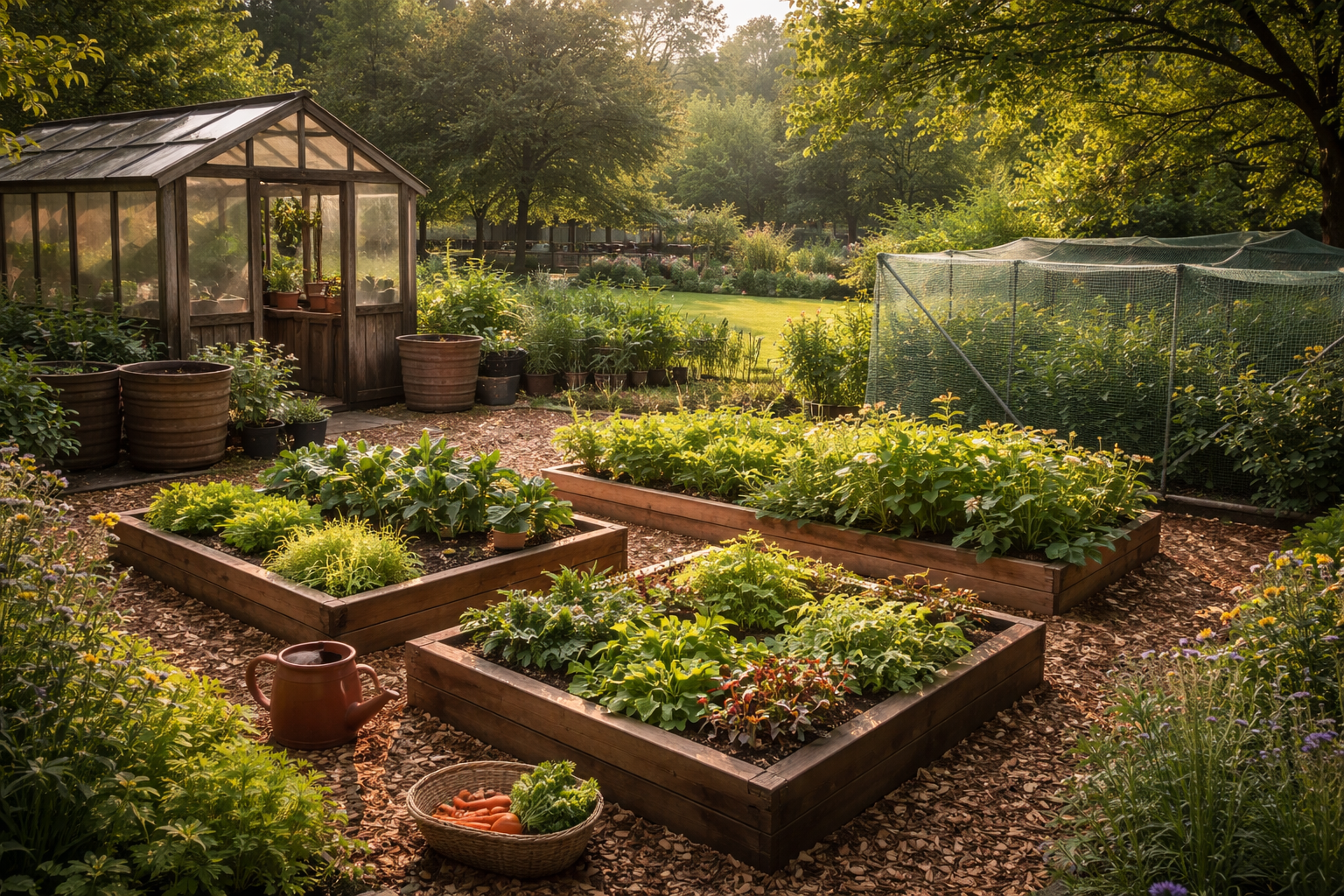
| There’s a moment that arrives in some gardens when the problem isn’t neglect, exactly, but misalignment. Nothing dramatic has happened. The owner still cares. The gardener still turns up. Plants are alive, structures intact, compost bins standing where they were always meant to stand. And yet the relationship between the garden and the people around it has subtly changed. I’ve noticed this moment more often in recent years, and not only in older gardens or with older clients. It turns up in family homes, in newly planted spaces, in gardens that were once full of intention and energy. It’s the point at which a garden designed for active use quietly outpaces the life that now surrounds it. Raised beds are a good example. They are built with optimism. They promise order, productivity, purpose. But a raised bed that isn’t planted doesn’t rest. It still needs weeding. The soil compacts. The edges loosen. The very structure that was meant to simplify gardening becomes another surface that needs managing. The same is true of greenhouses, orchard cages, and compost systems. When they’re used, they are efficient. When they aren’t, they add friction. What’s interesting is that many people don’t articulate this as a problem. Instead, it shows up indirectly. Garden visits get reduced. Maintenance starts to feel like a cost that’s harder to justify. The garden doesn’t collapse, but it stops moving forward. It holds itself in a kind of polite suspension, waiting for time, energy, or enthusiasm to return. As a working gardener, that’s the point at which I’ve learned to pause rather than push. Not every garden needs more input. Sometimes it needs a different arrangement altogether. The assumption that less use means less work There’s a quiet assumption that runs through a lot of domestic gardening: if you stop using part of a garden, it will demand less of you. In practice, the opposite is often true. A lawn left unmown becomes more complicated to cut, not easier. A greenhouse left empty doesn’t preserve itself; it deteriorates. Compost that isn’t actively fed and turned doesn’t politely wait; it slumps, smells, or dries out. Gardening systems are designed around flow. When the flow stops, they don’t freeze in place. They decay. This is rarely acknowledged because it runs against how we think about effort. We assume activity equals work, and inactivity equals rest. Gardens don’t operate on that logic. They respond to presence, not intention. I’ve seen clients quietly carry guilt about this. They feel they’ve somehow failed their garden by not keeping it up. What’s often missing from that conversation is the recognition that the garden itself may be out of step with the life currently being lived around it. That’s where the idea of a shared arrangement began to take shape, not as a clever solution, but as a way of acknowledging reality without blame. Two gardens in one space Many gardens, especially those that have evolved, contain two very different kinds of space. There is the garden that frames daily life: the view from the kitchen, the place where a chair sits, the stretch of lawn that makes a house feel open rather than hemmed in. This part of a garden thrives on steadiness. It doesn’t want constant intervention. It wants rhythm. Then there is the working garden. It may not even be called that, but it behaves like one. It is designed around use: growing, composting, propagating, and storing. It assumes someone will be there regularly, noticing, adjusting, responding. Problems arise when one person is expected to maintain both spaces equally, even if they no longer serve their original purpose. Reducing maintenance across the whole garden doesn’t solve that. It often accelerates the imbalance. The idea we’ve begun exploring is not about asking clients to do more or to recommit to a way of gardening that no longer fits. It’s about separating responsibility more honestly. What happens if the working garden is allowed to remain a working garden, even if the homeowner no longer needs to be the one doing the work? From maintenance to exchange The word “exchange” matters here. This is not about taking something for nothing, nor about reframing maintenance as charity or a favour. It’s about recognising that value doesn’t always move in one direction. In certain gardens, we’ve started to ask whether the utility area might function better if we actively used it, rather than lightly maintaining it for a purpose that has faded. In return, the central garden continues to receive care, without that care feeling like a stretched expense. This isn’t something that suits every client or every garden. It only works where there is trust, space, and a shared understanding of boundaries. But where it does work, it resolves a tension that standard maintenance models struggle to address. The garden doesn’t shrink. It doesn’t get simplified by removal or abandonment. Instead, it becomes divided by use rather than ownership. One part remains domestic and private. The other becomes quietly productive. What’s interesting is how often this feels like relief rather than compromise. Presence without intrusion One of the first concerns people raise when they hear about this idea is disturbance. The fear is understandable. No one wants their garden to become a workplace in the conventional sense, with constant activity or loss of privacy. In practice, working gardens don’t need constant presence to function well. They need attentiveness at the right moments. There is a difference between being busy and being effective. A well-managed greenhouse doesn’t require daily visits if it has been set up thoughtfully. Raised beds planted for flowers and herbs, rather than intensive vegetable production, are forgiving. Once established, orchard cages require seasonal care rather than continual input. The aim is not to intensify activity, but to restore purpose. When a space is used with intention, it often becomes quieter, not louder. Systems settle. Compost behaves. Plants grow in expected rhythms. As a gardener, I’ve found that the more deliberate the use of a space, the less chaotic it becomes. The myth of the perfect productive garden There is another assumption worth challenging here: that a productive garden must be visibly productive to be justified. Images of abundance surround us, of raised beds crammed with vegetables, of greenhouses bursting at the seams. These images are seductive but also misleading. Productivity isn’t always measured in volume. Sometimes it’s measured in stability. A bed planted with herbs and cutting flowers may never look impressive on a harvest table, but it holds soil, supports insects, and asks very little in return. A greenhouse used for growing plants quietly supports dozens of other gardens without ever drawing attention to itself. When we think about using utility spaces in this way, we’re not chasing yield. We’re looking for resilience. We’re interested in gardens that continue to function well even when attention ebbs and flows. That perspective has been shaped as much by failure as by success. I’ve grown enough overambitious beds to know that intensity is fragile. Simpler systems last longer. Training, without the training ground Alongside the client-facing benefits, there is another layer to this idea that matters to us as gardeners. Good gardening is learned slowly. It doesn’t come from manuals or courses alone. It comes from watching plants over time, from making small mistakes in low-stakes environments, from understanding how systems behave across seasons. Our allotment has taught us a great deal, but it is only one context. Domestic gardens behave differently. Soil varies—light shifts. Human expectations shape decisions in ways that allotments don’t. Having access to working utility spaces within real gardens allows us to train, observe, and refine skills in a grounded rather than theoretical way. It allows newer staff to learn how to manage compost properly, set up watering systems that actually reduce labour, and work with structures rather than fight them. This isn’t about turning clients’ gardens into classrooms. It’s about recognising that learning and care can coexist when approached with humility and restraint. What happens when circumstances change One of the most critical aspects of this arrangement is its reversibility. Gardens are not static, and neither are lives. A utility area that feels surplus to requirements now may feel valuable again in a few years. Or it may not. We’ve been careful to think about how this kind of partnership ends as well as how it begins. The worst arrangements are the ones that become awkward to unwind. If a client decides they no longer want raised beds, compost systems, or greenhouses, that shouldn’t feel like a failure. It’s simply another stage in the garden’s life. Being involved in that transition allows materials to be reused rather than wasted, and decisions to be made calmly rather than reactively. In some cases, simplifying a garden is the most respectful thing you can do for it. Care without obligation What keeps drawing me back to this idea is how often it reframes care as something lighter rather than heavier. Instead of asking clients to recommit to gardening as an identity, it allows them to remain connected to their garden without obligation. They don’t have to decide what to plant. They don’t have to keep up. They don’t have to feel guilty about structures they no longer use. The garden continues to be tended, but responsibility is redistributed in a way that reflects reality rather than aspiration. From a gardener’s point of view, that honesty is refreshing. It allows us to stop pretending that every garden must be all things to all people at all times. Letting conclusions emerge I’m wary of turning this into a model or a programme. It isn’t that. It’s an idea that has emerged from paying attention to where friction arises and asking whether it’s necessary. Some gardens want less. Some want something different. Some want to be shared. What this approach offers, at its best, is a way of keeping gardens alive without forcing them to perform. It recognises that value can flow both ways, and that care doesn’t always look like ownership. As gardeners, we’re used to adapting to soil, weather, and plants. Adapting our relationships with clients and with gardens themselves feels like a natural extension of that work. The point isn’t to preserve every structure or justify every expense. It’s to allow gardens to keep moving, even when the lives around them have shifted. And sometimes, that movement begins not with doing more, but with rearranging who does what, and why. |
| About our writing & imagery Most articles reflect our real gardening experience and reflection. Some use AI in drafting or research, but never for voice or authority. Featured images may show our photos, original AI-generated visuals, or, where stated, credited images shared by others. All content is shaped and edited by Earthly Comforts, expressing our own views. |
 Earthly Comforts