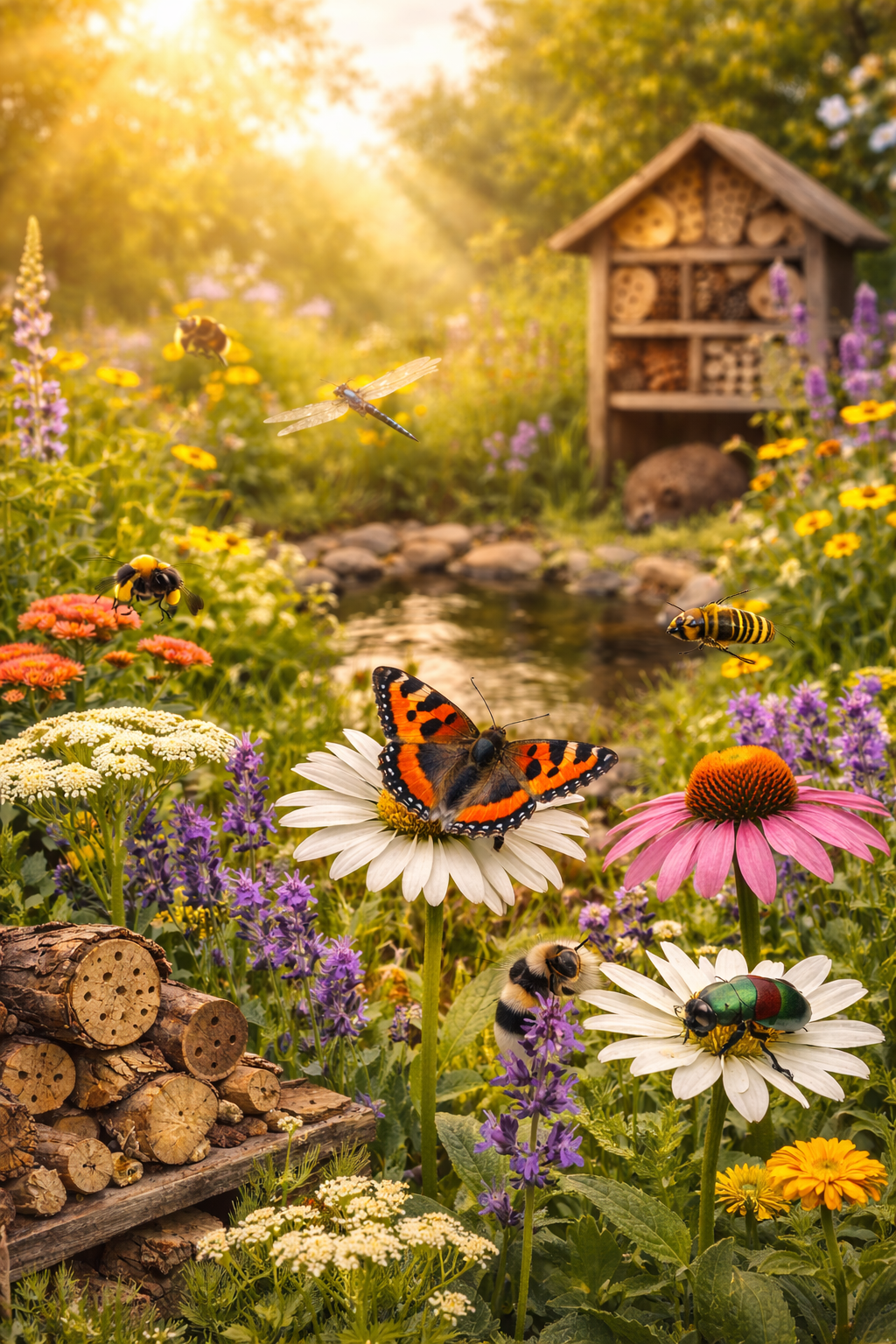
| Why Insect Decline Is Slowing in Some Places — and What That Means for Our Gardens Recent biodiversity reporting has offered a phrase that feels cautiously encouraging: glimmers of hope. After decades of documented decline, some insect populations appear to be stabilising, at least in the short term. This does not mean the crisis is over, nor does it suggest a return to former abundance. But it does signal something important — that action, however small or scattered, can make a difference. Understanding what these “glimmers” represent is vital. They are not signs of recovery in the traditional sense. Instead, they point to areas where declines may be slowing, where losses are no longer accelerating, and where ecosystems are beginning to hold their ground. In ecological terms, that matters. Stabilisation is often the first step before any genuine improvement becomes possible. What Do “Glimmers of Hope” Actually Mean? When scientists talk about glimmers of hope, they are usually referring to trends over recent years rather than the full historical picture. Many insect species remain far below their numbers from decades ago, but some are no longer declining as steeply as before. In a few cases, populations are holding steady. This matters because unchecked decline leads to collapse. Slowing that decline buys time — time for habitats to recover, for better land management to take effect, and for people to change how they interact with the natural world. It also suggests that certain pressures, such as reduced chemical use or improved habitat quality in specific areas, may be easing. Hope, in this context, is fragile. It depends on continued effort and widespread participation. Why Gardens Are Part of the Hope Story One reason these glimmers exist at all is that landscapes are not uniform. While large-scale pressures like climate change and intensive land use remain dominant, pockets of refuge are emerging. Gardens are increasingly part of that picture. Across towns and villages, more gardeners are leaving areas unmown, planting nectar-rich flowers, reducing chemical use, and allowing natural processes to unfold. Individually, these actions may seem modest. Collectively, they create networks of feeding, breeding, and resting sites that insects can rely on. Gardens also provide consistency. Unlike agricultural land, which may change use from year to year, a garden that provides shelter and food across seasons becomes a dependable resource. For insects struggling to complete their life cycles, that reliability can be the difference between survival and loss. Stabilisation Is Not Recovery — Yet It is important to be honest about what has not changed. Insect numbers remain low compared to historical levels. Many species are still vulnerable, and some continue to decline sharply. A plateau is not the same as a rebound. However, ecosystems rarely bounce back quickly. Recovery, when it happens, is slow and uneven. It begins with halting losses, then rebuilding complexity over time. Seen through that lens, stabilisation is not a disappointment; it is progress. Gardens that prioritise diversity, soil health, and year-round habitat are helping to create conditions where recovery is at least possible. Without those conditions, hope would be far harder to justify. The Role of Ordinary People One of the most encouraging aspects of recent biodiversity data is the role volunteers and everyday observers play. Monitoring schemes, garden records, and citizen observations are now central to understanding what is happening to insects. This matters because it shifts conservation from something distant and institutional to something personal and participatory. When people notice fewer butterflies, then later notice stability or slight improvement, they are witnessing a change in real time. That awareness often leads to further action, creating a positive feedback loop. Gardens become not just habitats, but observation points — places where people reconnect with seasonal rhythms and ecological relationships. Holding the Line Matters In conservation, holding the line is often undervalued. Preventing further loss may not feel as inspiring as restoring abundance, but it is a necessary stage. Without stability, restoration efforts struggle to take root. Gardens that support insects are helping to hold that line. They reduce pressure on fragile populations and provide stepping stones between larger habitats. They also help buffer ecosystems against shocks, such as extreme weather, by providing microhabitats that offer shelter and moisture. In this sense, hope is not abstract. It is practical, grounded, and cumulative. Turning Glimmers into Momentum The danger with hopeful language is complacency. Glimmers of hope can fade quickly if attention shifts elsewhere. For stabilisation to turn into recovery, supportive practices must become the norm rather than the exception. This means continuing to rethink what a “good” garden looks like. It means valuing life over tidiness, diversity over uniformity, and long-term resilience over short-term control. It also means recognising that gardening choices are ecological choices, whether intentional or not. The hopeful signs we are beginning to see are not accidental. They are the result of thousands of small decisions made by people who chose to work with nature rather than against it. A Quiet but Meaningful Optimism There is no easy fix for insect decline, and no single solution waiting to be applied. But there is reason for cautious optimism. The slowing of losses suggests that ecosystems can respond when pressure is reduced and habitat is restored, even at small scales. Gardens are proving that change does not always begin with sweeping policies or grand interventions. Sometimes it begins with leaving a patch of ground undisturbed, planting one more flowering plant, or choosing not to intervene. These choices may seem minor, but together they form the foundations of hope — not loud or dramatic, but steady, grounded, and real. |
Glimmers of Hope
 Earthly Comforts