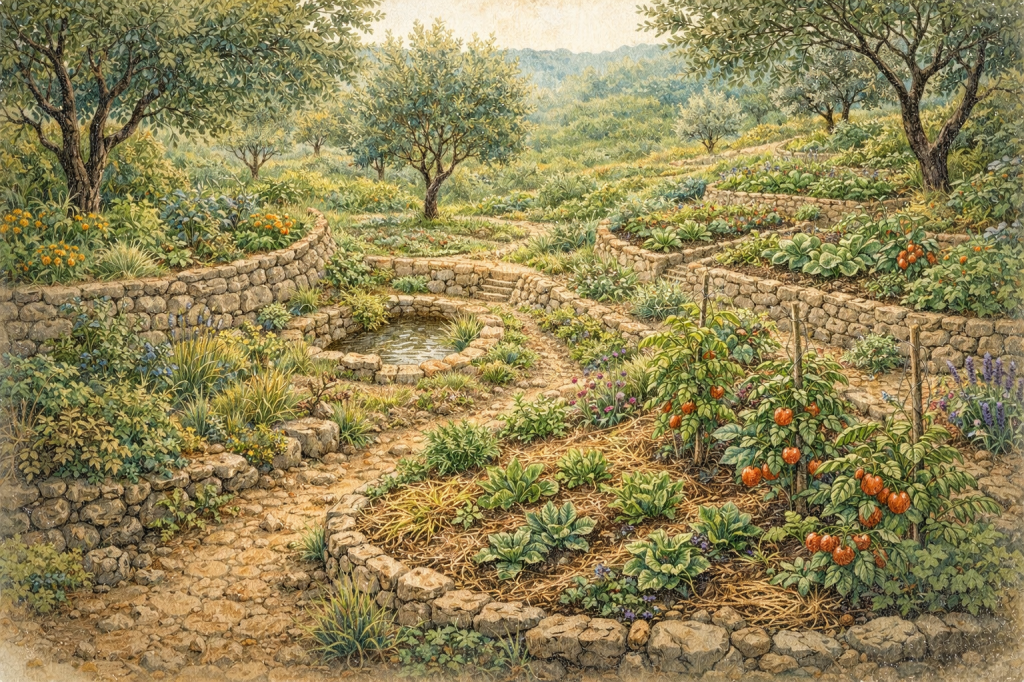
| Episode 6: Stefano Soldati Growing Vegetables as Part of Living Systems If Pascal Poot’s work asks how vegetables adapt under stress, Stefano Soldati explores a related but distinct question: What happens when vegetables are no longer treated as isolated crops, but as participants in a wider, living system? Based in Italy, Soldati is best known as a practitioner and educator within Mediterranean permaculture, where vegetable growing is inseparable from soil life, perennial structure, shade, water flow, and time. His work may be quieter than headline-driven gardening figures, but it is deeply influential among growers working with heat, marginal soils, and long-term land stewardship. An Italian Context for Vegetable Growing Vegetable gardening in much of Italy looks very different from its northern European counterpart. Summers are hot, rainfall is irregular, and soils are often shallow or degraded. In these conditions, conventional high-input vegetable growing can quickly become unsustainable. Stefano Soldati’s work emerges directly from this reality. Rather than asking how to force productivity, he asks how to design conditions where vegetables can persist, even when water is scarce and temperatures are extreme. Beds are rarely bare. Vegetables are often grown alongside: Perennials and shrubs Nitrogen-fixing plants Ground covers Trees that provide partial shade The result is not a tidy vegetable plot, but a functional landscape. Vegetables Within a Permaculture Framework Soldati’s approach places vegetables inside a permaculture framework that prioritises relationships over rules. Crops are selected not only for yield, but for how they interact with their surroundings. In practical terms, this means: Using shade strategically to reduce heat stress Building soil through organic matter and root diversity Slowing and capturing water across the site Accepting seasonal variation rather than fighting it Vegetables are not expected to perform identically year after year. Instead, the system is designed to absorb fluctuation — something increasingly relevant as climate patterns become less predictable. Time as a Gardening Tool One of the most distinctive aspects of Stefano Soldati’s work is his emphasis on time. Where many vegetable gardens are reset annually, his systems are allowed to mature. Soil improves gradually. Microclimates develop. Self-seeding becomes part of the cycle. Over time, vegetables begin to benefit from conditions deliberately slow to develop. This challenges the idea that gardening success should be immediate. Instead, Soldati demonstrates that some of the most resilient vegetable systems only reveal their strengths after years of observation and adjustment. Practical Lessons for Home Growers Although rooted in permaculture, Soldati’s work is not abstract. For home vegetable gardeners — especially those dealing with heat, drought, or declining soil — his approach offers several transferable lessons: Vegetables do not need full sun at all costs. Bare soil is a liability in hot climates. Diversity stabilises production Long-term thinking reduces labour over time. Even small gardens can borrow from this mindset by integrating herbs, flowers, mulch, and perennials into vegetable spaces. Why Stefano Soldati Belongs in This Series Stefano Soldati is included not because he represents mass popularity, but because he represents a way of thinking that many gardeners will need. As conditions become more challenging, vegetable gardening may rely less on inputs and more on design. Soldati’s work shows how vegetables can thrive when supported by living systems rather than constant correction. Within the European section of this series, he provides a crucial counterpoint to both intensive productivity and extreme stress-selection. His work occupies the middle ground: designed resilience. Where to Follow Stefano Soldati Stefano Soldati primarily shares his work through education and long-form teaching rather than frequent short-form content. His presence reflects the nature of his practice: thoughtful, system-based, and rooted in lived experience. You can find his work through: Educational talks and filmed lectures, where he explores permaculture design, vegetable growing in Mediterranean climates, and long-term land stewardship Permaculture courses and workshops, delivered in Italy and internationally, focus on practical design principles and real-world application. Online resources connected to Permaculture Italy, including articles, interviews, and course material linked to his teaching and project work Rather than offering quick techniques, Soldati’s work invites growers to think more deeply about how vegetables fit into wider living systems, making his resources particularly valuable for those interested in resilience, design, and long-term sustainability. Books and Teaching Stefano Soldati is associated with permaculture education and teaching rather than a large catalogue of popular books. His influence comes primarily through: Courses Design work Long-term projects This makes his contribution quieter, but no less substantial. A Mediterranean Perspective on the Future As this series continues across Europe, Stefano Soldati’s work reinforces an essential idea: vegetable gardening does not exist in isolation from land, climate, or culture. In Italy, where food growing has always been tied to landscape and tradition, his approach feels less like innovation and more like reconnection — a reminder that vegetables grow best when they are allowed to belong. |
 Earthly Comforts