| A Seven-Part Exploration of Resilience, Climate, and the Future of Earthly Comforts |
| Part II — The Global Shift Away from “Lawn-First” Services |
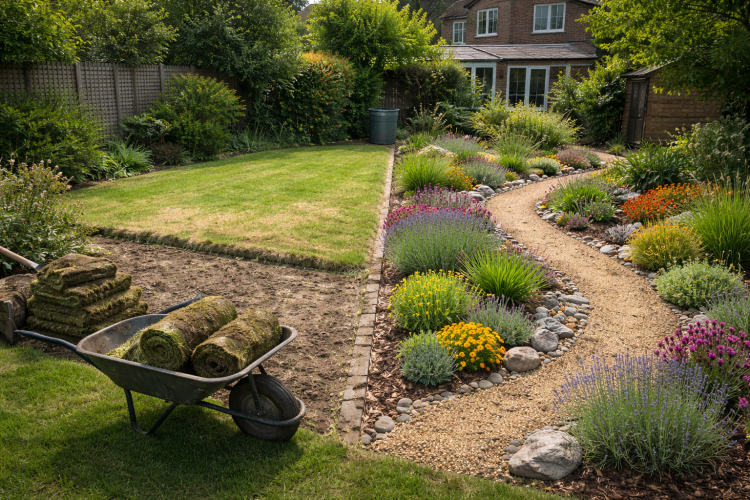
| Turf conversion, water pressure, and the restructuring of garden businesses In the previous part of this series, we established that climate volatility is no longer a distant projection but an operational reality. Wetter winters, more erratic rainfall, hotter and potentially drier summers — these are not abstract forecasts. They are conditions that shape working days, client conversations, and business planning. Part II moves outward. If climate pressure is altering local gardening practices, how are businesses elsewhere responding? In particular, what happens to a lawn-centric service model when environmental constraints intensify? To answer that question clearly, it is useful to examine regions where water scarcity has already forced structural change. California provides one of the clearest examples, not because it mirrors Kent, but because it demonstrates what occurs when turf becomes economically and politically unsustainable. For much of the twentieth century, the suburban lawn symbolised prosperity and order in both the United Kingdom and the United States. Its cultural power shaped residential landscapes across continents. Yet lawns are resource-intensive systems. They require consistent water, fertiliser, cutting, and maintenance. Under stable climatic conditions, this model appears sustainable. Under prolonged drought, it becomes fragile. In parts of California, recurring drought cycles and mounting water security concerns prompted policy interventions. Water authorities introduced rebate programmes incentivising the removal of ornamental turf and its replacement with drought-tolerant planting. In some cases, these rebates were substantial, covering a significant portion of the cost per square foot removed. The language shifted as well. Policymakers began distinguishing between “functional turf,” such as play areas, and “nonfunctional turf,” which refers to decorative grass with no direct use. The distinction was not aesthetic. It was economic and environmental. Water allocation could no longer justify ornamental expanses. The result was not the collapse of landscaping businesses. Instead, it triggered adaptation. Companies that had built predictable revenue around mowing and turf management began restructuring their service portfolios. Turf removal became a billable project. Soil preparation and grading followed. Drip irrigation systems replaced sprinklers. Drought-tolerant planting design gained prominence. Maintenance contracts shifted from cutting frequency to plant stewardship and irrigation monitoring. Revenue did not disappear; it reconfigured. This reconfiguration offers an instructive lesson. When environmental constraints undermine a dominant service line, businesses that can pivot to structural adaptation preserve stability. Those who resist often experience volatility. The UK is not California. Average rainfall patterns differ, and cultural expectations around gardens remain distinct. Yet parallels exist. The Met Office has projected that UK summers may become hotter and potentially drier, while winters trend warmer and wetter under certain scenarios. Water companies have issued hosepipe bans during sustained dry spells in parts of England. Public discourse around water security and biodiversity continues to intensify. Although the UK has not formally categorised ornamental turf in its language, the pressures are evident. Extended dry periods stress lawns that were historically dependable. Heavy rainfall events saturate soil, restricting access and increasing the risk of compaction. The assumption that turf can remain the unquestioned centre of domestic garden services becomes less certain. The economic implications for a small gardening business are subtle but significant. A lawn-first model concentrates revenue on a single biological system. When that system performs well, income flows steadily. When it struggles, income contracts or becomes harder to justify. Climate variability increases the frequency of stress events. Consequently, the revenue stream tied to grass becomes more sensitive to weather patterns. Businesses responding to this pressure have adopted several structural strategies. The first is the monetisation of conversion. Rather than viewing lawn reduction as a loss of future mowing income, firms frame it as an opportunity for design and installation. Turf removal requires labour, disposal, soil preparation, and reconfiguration. Replanting requires plant selection, mulching, and often irrigation redesign. Each stage generates professional fees. Moreover, the resulting landscape requires ongoing care — albeit of a different nature from cutting. The second strategy involves water infrastructure. In drought-prone regions, irrigation retrofits have become a reliable source of income. Smart controllers, drip lines, and soil moisture sensors are installed not as luxury additions but as risk mitigation tools. In wetter climates, drainage improvements and sustainable drainage features serve a parallel function. Both approaches move the business away from surface maintenance toward system management. The third adaptation concerns pricing logic. Traditional maintenance models often focus on visit frequency. Climate-aware models increasingly revolve around function. Soil improvement programmes, drought-resilient planting packages, and seasonal resilience assessments shift the conversation from how often the grass is cut to how effectively the landscape performs under stress. This shift in framing alters perceived value. Clients readily compare mowing rates; they compare resilience strategies less easily. Expertise in environmental adaptation becomes a differentiator. Culturally, attitudes toward lawns are evolving as well. In urban areas across Europe and North America, biodiversity initiatives and community gardening movements have encouraged reduced turf areas and increased planting diversity. Younger homeowners in particular demonstrate openness to mixed planting schemes, edible spaces, and pollinator habitats. While this trend is uneven, it signals a gradual diversification of expectations. For a gardening service operating in Kent, the question is not whether to replicate Californian xeriscapes. The climatic context does not demand that. The relevant lesson lies in structural anticipation. Regions that experience environmental constraint earlier offer insight into potential future adjustments elsewhere. If water pressure intensifies in parts of the UK, if public scrutiny of resource use increases, or if turf reliability declines under hotter summers, businesses that have already diversified their service base will absorb the shift more easily. Those dependent primarily on mowing frequency may face sharper adjustments. It is important to avoid oversimplification. Lawns will not vanish from British gardens. They serve recreational, aesthetic, and ecological roles when managed appropriately. The argument here is not abolition but proportionality. Reducing overdependence on a single landscape element strengthens business resilience. The economic psychology behind turf reduction deserves attention. When a lawn is replaced with a planting scheme designed for lower water demand and higher biodiversity, the maintenance pattern changes. Instead of uniform cutting, the work shifts to seasonal pruning, monitoring, and soil care. The labour intensity may not decline significantly, but its nature evolves. The client perceives a shift from repetitive trimming to informed stewardship. From a financial perspective, this can stabilise income under volatile conditions. Conversion projects generate immediate revenue. Ongoing stewardship generates recurring income less tied to rainfall patterns. Advisory services add value independent of plant growth cycles. The broader point is structural. Climate volatility challenges the assumption that one dominant service model can remain indefinitely stable. Observing how other regions have responded to similar pressures offers foresight. For Earthly Comforts, this means examining the proportion of income derived from turf-based maintenance and considering how to gradually rebalance it. Introducing modular systems, soil-focused programmes, and climate-aware planting does not replace lawns; it reduces the risk of concentration. The global shift away from lawn-first services is not a dramatic rupture. It is a gradual rebalancing driven by environmental realities and economic pragmatism. Where water becomes scarce, turf shrinks. Where rainfall becomes erratic, drainage expertise becomes more important. Where public awareness grows, expectations evolve. The lesson is not to follow trends uncritically, but to recognise structural signals early. Diversification undertaken deliberately is less disruptive than adaptation forced by crisis. In the next part of this series, we turn from global patterns to practical embodiment, examining how modular micro systems — particularly pallet collar raised beds — function as climate infrastructure within domestic gardens. |
| About our writing & imagery Most articles reflect our real gardening experience and reflection. Some use AI in drafting or research, but never for voice or authority. Featured images may show our photos, original AI-generated visuals, or, where stated, credited images shared by others. All content is shaped and edited by Earthly Comforts, expressing our own views. |
 Earthly Comforts