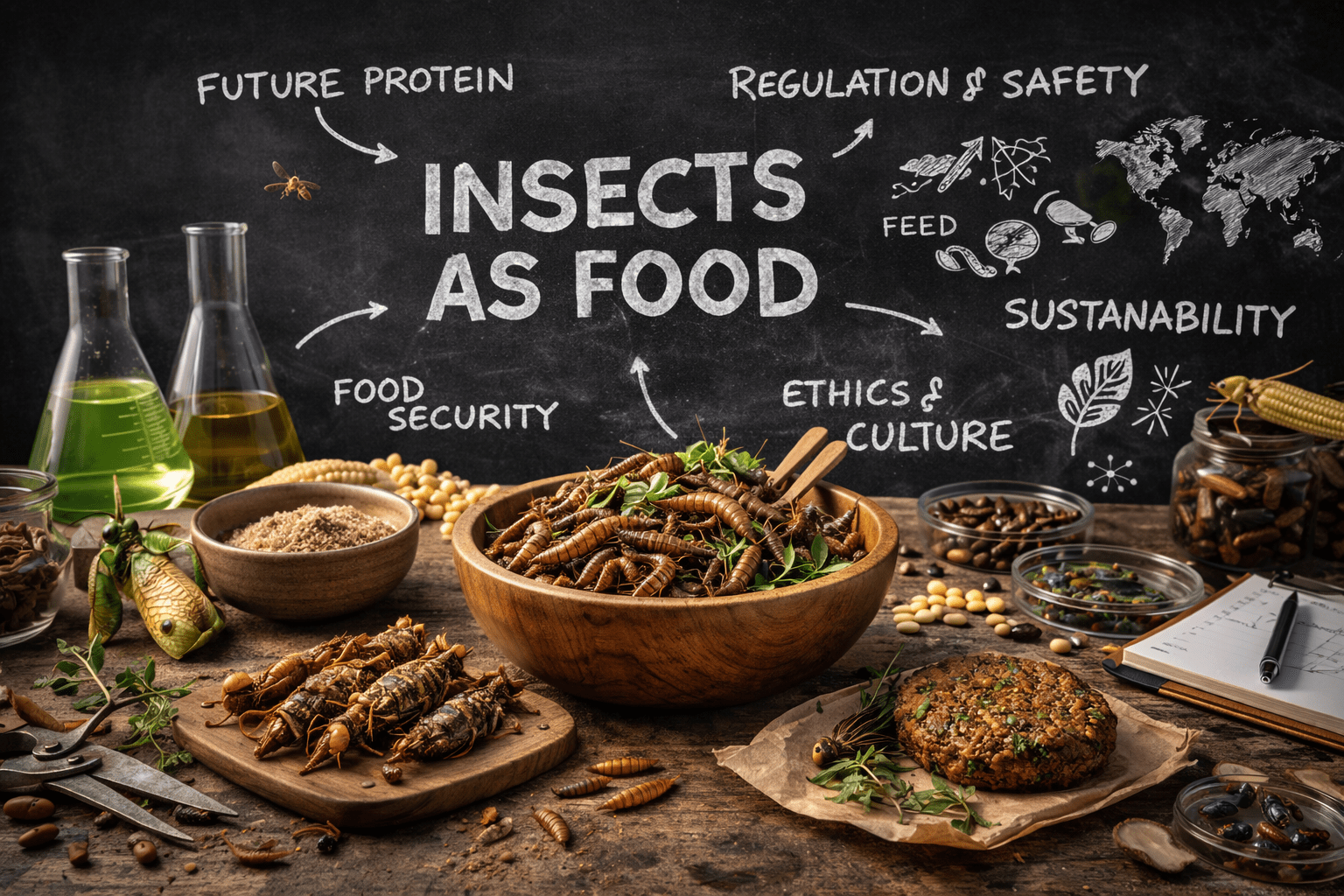
| This post follows on from my previous two reflections exploring insect decline and our shifting relationship with the natural world. After looking at how many insect species are disappearing each year, and then considering what it might mean if insects became a future food source, I realised I wasn’t finished thinking about it. This piece exists because I am genuinely fascinated by where this subject is leading us — not just environmentally, but culturally, ethically, and practically. As a gardener, watching these conversations unfold while working daily alongside insects feels both unsettling and unavoidable. |
| The Realities of “Bugs on the Menu” in the Near Future The idea of eating insects still triggers a gut reaction for many people in the UK: curiosity mixed with “surely not.” But in the background, the topic has moved from novelty snack and social-media dare into something more serious—because the pressures that reshape diets are also becoming more serious: cost, climate volatility, land use, and the need to find proteins that don’t demand ever more farmland. If insects do become a mainstream consumption item in the future, it won’t happen because everyone suddenly fancies a bowl of crickets. It’ll happen (if it happens) because insects fit a set of practical constraints—and because regulators, manufacturers, and consumer culture find ways to make them feel normal. Here’s what the reality looks like when you take the hype out and look at what research, regulation, and real-world adoption are actually saying. |
| Why did insects enter the “future food” conversation at all? Insects became part of the alternative-protein conversation for three big reasons. They can be efficient at turning feed into edible protein. Many species grow quickly, breed rapidly, and can be reared with a relatively small footprint. This is one reason major international bodies have treated insects as a potential lever for food and feed security. (iadns.onlinelibrary.wiley.com) They can slot into existing products. Most companies don’t plan to sell a whole insect on a plate. The more realistic route is milling insects into powders, pastes, oils, or protein ingredients and blending them into familiar formats—snack bars, pasta, baked goods, “meat” analogues—where the insect isn’t visually obvious. They can also be used indirectly, as animal feed. Even if many people never eat insects directly, insect protein can still enter the food system through poultry, fish, or pigs—depending on what regulations allow and what becomes economically viable. The environmental reality: “Better than beef” is not the whole story. A lot of early momentum came from life-cycle assessment (LCA) work suggesting that mealworms and other insects could be less land-intensive and emit lower greenhouse gas emissions than some conventional animal proteins. A widely cited mealworm LCA found lower land use and lower greenhouse gas emissions than several conventional animal proteins, though outcomes depend on how and where production happens. (PLOS) But as the evidence base matures, the picture becomes more nuanced. Broader LCA work repeatedly highlights that energy use (heating, ventilation, drying, processing) can be a major driver of impact in insect systems, and results can swing depending on feed inputs and production design. (ScienceDirect) There’s also a key comparison problem. Insect protein is often compared to beef or pork because it can look strong in that match-up, but that doesn’t automatically mean it outperforms plant proteins. A recent peer-reviewed analysis argues that insect-based foods are unlikely to significantly reduce meat consumption in the West, citing practical barriers such as acceptance and market dynamics—an important reality check on “insects will replace meat” claims. (Nature) So if insects do become a “future food,” the environmental case will hinge less on the insect itself and more on the system around it: what insects are fed, how much energy is used to keep conditions stable, how processing is powered, and what the product is replacing in the diet (beef is a very different substitution case than beans). Feedstock and “Circular economy”: promising, but constrained One of the most appealing ideas is that insects can convert organic side-streams into valuable protein, closing loops rather than taking more land. In practice, this is complicated. The “circular” promise depends on what side-streams are legally and safely permitted, because feed rules, contamination risks, and consistency requirements can limit what insects are allowed to consume—especially if the end product is for humans, or if insects are used to feed animals destined for the human food chain. Even within feed-focused systems like black soldier fly larvae, LCA findings show that impacts depend strongly on the chosen diets and local operating conditions. (ScienceDirect) The circular vision is still real, but it’s not a free-for-all. It’s a carefully controlled industrial process—or it won’t scale. The regulatory reality in Great Britain and the EU: This is already happening, but under tight control In Great Britain (England, Scotland, Wales), edible insects are subject to novel food rules. From 1 January 2024, food products containing edible insects may only remain on the GB market if the Food Standards Agency (FSA) received a novel food application for that insect species on or before 31 December 2023. (Food Standards Agency) A practical point for accuracy: in the transition period, the FSA’s position is commonly summarised as only a small set of species being able to remain on sale under those measures—often listed as yellow mealworm (Tenebrio molitor), house cricket (Acheta domesticus), banded cricket (Gryllodes sigillatus), and black soldier fly (Hermetia illucens)—because those are the species with applications received by the deadline that businesses rely on for continued market presence. (Ian Thomas Associates) In the EU, authorisations have been progressing under the Novel Food Regulation pathway. For example, the EU has authorised the frozen, dried, and powdered forms of the house cricket (Acheta domesticus) under specific conditions. (EUR-Lex) This matters because it changes the “future” conversation into a “present” one. The question isn’t “will it ever be legal?” It’s “how fast will approvals expand, what formats will be allowed, and how will safety and labelling be handled?” The food safety reality: Allergies are a serious, non-optional part of the story Insect foods aren’t automatically unsafe—but they’re not a casual ingredient either. European safety assessments repeatedly highlight allergy risk. EFSA opinions on yellow mealworm, for example, note that consumption may induce sensitisation and allergic reactions, and may trigger reactions in people with existing allergies to crustaceans and dust mites due to potential cross-reactivity. They also note that allergens from feed could end up in the novel food. (European Food Safety Authority) If insect consumption grows, the “real world” version will involve strict controls on species, farming conditions, processing, microbiology, and very clear allergen communication. The future is not the wild west. It’s paperwork, standards, and compliance. The cultural reality: Most Western consumers won’t eat visible insects—at first The biggest barrier in places like the UK is not nutrition. It’s acceptance. Large reviews of consumer acceptance repeatedly find the same pattern: people are more open when insects are incorporated invisibly (powders, flours), when products feel familiar, and when “disgust” is managed through presentation and social norms. (PMC) A broader systematic review of alternative proteins also finds that acceptance for insects tends to be the lowest among the major alternative protein categories studied, reinforcing the idea that “mainstream” adoption would likely be slow and format-dependent. (ScienceDirect) So the most plausible pathway is not plates of crunchy crickets. It’s insect ingredients inside everyday items, marketed around fitness, function, and familiarity. The economic reality: Scaling is harder than the hype suggests Industrial insect farming sits in a tricky middle zone. It isn’t traditional agriculture, but it isn’t simple tech manufacturing either. It needs stable biology (temperature, humidity, breeding), tight biosecurity, reliable inputs, energy for climate control and processing, and consistent output that meets food-grade specifications. This is one reason you’ll see insect protein positioned both as premium (health/novelty) and as a commodity (feed ingredient). Those are two very different businesses—and the path to profitability depends on energy prices, regulation, scale, and whether the product can compete with other proteins that are already cheaper and culturally normal. The ethics reality: Welfare questions are coming, fast As the industry grows, ethical questions expand. What does humane handling look like for billions of insects? What are acceptable killing methods? What about genetic optimisation or intensive rearing conditions? You don’t need a final position today to see where it’s going: any mainstream animal production system eventually faces welfare scrutiny. Insects won’t be exempt just because they’re small. The “future reality”: Insects may become normal in feed before they become normal on plates If you want the most plausible mainstream scenario, it’s this. Insect-derived ingredients expand in animal feed (where regulations allow and they can compete on price and supply stability), while human consumption grows more slowly, led by powders and blended products rather than visible insects. This still changes food culture. It still changes farming. It still changes the regulation. But it avoids betting everything on a sudden shift in consumer psychology. |
| What this means in plain terms Insects as a consumption item may well grow, but it won’t be a single, simple trend. It will be a patchwork of: Tightly regulated species and formats (especially in GB and the EU). (Food Standards Agency) A sustainability story that depends on energy, feed, and what insects replace in the diet. (PLOS) A safety story dominated by allergens and standards. (PMC) A consumer story driven by “invisible” use and familiar foods. (ScienceDirect) And above all: insects won’t “save the planet” by themselves. They’re a tool—useful in some contexts, oversold in others. |
| Further Reading & Supporting Research (Sources) Food Standards Agency (GB). Edible insects guidance (updated Sept 2025). (Food Standards Agency) Commission Implementing Regulation (EU) 2022/188. Authorising frozen, dried and powder forms of Acheta domesticus as a novel food. (EUR-Lex) EFSA Journal (2021). Safety of frozen and dried formulations from whole yellow mealworm (Tenebrio molitor larva) as a novel food (allergenicity and cross-reactivity considerations). (European Food Safety Authority) Oonincx, D.G.A.B. & de Boer, I.J.M. (2012). Environmental impact of the production of mealworms as a protein source for humans – A life cycle assessment. (PLOS ONE). (PLOS) Smetana, S. et al. (2016). Sustainability of insect use for feed and food: Life Cycle Assessment perspective. (Journal of Cleaner Production). (ScienceDirect) Biteau, C. et al. (2025). Beyond the buzz: insect-based foods are unlikely to significantly reduce meat consumption. (Nature) Kröger, T. et al. (2022). Acceptance of insect-based food products in Western societies (systematic review). (PMC) Onwezen, M.C. et al. (2021). Systematic review on consumer acceptance of alternative proteins (includes insects). (ScienceDirect) Hartmann, C. & Siegrist, M. (2017). Consumer perception and behaviour regarding sustainable protein consumption: a systematic review. (ernaehrungs-umschau.de) |
 Earthly Comforts
Interesting concept, but the thought of eating insects is unsettling.
LikeLiked by 1 person
Hey eugenia, l think for many it would be, and yet, somewhere l see it coming.
LikeLiked by 1 person