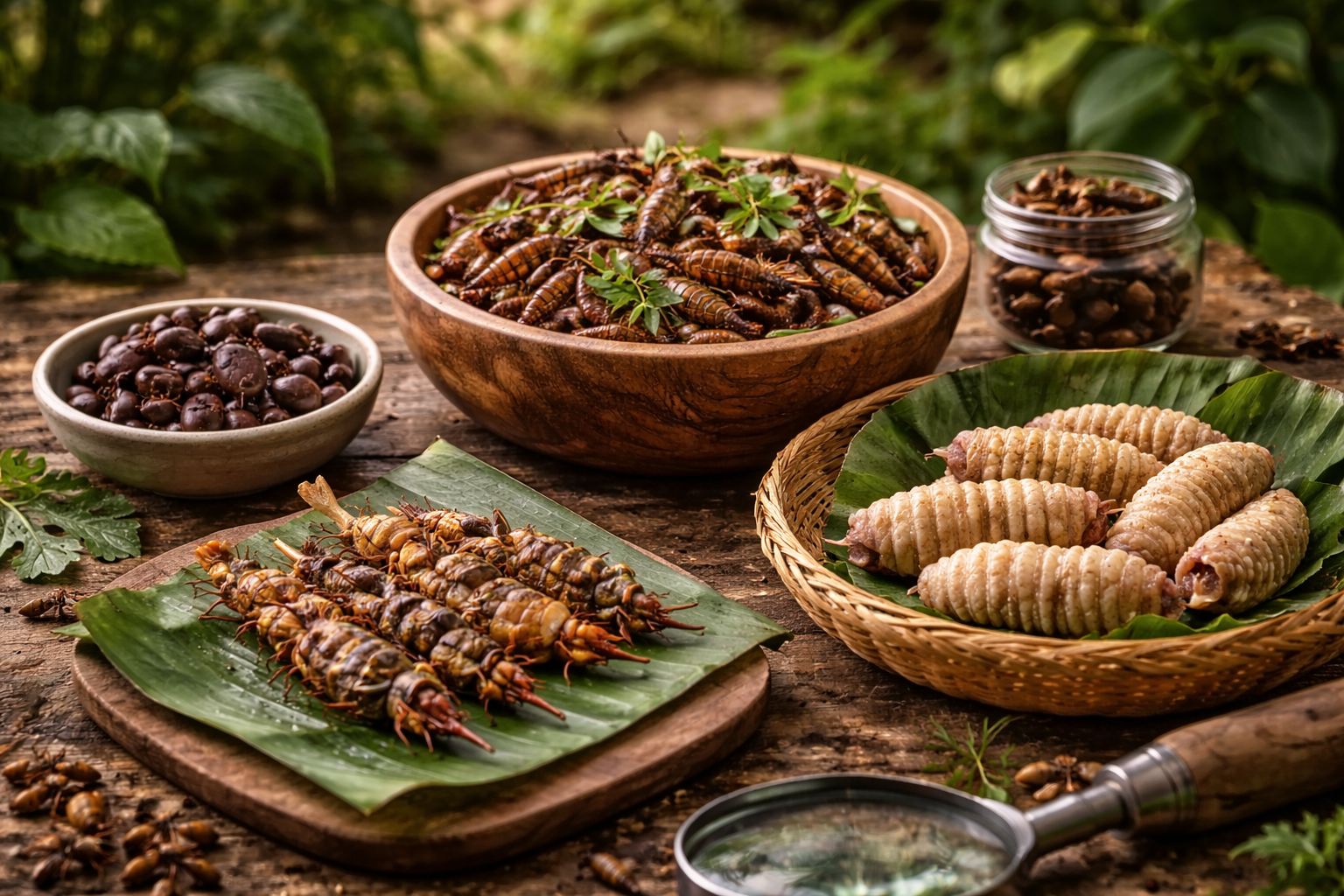
| The Context Was This is the last reflection in a series that began with loss. First, I wrote about how many insect species are disappearing each year, often without notice. Then I explored the growing conversation around insects as future food — framed as innovation, necessity, or solution. This final piece exists because those two threads kept pulling me back to something more personal: the realisation that insects as food were never strange to me. What changed wasn’t the insects. It was the story we tell ourselves about them. As a child, I was offered insects not as dares or curiosities, but as valued food. In Australia, the ants, witchetty grubs, and sea snails I ate were considered delicacies at the time. They weren’t framed as survival food or novelty. They were interesting, respected, and worth sharing. I liked them. That mattered more than any explanation. Later, in Malaysia, the experience shifted again. The amahs ate insects as part of their everyday diet. Between the ages of six and eight, I was introduced to those dishes naturally, without ceremony. No one tried to convince me they were sustainable, nutritious, or clever. They were simply food, eaten daily by people I trusted. I accepted them because there was no reason not to. When I travelled to Thailand, insects appeared once more — bamboo worms, grasshoppers, crickets, grubs — sold openly, eaten casually, part of the rhythm of street food. By then, there was no barrier left to cross. Insects weren’t a category. They were regional foods, prepared by people who knew what they were doing. Even in Europe, during my teens, I encountered insect dishes — sometimes as regional traditions, sometimes as curiosities — but never as something shocking. The idea that insects were inherently repulsive simply hadn’t taken root yet. Looking back, what stands out isn’t what I ate, but when. I was young enough not to have learned disgust. I hadn’t absorbed the cultural cues that tell us certain foods are acceptable and others are not. That came later. Much later. This is where the modern conversation around insects as food begins to feel strangely disconnected. In the West, insects are framed as future solutions, presented as necessary, scarce, or innovative. They arrive wrapped in justification. They are explained, defended, processed, and disguised. They are made acceptable through powders, bars, and language that avoids naming them too clearly. What’s missing from that conversation is context. In cultures where insects are eaten traditionally, they are rarely separated from land, season, and routine. They are gathered or prepared with knowledge. They are limited, not extracted endlessly. They are food because they always have been, not because they solve a problem. In contrast, modern insect consumption is often discussed as an industrial answer to an industrial problem. The risk isn’t that insects will be eaten. Humans have always done that. The risk is that insects become valuable only once they are commodified, farmed, scaled, and stripped of relationship — at the very moment wild insect populations are collapsing. That contradiction sits at the heart of this series. We are losing insects quietly, through habitat loss, chemicals, simplification, and noise. At the same time, we are discovering their “value” as a protein source. One version mourns absence. The other plan is extraction. Both speak about insects, but only one listens. From a land-based perspective — from gardening, growing, observing — insects are not interchangeable units. They are signals. Pollinators. Decomposers. Soil engineers. Remove them, and systems unravel. Eat them without understanding that role, and something feels off. This isn’t an argument against eating insects. My own life makes that dishonest. It’s an argument against pretending the issue is new, or purely technical, or solvable through product design alone. What made insects acceptable to me as a child wasn’t sustainability messaging or nutrition charts. It was trust. Familiarity. Being offered food without judgment. Being young enough not to have learned fear. That’s an uncomfortable insight for modern food culture, because it suggests the barrier isn’t insects. It’s us. If insects do become a more visible part of future diets, the most important question won’t be how efficiently they’re farmed or how cleverly they’re disguised. It will be about re-learning how to eat within context — with restraint, respect, and awareness of what sustains the systems we depend on. Insects don’t need to be reinvented. They need to be understood. And perhaps that’s the real thread tying this series together: we noticed insects disappearing only once they began to matter to us again. Not as neighbours, not as co-workers in soil and season, but as potential solutions. Whether that realisation leads to care or consumption is still an open question. |
| About our writing & imagery Many of our articles are written by us, drawing on real experience, reflection, and practical work in gardens and places we know. Some pieces are developed with the assistance of AI as a drafting and research tool. Featured images may include our own photography, original AI-generated imagery, or—where noted—images kindly shared by other creators and credited accordingly (for example, via Pixabay). All content is shaped, edited, and published by Earthly Comforts, and the views expressed are our own. |
 Earthly Comforts