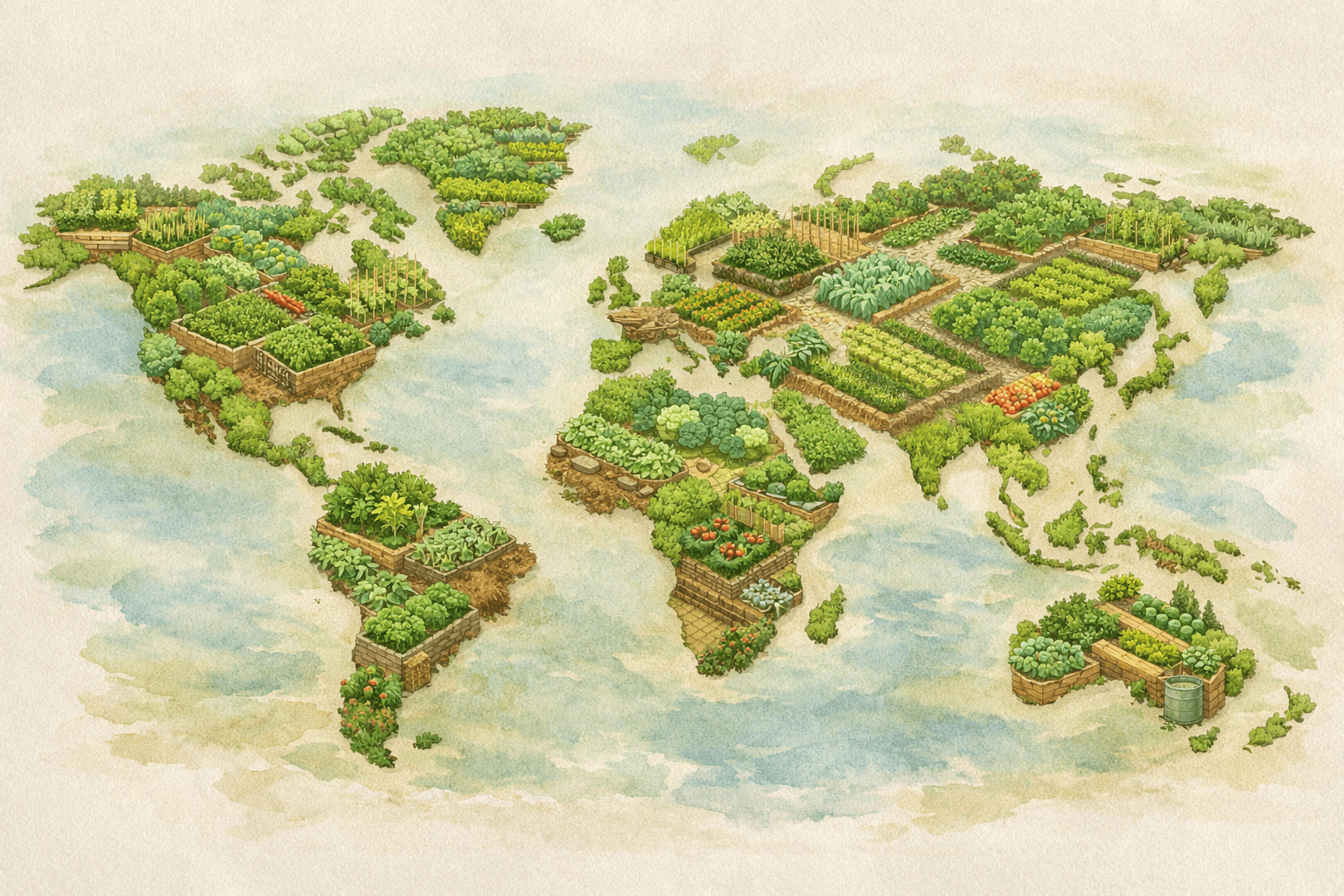

| Episode 7: Mariano Bueno Designing Vegetable Gardens for Heat, Drought, and Reality As the series moves deeper into southern Europe, the challenges facing vegetable gardeners become sharper. Heat intensifies. Rainfall becomes unreliable. Soils thin and harden. Under these conditions, success depends less on force and more on design. This is where Mariano Bueno enters the conversation. Based in Spain, Bueno has spent decades working at the intersection of vegetable growing, soil regeneration, and ecological design. His work is shaped by Mediterranean realities — long summers, limited water, and landscapes that demand cooperation rather than control. A Mediterranean Starting Point Vegetable gardening in Spain is defined by constraint. In many regions, summer temperatures exceed the tolerance of traditional northern European crops, while rainfall is irregular and often intense. Mariano Bueno’s work begins with an acceptance of these limits. Rather than asking how to override climate, he asks how to work within it — selecting crops, layouts, and soil strategies that align with local conditions. This perspective immediately reframes vegetable gardening. Instead of universal rules, gardeners are encouraged to observe: Where shade naturally falls How water moves across land Which plants persist without constant attention The garden becomes a response to the place rather than an imported template. Vegetables as Part of a Designed System Bueno is best understood not as a crop-by-crop instructor, but as a systems thinker whose work consistently returns to vegetables as one component of a larger whole. In practice, this means: Designing beds to slow, capture, and store water Building soil organic matter to buffer heat and drought Integrating trees, shrubs, and groundcovers to create microclimates Choosing vegetables that tolerate stress rather than peak conditions Vegetables are supported indirectly — through better soil, moderated temperatures, and improved moisture retention — rather than through constant irrigation or feeding. Soil First, Always Across Bueno’s work, soil is treated as the primary engine of productivity. In hot climates, bare soil is a liability. It dries quickly, erodes easily, and loses biological life. To counter this, his approach emphasises: Continuous soil cover Mulching with available organic matter Encouraging soil organisms to build structure naturally These practices reduce evaporation, moderate temperature swings, and allow vegetables to survive longer between watering — a critical advantage in Mediterranean gardens. Water as a Design Challenge One of Mariano Bueno’s most valuable contributions is his framing of water scarcity as a design problem, not a failure. Rather than relying on irrigation alone, he promotes strategies that: Slow rainfall so it infiltrates rather than runs off. Capture moisture where it falls. Reduce plant stress through shade and spacing. Vegetable gardens designed this way may look less conventional, but they function far more reliably over time. Why Mariano Bueno Matters in This Series Mariano Bueno is included not for celebrity, but for relevance. As climate pressures increase across Europe and beyond, the conditions he has worked within for decades are becoming more widespread. His contribution sits between the extremes represented earlier in the series: Not high-input productivity Not stress-selection alone Instead, he offers a designed middle path — one that balances vegetable growing with ecological stability. Placed after Pascal Poot and Stefano Soldati, his episode completes a Mediterranean trio: Poot — adaptation through stress and seed Soldati — vegetables within living systems Bueno — design for heat, water, and survival Together, they offer a realistic vision of food growing under pressure. Teaching Through Experience Mariano Bueno’s influence comes largely through education. Over many years, he has taught courses, written extensively, and spoken publicly about permaculture and organic gardening. While his presence may feel quieter than social-media-driven gardeners, his ideas have shaped how vegetables are grown in dry regions across Spain and southern Europe — often indirectly, through students and practitioners rather than mass audiences. This mode of influence is slower, but durable. Where to Follow Mariano Bueno Mariano Bueno shares his work primarily through: Educational talks and filmed lectures on permaculture and Mediterranean food systems Courses and workshops focused on ecological design and practical application. Books and written resources addressing soil health, water management, and organic growing Books and Publications Mariano Bueno has written and contributed to several influential works on organic gardening and permaculture, focusing on: Ecological design Sustainable food systems Adapting agriculture to Mediterranean climates The Mediterranean Kitchen Garden: Growing Organic Fruit and Vegetables in a Hot, Dry Climate These publications form a cornerstone of his long-term influence. Designing for What Is Coming As this European section of the series draws to a close, Mariano Bueno’s work reinforces a central truth: vegetable gardening cannot be separated from climate. Where water is limited and heat is intense, success depends less on control and more on design, observation, and restraint. His work offers a framework that many gardeners — whether in Spain today or elsewhere tomorrow — will increasingly need. |
 Earthly Comforts