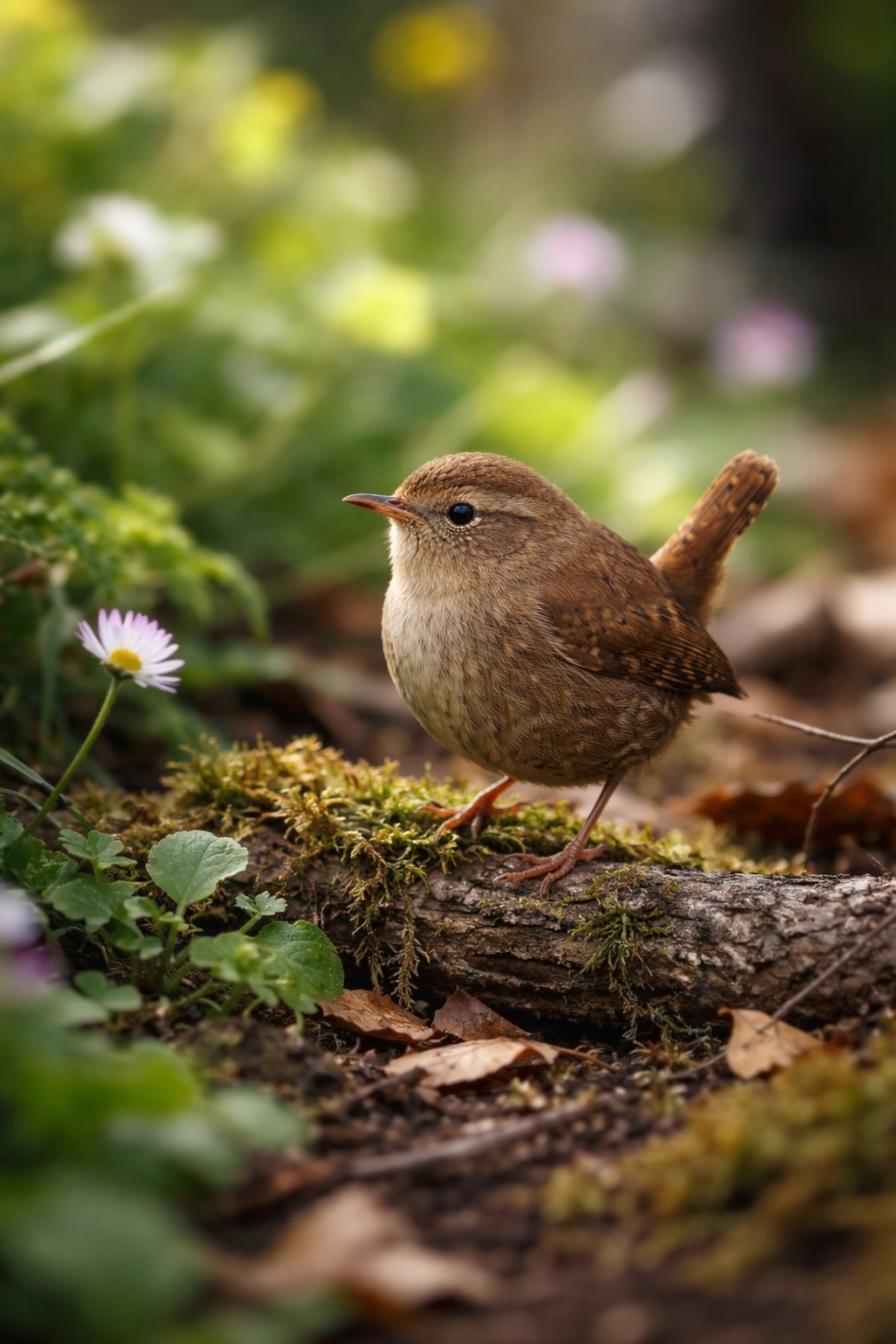
| The tiny bird with the mighty song There is a moment in early spring — often before the days feel truly warm — when the garden seems to clear its throat. The light changes first. Then the soil softens. And somewhere deep in a hedge, compost heap, or ivy-clad fence, a sound breaks out that feels far too loud for its source. Bright, hurried, defiant. A song that seems to say: I am here, and I have always been here. This is the wren. At barely ten centimetres long, the wren is one of the smallest birds in the UK, yet it carries one of the loudest songs relative to its size. In March, as winter loosens its grip, that song becomes one of the earliest and most reliable signs that spring has truly arrived — not on the calendar, but in the garden itself. Wrens do not announce themselves with colour or spectacle. They do it with presence. And once you begin to notice them, you realise just how closely their lives are woven into the quiet, overlooked corners of our gardens. |
| A bird that lives where we least look Wrens are birds of the in-between. They rarely perch proudly on open branches or feeders. Instead, they move low and fast — darting through hedges, creeping along fence lines, slipping into gaps beneath sheds or behind stacked pots. Their tails are often cocked upright, their bodies round and compact, their movements quick and purposeful. If you have: A dense hedge Ivy on a wall A pile of logs or old pots A compost heap A slightly untidy corner you haven’t quite got round to …then you already have the kind of place wrens are drawn to. Unlike birds that rely on open lawns or feeders, wrens depend on structure. They need layers, crevices, shelter from wind and rain, and plenty of places where insects gather. What we might describe as “messy, they experience as rich and full of opportunity. This is one reason wrens often do well in gardens that are gently managed rather than tightly controlled. They are not asking for perfection — just permission to exist. |
| The mighty song of early spring One of the most remarkable things about the wren is its voice. For such a small bird, the song is astonishingly loud and complex — a rapid cascade of trills and rattles that can carry across neighbouring gardens. Males begin singing early in the year, sometimes as early as late January, but March is when their voices become a daily presence. The song serves several purposes: To claim territory To attract a mate To assert survival after winter In a way, it is a declaration. Wrens have one of the highest winter mortality rates of any UK garden bird. Cold snaps can be devastating, particularly for such small-bodied creatures. So when a wren sings in spring, it is not just marking territory — it is marking survival. Listening to a wren sing is listening to a small victory. |
| Nesting: creativity in the cracks Wrens are famously inventive nesters. Rather than relying solely on nest boxes, they will build nests in: Old boots or watering cans Sheds and outbuildings Stacked firewood Dense hedges Climbing plants Compost bins The male wren often builds several “starter” nests — small, domed structures woven from moss, grass, and leaves. The female then chooses one to complete and line. This behaviour makes wrens particularly sensitive to early spring garden activity. Clearing out sheds, tidying piles, or stripping back climbers in March can inadvertently remove potential nesting sites just as the breeding season begins. It’s not that gardens must be left untouched — simply that a little awareness goes a long way. Many wrens nest successfully right alongside human activity, as long as their chosen corner remains undisturbed once occupied. |
| Why wrens need “untidy” gardens Wrens feed almost entirely on insects and spiders. They forage constantly, flicking through leaf litter, probing bark, and investigating the underside of foliage. This means that some of the most valuable things for wrens are also the things most often removed: Fallen leaves Old stems Dead wood Dense ground cover Leaf litter, in particular, plays a crucial role. It harbours insects through winter and early spring, providing wrens with vital food when resources are scarce. Clearing everything away too early can leave birds searching harder for less reward. In this sense, a garden that looks a little unfinished in March is often quietly working very hard. |
| Winter survival, spring reward To understand the wren in spring, it helps to understand what it has just come through. Wrens are resident birds — they do not migrate. During winter, they often roost communally, squeezing together in tight spaces to share warmth. Old nests, dense hedges, and sheltered cavities become lifelines. Cold, wet winters can dramatically reduce local wren populations. This makes the individuals you see and hear in spring all the more significant. Each one has navigated frost, scarcity, and exposure — often within a few metres of our homes. Spring is not a fresh start for wrens. It is a continuation. |
| Learning to notice rather than manage One of the quiet lessons wrens offer is this: not everything in the garden needs active intervention. Wrens do not require special feeders or elaborate structures. They thrive when gardeners: Pause before clearing Leave some areas alone. Allow hedges and corners to remain dense. Accept that life often hides in the margins. Watching a wren slip through a hedge or vanish beneath a pile of leaves is a reminder that gardens are not just displays — they are habitats layered with purpose. You may never see a wren’s nest. You may only catch flashes of movement or hear a song without spotting the singer. But presence does not require visibility to be meaningful. |
| A small bird that sets the tone for spring As March unfolds, the wren’s song becomes part of the background rhythm of the season — joining lengthening days, opening buds, and the first real warmth in the soil. It is a bird that asks very little, yet gives a great deal: A voice in the quiet months Movement in still hedges Proof that survival does not always look dramatic If spring has a soundtrack, the wren is one of its opening notes. And once you learn to listen for it, the garden never feels quite empty again. |
About our writing & imagery
Most articles reflect our real gardening experience and reflection. Some use AI in drafting or research, but never for voice or authority. Featured images may show our photos, original AI-generated visuals, or, where stated, credited images shared by others. All content is shaped and edited by Earthly Comforts, expressing our own views.
 Earthly Comforts