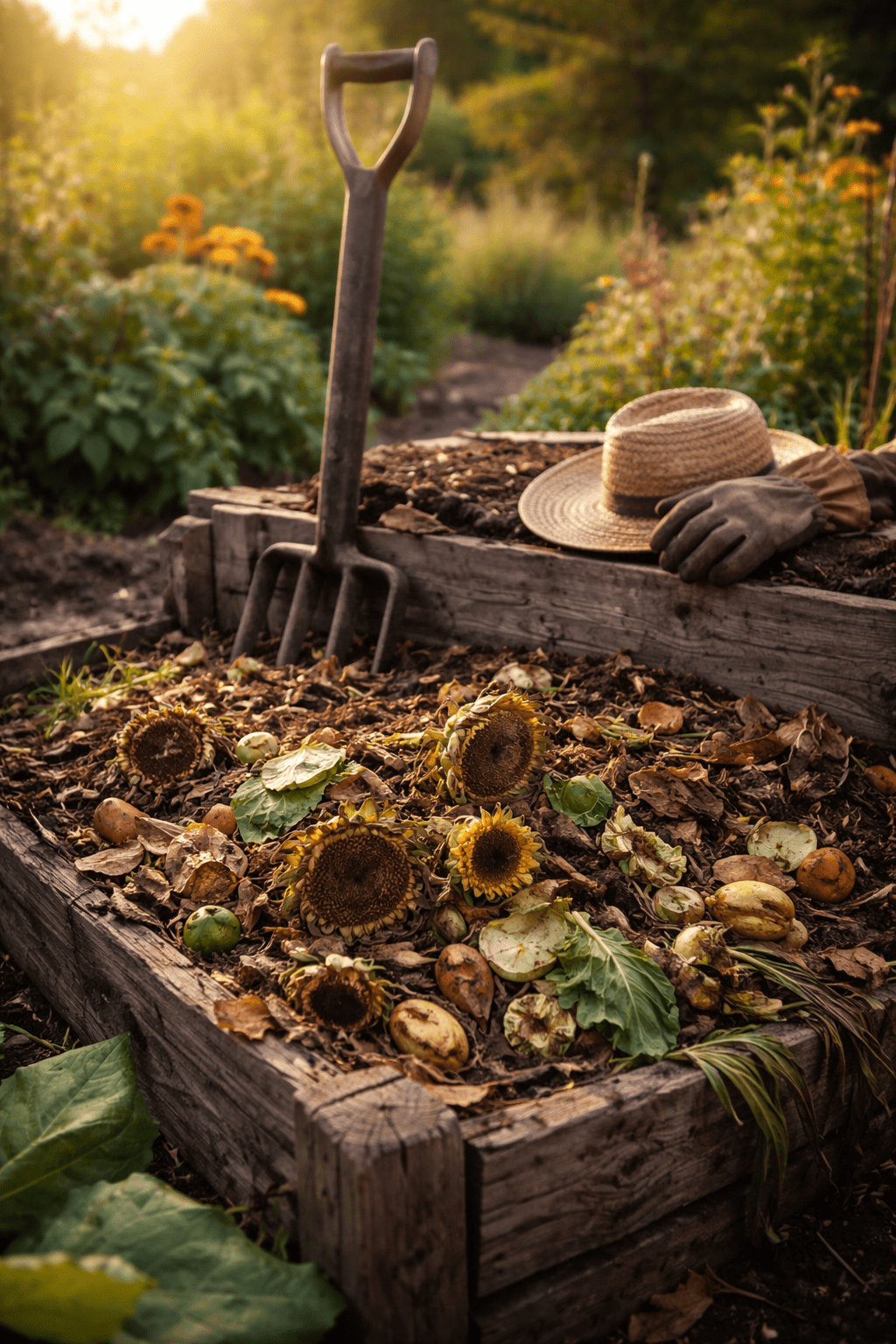
| In gardening, decay often arrives with an uncomfortable label: failure. Yellowing leaves, collapsing stems, spent flowers, composting plant matter — all can feel like signs that something has gone wrong. Yet decay is not a mistake. It is not a collapse of effort. It is a process that every healthy garden depends upon, whether we acknowledge it or not. When we stop treating decay as an endpoint and begin to see it as a stage, our relationship with the garden changes. We move from fighting nature to working with it. And in doing so, we often discover lessons that extend far beyond the garden gate. Decay is simply a transformation at a slower pace. In natural systems, nothing is wasted. A fallen leaf does not represent the failure of the tree; it represents the tree completing a cycle. The leaf has done its work — capturing sunlight, feeding growth — and now it returns to the soil, becoming nourishment for something else. The same is true of spent perennials, collapsing annuals, and even entire beds being cleared at the end of a season. What appears to be a loss is actually a redistribution. Gardens that fear decay tend to be over-managed. Every leaf is cleared, every stem removed, every patch of bare soil immediately covered or corrected. While tidiness has its place, an obsession with constant “perfection” often strips the soil of its resilience. Organic matter is removed before it can break down. Microbial life is disturbed. The garden becomes dependent on external inputs rather than its own internal cycles. By contrast, gardens that allow decay — mulched beds, leaf litter under hedges, compost built slowly — develop depth. Their soils hold moisture better. Their plants cope with stress more easily. Their ecosystems become quieter, steadier, and more self-supporting. Decay is not disorder. It is preparation. Patience is the currency of all real gardening. There is no shortcut through decomposition. You cannot rush a compost heap without consequences. Forced heat, constant turning, and artificial accelerants may create speed, but they rarely create balance. True compost takes time because biological communities need time to organise themselves. Fungi must establish networks. Bacteria must bloom and decline. Insects must arrive, feed, and move on. Each stage relies on the one before it. Gardening teaches patience not through instruction, but through consequence. Sow too early, and seeds rot. Prune too late, and energy is wasted. Clear too soon and you lose winter protection. Wait too long, and growth becomes unmanageable. Timing, rather than control, becomes the skill. This mirrors life far more closely than we often admit. Many frustrations come from trying to harvest before roots are ready, or from tearing down something simply because it looks untidy in the moment. The garden reminds us that readiness cannot be forced without cost. Decay teaches us to trust invisible work. One of the hardest lessons in both gardening and life is learning to value what cannot be seen. A compost heap looks inert from the outside. Beneath the surface, it is alive with activity. Heat builds, materials soften, nutrients unlock. None of this is immediately visible, yet it is where the real work happens. The same is true beneath the soil. Roots extend long before top growth appears. Fungal networks quietly connect plants, sharing water and nutrients. When nothing seems to be happening above ground, foundations are often being laid below it. In life, periods that look unproductive often mirror this hidden phase. Rest, reflection, recovery, and even grief can resemble stagnation from the outside. The garden teaches us that these phases are not wasted time. They are integration time. They are when strength quietly accumulates. A gardener who understands decay learns when to leave things alone. There is a maturity that comes with knowing when not to intervene. Not every problem needs fixing. Not every decline needs correcting. Some plants die because their role is complete. Some spaces need to be emptied before they can be replanted wisely. Removing everything that fades prevents the garden from teaching us what it is ready for next. This patience creates better decisions. Observing how water sits in winter, how sunlight shifts, how plants self-seed or fail to return — these patterns only reveal themselves if the gardener is willing to wait. Immediate action often silences information. In life, the urge to “fix” can be just as disruptive. Rushing into solutions without understanding the full cycle often leads to repetition rather than resolution. The garden models a quieter approach: observe first, act later, and accept that not all endings are problems. Decay builds resilience, not weakness. Healthy soil is, at its core, decomposed matter. Every fertile garden bed is built from what has broken down before. Without decay, there is no structure, no nutrient-holding capacity, no microbial diversity. The strength of the system comes from layers of past growth returning to the earth. This principle applies just as clearly to people. Experience accumulates through both success and decline. Setbacks, endings, and periods of loss add texture to understanding. They deepen judgment. They create adaptability. Resilience is not built from constant growth, but from cycles of expansion and contraction. Gardens that never experience decay are fragile. Lives that never allow it tend to be the same. Learning to work with seasons — not against them. Modern life encourages permanence: constant output, constant growth, constant visibility. Gardens operate differently. They insist on seasons. They withdraw, rest, collapse, and return. Ignoring this rhythm leads to burnout — in soil and in people. Accepting decay as seasonal rather than terminal allows for gentler expectations. Winter gardens are not broken gardens. Dormant beds are not wasted space. They are resting systems preparing for renewal. When gardeners align with this rhythm, work becomes lighter. Decisions become clearer. Pressure reduces. The same alignment in life allows us to recognise when to push forward and when to step back without guilt. Decay is a teacher, not an enemy. Once we stop framing decay as failure, gardening becomes less about control and more about conversation. The garden speaks through what fades as much as through what flourishes. It shows us when enough has been taken, when balance is returning, and when patience is required. In learning to sit with decay — to compost it, observe it, and allow it — we practice a deeper form of patience. One that understands that growth is not linear, that endings feed beginnings, and that progress often looks like stillness before it looks like success. The garden does not reward urgency. It rewards attention. And in a world that rarely slows down, that lesson alone is worth tending. |
| About our writing & imagery Many of our articles are written by us, drawing on real experience, reflection, and practical work in gardens and places we know. Some pieces are developed with the assistance of AI as a drafting and research tool. Featured images may include our own photography, original AI-generated imagery, or—where noted—images kindly shared by other creators and credited accordingly (for example, via Pixabay). All content is shaped, edited, and published by Earthly Comforts, and the views expressed are our own. |
 Earthly Comforts