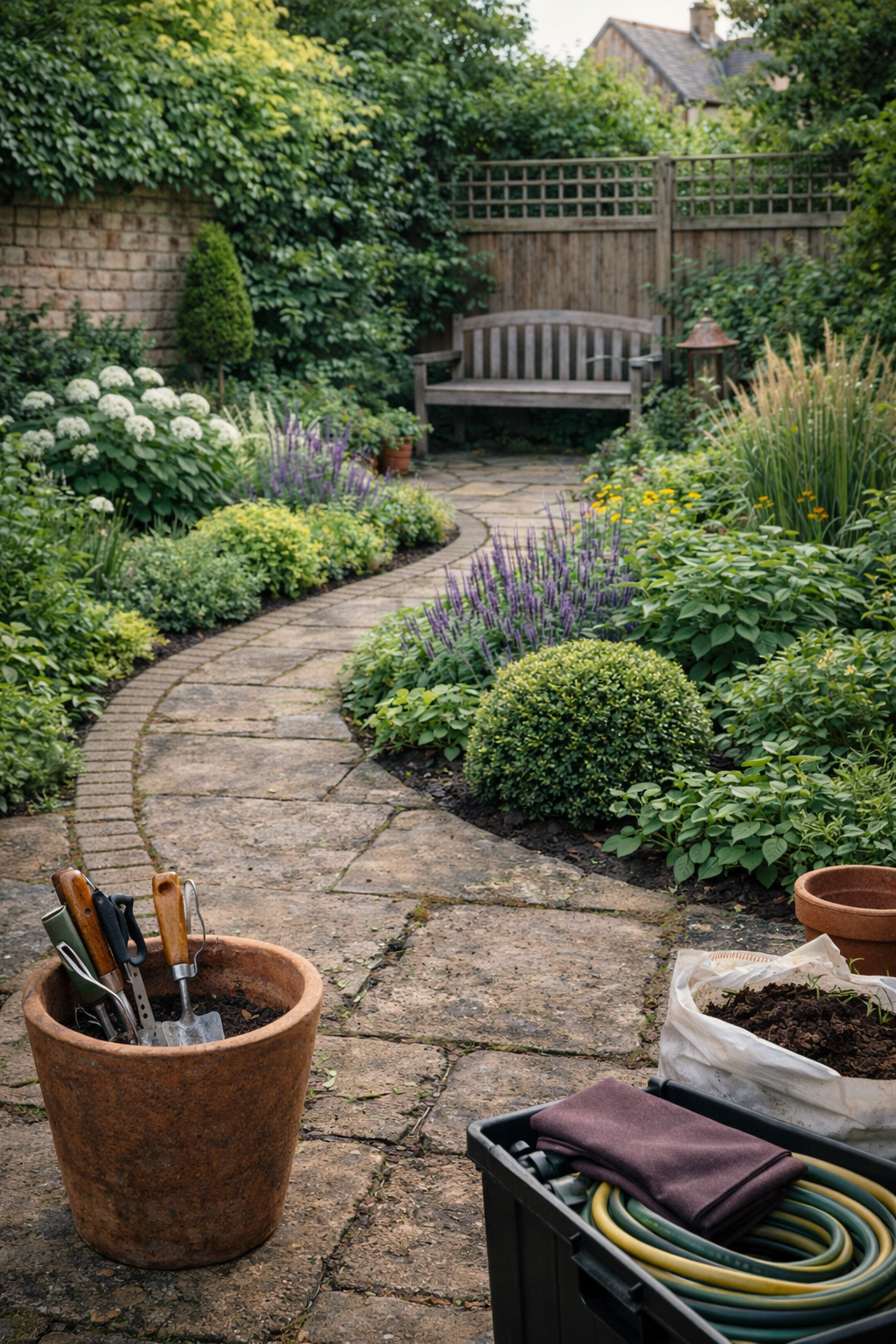
| Part 6 How to Make a Small Garden Feel Calm, Not Busy A small garden can be full of plants and still feel empty. Or it can be modestly planted and feel deeply restful. Calm in a garden is not about how much there is. It’s about how clearly the space reads — to the eye, to the body, and to the person responsible for it. Busy gardens don’t usually feel that way because they’re badly cared for. They feel busy because too many things are asking for attention at once. Calm comes from clarity, not emptiness. A calm garden is not a sparse garden. It’s a garden where each element has a clear role. Where your eye knows where to go, and where it’s allowed to pause. Where nothing feels like it’s shouting to be noticed. In small spaces, especially, calm comes from being able to read the garden easily — understanding what belongs where, and why. Confusion creates tension. Clarity creates ease. Repetition settles the eye. One of the most effective ways to create calm in a small garden is repetition. Repeating the same plant, shape, or material allows the eye to move gently rather than constantly resetting. It reduces visual noise and creates a rhythm that feels intentional rather than accidental. This might look like: The same plant repeated along a border. A limited palette of leaf shapes Matching pots rather than a collection One paving material is carried throughout. Repetition isn’t boring. In small gardens, it’s reassuring. Too many focal points create restlessness. Focal points are powerful — but only when used sparingly. In small gardens, multiple focal points compete rather than complement one another. The eye jumps from feature to feature without ever settling, and the space feels restless even when it’s tidy. A calm garden usually has: One main place for the eye to land Supporting elements that don’t compete Space around key features so they can breathe Often, removing a focal point creates more calm than adding one. Colour discipline matters more in small spaces. Colour has a stronger impact in small gardens because there’s less distance for it to soften. Too many colours used together can feel jarring, even when each plant is attractive on its own. Calm gardens tend to limit their palette and allow subtle variations to do the work. This doesn’t mean avoiding colour — it means choosing it deliberately. A small garden with a restrained colour scheme feels more settled across the seasons and easier to live with day to day. Space is part of the design. In calm gardens, space is not something waiting to be filled. Gaps between plants, clear edges, and open areas are what allow the garden to breathe. They give plants room to show their shape, making maintenance easier and less intrusive. In small gardens, especially, space is functional. It provides access, light, and moments of rest for the eye. A garden that allows space feels generous, even when it’s compact. Calm gardens are easier to maintain — and that’s not an accident. There’s a direct link between how a garden feels and how it’s maintained. Visually busy gardens often require constant decision-making: what to cut, what to leave, what’s finished, what’s failing. That mental load feeds back into how the garden is experienced. Calm gardens reduce choices. Maintenance becomes familiar rather than reactive. Over time, the garden feels supportive rather than demanding. This is not accidental. It’s the result of restraint carried through consistently. Calm is a long-term quality. A garden rarely feels calm immediately after being changed. Calm emerges as plants settle, spacing begins to make sense, and the garden is allowed to repeat itself year after year. Rushing that process — by adding, adjusting, and interfering too often — delays it. A small garden becomes calm when it’s trusted to grow into itself. In the next post, I’ll look at how small gardens can support wildlife without tipping into chaos — and why tidy edges often matter more than wild intentions. Because a small garden done properly doesn’t try to impress. It allows you to rest in it. |
The Small Garden
 Earthly Comforts