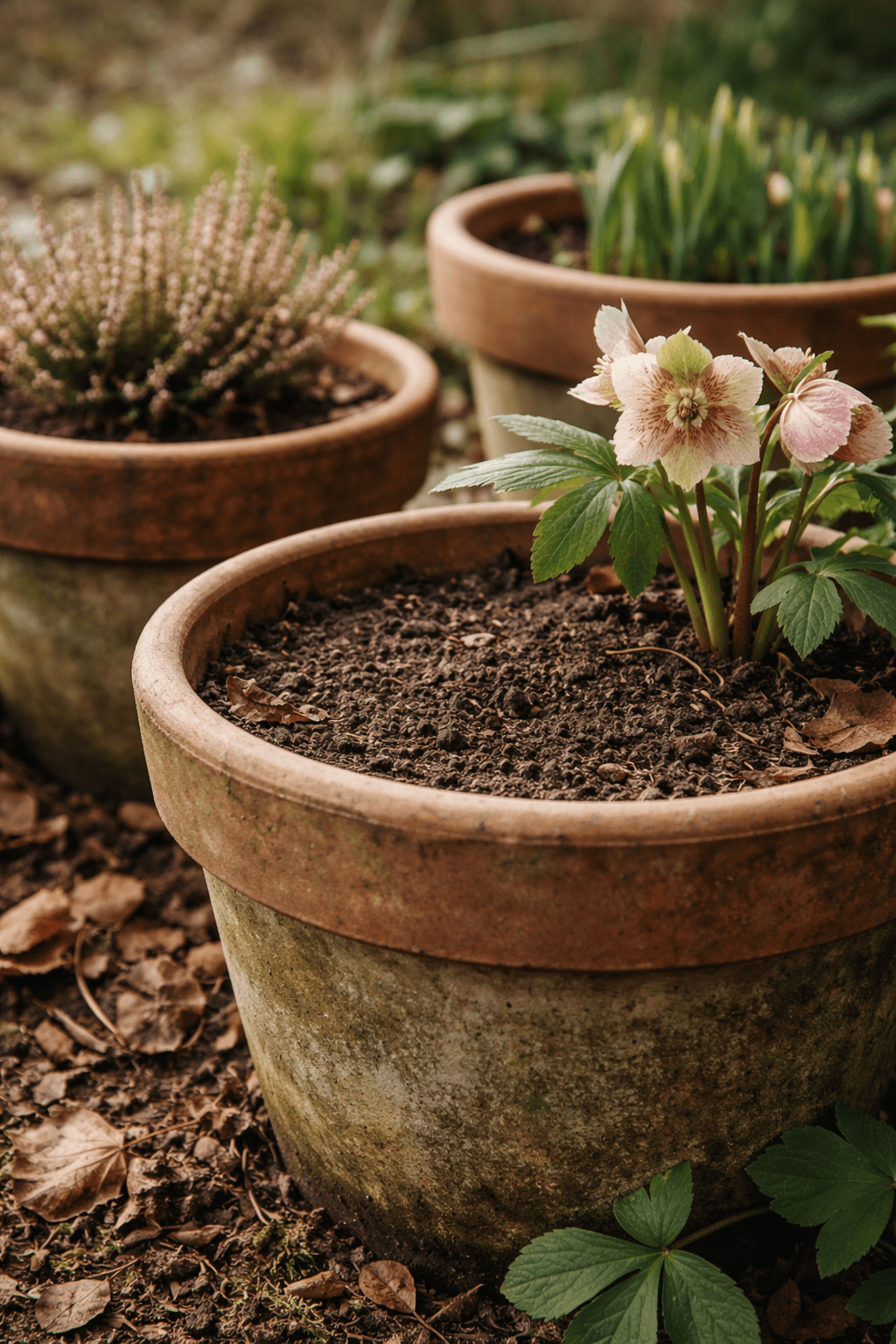
| There is a particular moment in late February when I begin to notice it. The hellebores are pushing quietly, the light has shifted almost imperceptibly, and the pots by the door — the ones that looked so full and promising in October — have sunk. Not dramatically. Just enough to expose the top of a root ball, to reveal a thin crescent of terracotta that was once hidden, to suggest something has happened while we weren’t looking. Clients sometimes assume it is a problem. They imagine worms tunnelling, the compost “going off”, or something leaching away irretrievably. In truth, soil in containers dropping over winter is both ordinary and revealing. It tells a story about what compost actually is and what winter does. The quiet work of settling Fresh compost, particularly peat-free mixes, is light when first tipped from the bag. It is full of air, fibres, bark fragments and partially composted material. When I fill a pot in spring, I always overfill slightly. Experience has taught me that what looks generous in April will look sparse by September. Over winter, gravity completes its patient work. Rain passes through repeatedly, carrying fine particles downward. The weight of water alone compresses the structure. Air pockets collapse. Materials that were once buoyant and fluffy begin to knit together. In a garden bed, this is less obvious because the soil mass is deep and buffered. In a container with nowhere for excess to hide, the shift is visible. There is a common assumption that compost should remain exactly as you left it. But compost is not static. It is transitional material. It is designed to change. Decomposition does not stop in winter. Another quiet myth is that winter is a season of dormancy below ground. The garden above may sleep, but the soil does not. Microbial life slows, certainly, but it does not disappear. Even in cold Kent winters, decomposition continues at a reduced pace. Much of what we buy as compost is only partially broken down. Bark fines soften. Coir fibres lose structure. Green waste compost continues its transformation. As organic matter decomposes, volume reduces. This is not failure. It is maturation. Peat-free composts in particular can shrink more noticeably than older peat-based mixes, which were structurally more stable (if environmentally indefensible). Gardeners sometimes interpret this shrinkage as a sign of inferior quality. It is simply honest material behaving naturally. Water, frost and movement In exposed gardens — and Sandwich can be blustery enough — containers experience repeated cycles of saturation and drying, freezing and thawing. When water freezes, it expands. The compost may lift slightly, then settle lower when thawed. Over a winter, these micro-movements accumulate. Occasionally, I find compost pulled away from the sides of a pot, leaving a visible gap. It looks alarming, but it is simply a contraction. The structure has altered. In heavy clay soil, we call this shrink–swell behaviour. In containers, we call it winter. There is also leaching to consider. Persistent rainfall washes nutrients and very fine particles downward and, in some cases, out through drainage holes. The pot becomes marginally poorer and denser. Again, this is not a dramatic loss. It is a gradual recalibration. Three practical observations from working gardens In practice, I notice three patterns. First, larger containers drop less dramatically than small ones. Volume matters. A deep half-barrel buffers change; a narrow terracotta pot exaggerates it. Second, pots filled with woody perennials tend to settle more than those filled with seasonal bedding plants. The roots of established plants knit the compost together, and as they thicken, they subtly displace structure. Third, clients who mulch their containers lightly in autumn see less visible drop. A thin layer of leaf mould or composted bark acts almost like a cushion, absorbing some of winter’s rearrangement. None of these is rules, but they are consistent enough to inform how I work. When it is not normal Very occasionally, a dramatic drop signals something else. Burrowing rodents can hollow out large planters. Poorly drained pots can slump if the compost has turned anaerobic. In those cases, the smell tells you before the level does. But nine times out of ten, a two- or three-centimetre drop by March is entirely ordinary. I would gently challenge the instinct to panic and replace everything wholesale. The compost has not failed you. It has simply lived. The spring response I do not rush to top up immediately. I wait until the soil has dried slightly and the plants show signs of renewed growth. Then I refresh. Rather than emptying pots, I remove the top few centimetres, lightly loosen the surface with a hand fork, and add fresh compost mixed with a modest, slow-release feed: this restores structure and nutrients without unnecessary disturbance. Full re-potting is reserved for plants that genuinely need root space. There is a temptation to treat container gardening as a static display — plant once, admire forever. But containers are more dynamic than borders. They are miniature ecosystems under pressure. Their limited volume makes every seasonal shift more visible. Perhaps that is why I like them. They reveal processes we otherwise ignore. A quiet lesson Soil dropping over winter is not a defect. It is evidence. Evidence of gravity, of microbial persistence, of weather’s influence on small contained worlds. It reminds us that compost is not an inert product but a living, changing medium. For those of us who work with gardens daily, it becomes almost comforting. The slight recession of the soil level in February is as predictable as the first crocus. It marks time. Gardening, at its best, is attention to such subtleties. Noticing the lowered line of compost is noticing winter’s handwriting. And in spring, when we top up, aerate and refresh, we are not correcting a mistake. We are participating in a cycle. Containers teach us humility in this way. They shrink, settle, shift and ask us to respond thoughtfully rather than reactively. In that small adjustment — a handful of fresh compost, a gentle fork through the surface — there is a quiet acknowledgement that change is not something to resist. It is something to work with. |
| About our writing & imagery Most articles reflect our real gardening experience and reflection. Some use AI in drafting or research, but never for voice or authority. Featured images may show our photos, original AI-generated visuals, or, where stated, credited images shared by others. All content is shaped and edited by Earthly Comforts, expressing our own views. |
 Earthly Comforts