| A Seven-Part Exploration of Resilience, Climate, and the Future of Earthly Comforts |
| Part IV — The Economics of Resilience |
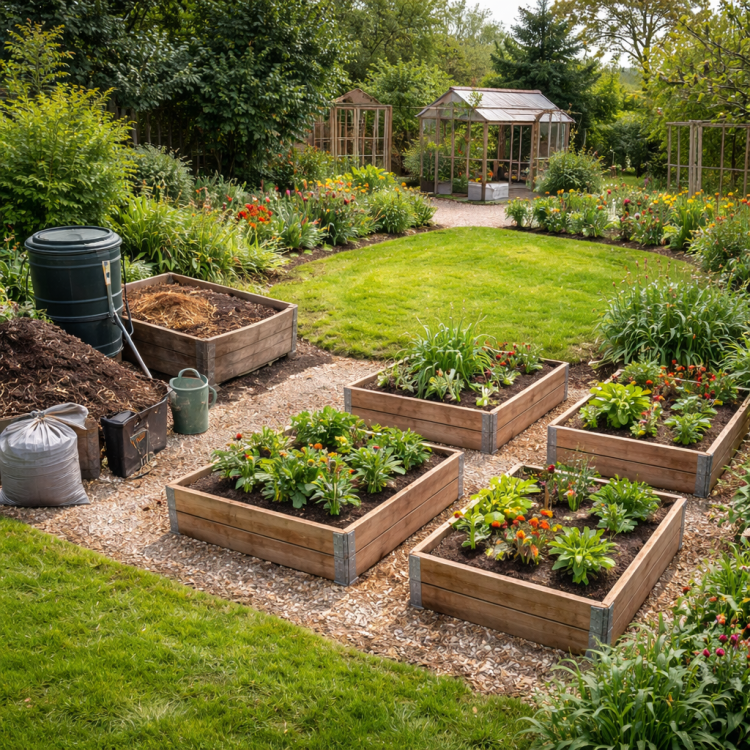
| Why diversification is structural, not optional In the earlier parts of this series, we examined climate volatility as an environmental reality and considered how garden design and maintenance structures are beginning to respond. We examined the fragility of lawn-first models and explored microgardening as a form of modular climate infrastructure. This fourth part moves deliberately into commercial territory. Because without financial viability, resilience remains theoretical. A small gardening business operates within narrow margins. Labour, insurance, fuel, equipment maintenance, waste disposal, and administrative overhead all form a fixed cost base that does not fluctuate in sympathy with rainfall. Revenue, however, often does. When a service model relies heavily on mowing and predictable seasonal growth, it becomes inherently exposed to weather variability. Grass growth has historically provided a dependable rhythm to the maintenance calendar. Weekly or fortnightly cutting establishes predictable billing and workload planning. Yet this predictability depends on moderate weather patterns. Extended dry spells suppress growth and reduce visible work. Prolonged wet periods restrict access and compress schedules. Extreme heat stresses turf beyond recovery, while winter saturation damages soil structure and reduces the number of workable days. In each case, the income stream tied to grass becomes unstable. The problem is not that mowing disappears. The problem is concentration risk. When a large proportion of revenue depends on a single growth cycle, volatility in that cycle reverberates through the entire business. Diversification, in this context, is best understood as risk distribution rather than expansion. The objective is not to add unrelated services in pursuit of growth, but to layer complementary services that remain viable under varied climatic conditions. Soil conditioning programmes, raised bed installations, drainage improvements, and stewardship of productive spaces all operate on different seasonal triggers. They are not governed exclusively by grass growth. This distinction between frequency-based and function-based income is significant. Traditional maintenance models often sell time intervals — weekly visits, fortnightly rounds. Resilience-based services instead sell outcomes: improved soil structure, water efficiency, plant performance, and reduced risk of failure. The latter are less sensitive to whether grass grows quickly or slowly in a given month. Consider a period of extended drought. Weekly mowing may temporarily decline in both necessity and perceived value. However, soil mulching, drought-tolerant planting conversions, irrigation adjustments, and raised bed management become more relevant. In wet winters, drainage assessments and soil remediation may take precedence over turf presentation. A diversified structure allows the business to pivot its emphasis without losing revenue entirely. There is also a subtler financial dimension to this shift. Mechanical repetition is comparatively commoditised. Clients can easily compare mowing rates across providers. Expertise in soil health, plant resilience, and climate-aware design is less easily reduced to price comparison. As environmental pressures intensify, knowledge becomes a differentiating asset. A business that can articulate and implement resilience strategies occupies a different market position from one that primarily trims and tidies. Installation work plays a critical role in this economic rebalancing. Lawn reduction projects, modular bed construction, irrigation retrofits, and soil restructuring generate larger one-off revenue events that are not dependent on weekly growth cycles. When thoughtfully scheduled, such projects can offset slower maintenance periods. More importantly, they embed future work into the landscape. A raised bed requires ongoing stewardship. A drought-resilient planting scheme requires seasonal oversight. Conversion projects, therefore, create both immediate income and long-term stability. Membership-style models distribute revenue more evenly throughout the year. Structured soil programmes, advisory subscriptions, or priority access to propagated plants create recurring income streams that are not directly tied to the weather of any given week. They also strengthen client retention, reducing the marketing cost associated with constantly acquiring new households. It is important to acknowledge that diversification carries its own risks. Expanding too quickly into unfamiliar services can dilute focus and strain administrative capacity. A small business must define its limits carefully. The aim is not to offer everything. It is to strengthen structural stability by adding services that align with existing expertise and geography. For Earthly Comforts, that alignment lies in soil-led practices, modular microsystems, and stewardship of underused spaces already embedded within the client base. These are not radical departures. They are extensions of existing competence into areas that climate volatility increasingly makes relevant. Financial modelling under climate pressure reinforces the logic. If seventy per cent of income derives from mowing and growth-related tasks, a prolonged dry spell that reduces mowing by twenty-five per cent for six weeks materially impacts revenue. If, instead, a significant portion of income derives from installation projects, soil programmes, membership subscriptions, and modular system management, the sensitivity to grass growth declines. Revenue becomes more evenly distributed across tasks that respond differently to weather conditions. Diversification also stabilises labour. When work is concentrated narrowly around mowing cycles, scheduling becomes reactive. Growth surges compress workloads; droughts create gaps. A broader service mix smooths this curve. Staff can rotate between soil work, installations, training, and maintenance. Skill development improves, thereby increasing service quality and pricing resilience. There is an emotional dimension to this economic stability. A business whose income rises and falls sharply with rainfall operates under persistent uncertainty. Diversification reduces that psychological strain. Predictable revenue streams, even if modest, provide steadier ground for long-term planning and investment. None of this implies abandoning lawns altogether. Functional turf remains appropriate in many settings. The shift concerns proportionality. Reducing overdependence on a single task type strengthens the enterprise against environmental unpredictability. Resilience, then, is not ideological. It is structural. It is the deliberate design of a service mix capable of absorbing climatic shocks without destabilising the whole. For a small-town gardening business facing increasingly irregular seasons, diversification is less an ambition than a necessity. In the next part of this series, we examine how experimental plant trials and propagation deepen this economic resilience by building localised knowledge and reducing dependency on external supply chains. |
| About our writing & imagery Most articles reflect our real gardening experience and reflection. Some use AI in drafting or research, but never for voice or authority. Featured images may show our photos, original AI-generated visuals, or, where stated, credited images shared by others. All content is shaped and edited by Earthly Comforts, expressing our own views. |
 Earthly Comforts