
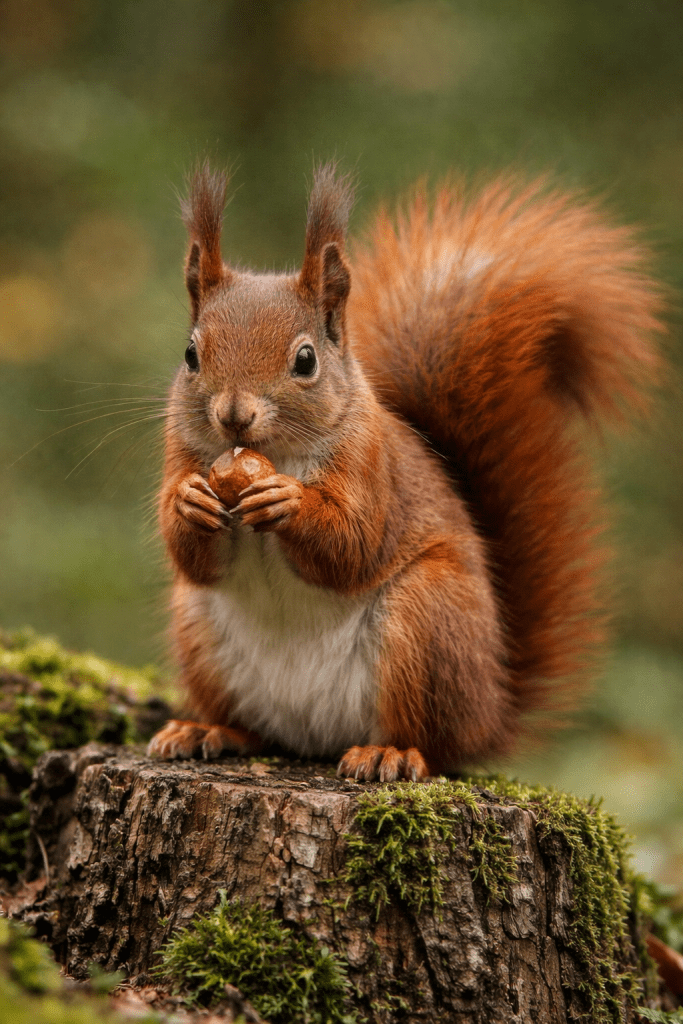
| Understanding the Red Squirrel in the UK The red squirrel is one of the most cherished and emotionally resonant mammals in the UK. Small, quick, and vivid against bark and bracken, it feels like a creature from an older landscape—one shaped by conifer forests, quiet woodland paths, and seasonal rhythms rather than roads and rooftops. To see a red squirrel is to feel you have stepped briefly into a Britain that still holds onto something fragile and rare. Yet the red squirrel’s story is not just one of charm. It is a story of specialisation, vulnerability, and the fine balance between habitat, competition, and survival. Understanding the red squirrel in the UK means understanding why some species endure change easily—and why others do not. |
| What Is a Red Squirrel? The red squirrel is a small, agile tree-dwelling mammal with rich russet fur, a pale underside, and a long, expressive tail used for balance and warmth. In winter, many develop distinctive ear tufts—fine brushes of hair that add to their unmistakable silhouette. Despite the name, red squirrels come in various colours. Their coats can range from deep chestnut to light ginger or even brownish tones, depending on habitat and season. What does not change is their lighter build and finer bone structure compared to their grey relatives. They are lighter, faster, and more delicate—beautifully adapted, but less forgiving of disruption. A Life in the Canopy Red squirrels are highly arboreal. They spend the vast majority of their lives in trees, moving swiftly through branches and crowns rather than travelling along the ground. This canopy-based lifestyle keeps them away from many ground predators and allows efficient movement between feeding sites. They build spherical nests called dreys, made from twigs, moss, leaves, and bark, and usually placed high in conifer trees or in dense woodland. A single squirrel may maintain several dreys within its home range, choosing between them based on weather and safety. Trees are not just shelter for red squirrels—they are the framework of life itself. Specialists of the Forest Red squirrels are woodland specialists. They thrive best in large areas of coniferous forest or mixed woodland dominated by species such as pine, spruce, and larch. These habitats provide the type of seeds and cones red squirrels are best adapted to eat. Their digestive system and jaw strength are well-suited to extracting seeds from tough cones, a niche that once gave them a competitive advantage. In these forests, red squirrels move confidently and efficiently, often outperforming other species. However, this specialisation comes at a cost: flexibility. Diet: Seasonal and Selective Red squirrels feed mainly on seeds from conifer cones, as well as hazelnuts, beech mast, berries, buds, fungi, and tree shoots. Insects, eggs, and other animal matter may be taken occasionally, but plant material dominates. They cache food in autumn, burying nuts and seeds in shallow soil or moss. Unlike grey squirrels, red squirrels rely more heavily on immediate consumption and less on long-term recovery of buried stores, particularly in conifer forests where cone availability fluctuates. Their diet closely follows the rhythms of the woodland year. Seasonal Rhythm and Survival Red squirrels do not hibernate. They remain active throughout winter, although activity reduces during severe weather. Their survival depends on the availability of autumn food and the quality of their habitat. In years when cone crops fail, red squirrels may struggle. Some years see very low breeding success, while others allow populations to rebound. This boom-and-bust pattern is natural—but becomes dangerous when populations are small or isolated. Winter is a test of preparation, not endurance. Breeding and Early Life Red squirrels typically breed once or twice a year, depending on food supply. Females give birth to litters of two to four young in well-insulated dreys. The young are born blind and helpless, developing slowly under close maternal care. As they grow, juveniles learn to climb, forage, and navigate the canopy. Dispersal occurs when young squirrels leave their birth area to find unoccupied habitat—often a risky journey in fragmented landscapes. High-quality woodland makes the difference between survival and loss. Quiet, Watchful, and Wary Red squirrels are more cautious than grey squirrels. They tend to avoid open spaces and are less comfortable in human-dominated environments. Their movements are quick and precise, but they retreat readily when disturbed. This wariness reflects adaptation to forest life, where concealment and speed are more effective than boldness. It also explains why red squirrels are rarely seen in gardens or towns, even where woodland is nearby. They are animals of cover, not exposure. Why Red Squirrels Have Declined Red squirrels were once widespread across the UK. Today, they survive mainly in parts of Scotland and northern England, as well as in a few isolated strongholds. Their decline is not due to a single cause, but to a combination of pressures: Competition with grey squirrels for food and space A disease carried by greys that is fatal to reds Loss and fragmentation of suitable woodland Reduced connectivity between forest habitats Red squirrels are less adaptable to mixed or broadleaf-dominated landscapes and struggle to compete where conditions are not tightly aligned with their needs. The Importance of Conifer Forests Conifer woodland plays a crucial role in red squirrel conservation. In these habitats, grey squirrels are less competitive, and red squirrels retain a natural advantage. Large, continuous forests allow stable populations to persist, while tree corridors help maintain genetic exchange between groups. Without this connectivity, populations become isolated and vulnerable. Forest structure matters as much as forest size. Predators and Natural Balance Red squirrels are prey for birds of prey such as goshawks and owls, as well as mammals like foxes. However, predation alone does not explain their decline. Interestingly, the recovery of certain native predators has helped red squirrels indirectly by reducing grey squirrel numbers in some areas. This shows how restoring balance in ecosystems can produce unexpected benefits. Healthy systems regulate themselves more effectively than managed ones. Human Connection and Cultural Importance The red squirrel holds a special place in British culture. It is often associated with childhood, folklore, and ideas of “native” wildlife. This emotional connection has driven significant conservation efforts and public support. But the red squirrel is not a symbol—it is a living species with specific needs. Protecting it requires more than affection; it requires suitable habitat, long-term planning, and acceptance of complexity. Sentiment helps, but structure sustains. Red Squirrels and People Where red squirrels persist, people often value them deeply. Visitor centres, reserves, and community-led conservation efforts help monitor populations and protect habitats. However, red squirrels do not coexist easily with dense human development. Roads, housing, and fragmented woodland make survival and dispersal difficult. Their presence is a marker of landscapes that still function on ecological terms. Why Red Squirrels Matter Red squirrels matter because they represent specialisation. They show what happens when a species is finely tuned to a particular way of life—and how vulnerable that can be when conditions change. They also remind us that biodiversity is not just about numbers, but about variety. Losing red squirrels would mean losing a distinct ecological role and a unique woodland character. What disappears is not just an animal, but a relationship between species and place. Seeing a Red Squirrel Encounters with red squirrels are often brief and unforgettable. A flash of colour across a trunk. A pause, tail flicking, before vanishing into the canopy. These moments feel precious because they are becoming rarer—and because they speak of intact forest, quiet space, and continuity. Red squirrels do not linger. They pass through like sparks. The Cost of Losing the Quiet Ones The red squirrel’s decline teaches an important lesson: not all species can adapt to rapid change. Some depend on stability, continuity, and restraint. Protecting such species means protecting entire systems—forests allowed to mature, landscapes allowed to connect, and management guided by patience rather than speed. This is slow work. But it is meaningful. A Future Still Possible Despite challenges, red squirrels are not gone. Where habitat is right and pressure reduced, they persist—and sometimes recover. Their future depends on long-term thinking: forest planning measured in decades, not years; conservation built on understanding, not reaction. They remind us that some of the most valuable wildlife does not shout for attention. It waits—quietly—in the trees. |
 Earthly Comforts
We have grey squirrels that frequently visit our patio, and they steal the food we set out for the birds. They are cute and fun to watch, and our cat goes crazy.
LikeLike