
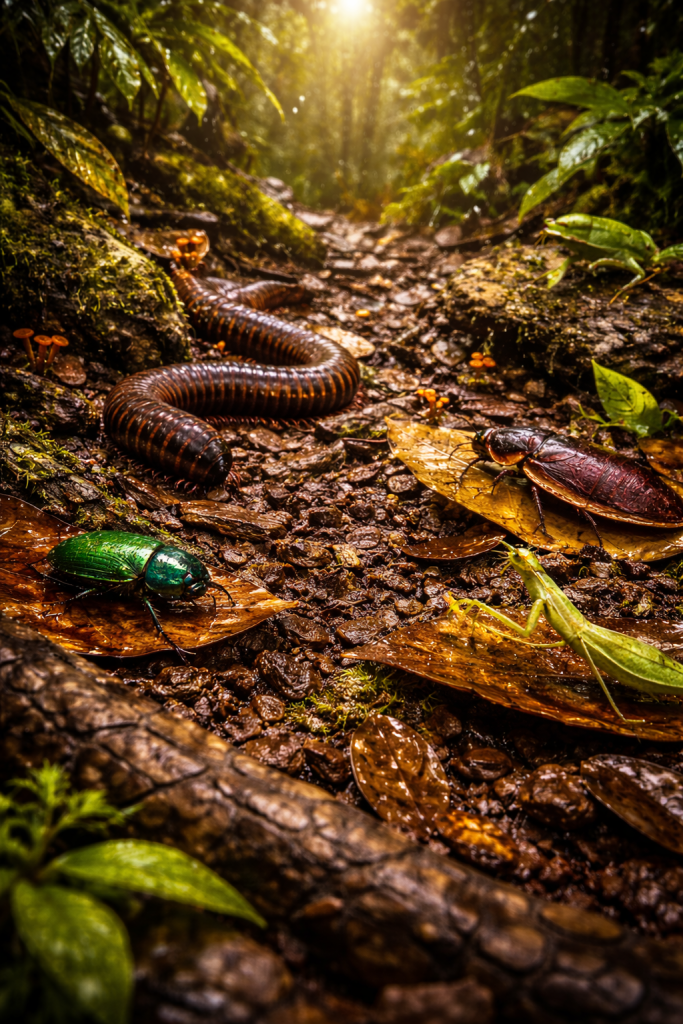
| When Everything Is Alive In Malaysia, there was never a moment when nothing was happening. Even stillness had weight. The air hummed. Leaves shifted without wind. The ground itself seemed to breathe. Life didn’t wait for daylight or permission — it pressed in from every direction, filling gaps you didn’t yet know existed. At night, especially, everything came to the surface. Insects clicked, drummed, rasped, vibrated. Wings brushed past skin. Shadows moved independently of bodies. You learned quickly that silence was an illusion — something you only believed in until you lived somewhere that never truly offered it. During the monsoon, that sense intensified. Rain didn’t fall politely; it arrived with force, volume, commitment. Soil loosened. Burrows flooded. Creatures relocated upward, outward, into spaces briefly shared with humans. Nothing retreated — it adapted. That was the defining lesson. Life in Malaysia did not pause for comfort. It reorganised. Insects appeared where you didn’t expect them because they had to. Ants formed living bridges. Cockroaches surfaced in daylight. Mosquitoes multiplied with ruthless efficiency. Butterflies vanished and returned. Predators adjusted. Prey recalculated. Every creature responded to pressure with movement. It taught me that vitality is not gentle. We often talk about “bringing life” into gardens — as though life needs encouragement. Malaysia showed me the opposite. Life is already there, waiting for opportunity. The question isn’t how to add it, but how to make space without breaking the systems that sustain it. As a gardener now, that awareness lives in the margins of my work. I notice when the soil feels too quiet. When leaf litter has been over-cleared. When the structure has been simplified for neatness at the expense of function. Behind the spade, I’ve learned that health is noisy, busy, layered. A living garden is not a calm one — it is active, overlapping, sometimes inconvenient. Things crawl. Things hide. Things emerge when conditions shift. Malaysia was the first place that taught me this truth fully: When everything is alive, nothing exists in isolation. And once you’ve lived somewhere like that, it becomes impossible to see gardens — or nature — as static scenes. They are processes. Movements. Conversations are happening whether we listen or not. The real choice is simple. Do we silence them for comfort — Or do we learn to live with the sound of life continuing all around us? |
| 10 True Facts About Malaysian Insects Malaysia has one of the highest insect diversities in the world Its tropical climate and rainforest habitats support an extraordinary range of insect species. Insects are active year-round. Warm temperatures mean there is no true dormant season, although activity shifts during monsoon periods. Many Malaysian insects are large compared to temperate species Consistent warmth and abundant food allow insects to grow bigger and live longer. Monsoon rains strongly shape insect life cycles. Breeding, movement, and survival often depend on rainfall patterns rather than temperature. Insects play a major role in rainforest decomposition Leaf litter, fallen wood, and organic waste are rapidly broken down by insects and other invertebrates. Mosquitoes are among the most dangerous insects. They transmit diseases such as malaria and dengue, making them a serious health concern. Many insects rely on camouflage to survive Leaf, bark, and stick mimicry are common adaptations in Malaysian forests. Some insects use bright colours as warning signals Vivid patterns often indicate toxicity or an unpleasant taste to predators. Insects are essential pollinators in tropical ecosystems Butterflies, beetles, flies, and other insects contribute to plant reproduction. Healthy insect populations indicate healthy ecosystems. Changes in insect numbers often reflect environmental disturbance or habitat loss. |
 Earthly Comforts