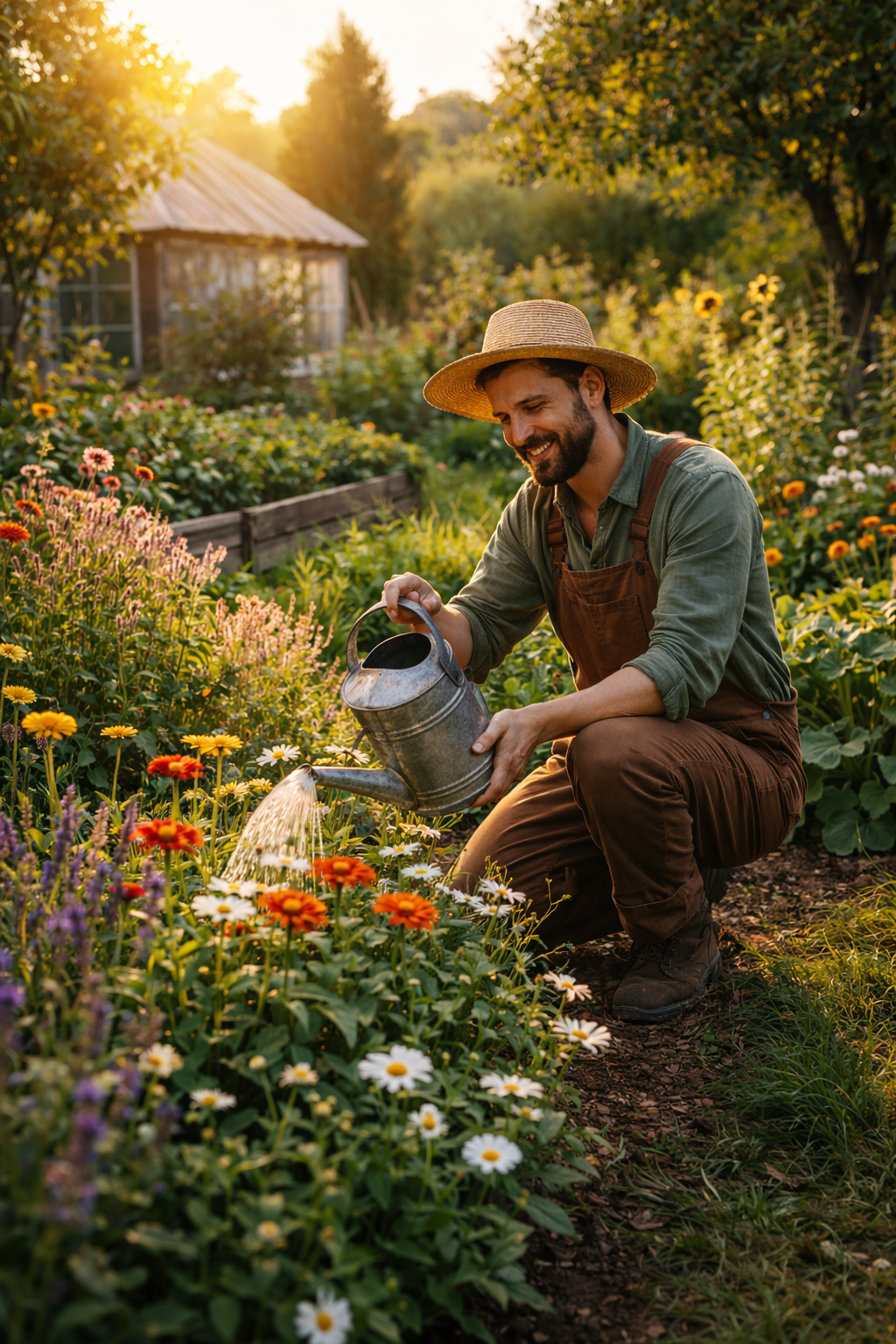
| Joy doesn’t shout. It doesn’t demand attention or announce itself with certainty. Often, it arrives quietly, in moments that feel small or even insignificant: soil under fingernails, the first green shoot after weeks of bare ground, the satisfaction of finishing a task that required patience rather than speed. In a world increasingly shaped by urgency, anxiety, and constant optimisation, joy has become something quietly subversive. To grow it deliberately may be one of the most radical acts left to us. Modern life trains us to prioritise efficiency, output, and visible success. Even rest is often reframed as “recovery” so we can return to productivity. Joy, however, resists being instrumentalised. It cannot be rushed, measured easily, or justified by spreadsheets. It exists for its own sake. That alone places it at odds with much of how we are encouraged to live. In the context of gardening, joy is often treated as a pleasant by-product rather than a central outcome. We talk about yields, maintenance schedules, aesthetics, and property value, but far less about how tending a living space changes the inner weather of the person tending it. Yet anyone who has worked with plants over time knows that joy is not accidental. It grows through rhythm, attention, and relationship. Growing joy requires slowness, and slowness is increasingly uncomfortable for many of us. When everything else is accelerating, slowing down can feel like falling behind. Gardening forces a different pace. Seeds germinate when they are ready, not when we demand results. Weather interrupts plans. Growth happens incrementally, often invisibly, until one day it suddenly doesn’t. This pace trains the nervous system. It reminds us that not all progress is linear or visible, and that waiting is not failure. There is also joy in care without spectacle. Much of gardening involves tasks no one will ever see: improving soil structure, composting, pruning back rather than adding more, tending roots instead of blooms. These acts don’t photograph well, but they matter deeply. They echo a quieter ethic of care that values foundations over appearances. Choosing to find joy here pushes against a culture that rewards only what can be displayed. Joy is radical because it reconnects us to agency without control. In many areas of modern life, people feel acted upon rather than active. Policies shift, costs rise, and technologies change faster than skills can keep up. Gardening does not restore control, but it restores participation. You are not in charge of outcomes, but you are involved. You show up, you respond, you adapt. That sense of meaningful participation is deeply nourishing, and increasingly rare. There is also a social dimension to joy that makes it politically and culturally significant. Joy spreads, not through performance, but through presence. A well-tended garden changes how neighbours feel about a street. A shared plant, cutting, or bit of advice creates a connection without transaction. These are small acts, but they rebuild trust in slow, grounded ways. In times when communities feel fragmented, joy becomes connective tissue. Importantly, joy does not mean ignoring difficulty. Gardens include failure, loss, and disappointment. Crops fail, plants die, and weather destroys careful plans. The joy that emerges is not naïve optimism but resilience. It comes from learning that loss does not negate meaning, and that effort is worthwhile even when outcomes are uncertain. This kind of joy has depth. It is not dependent on constant success. In sustainable and ecological gardening, joy plays an even more essential role. Practices that prioritise soil health, biodiversity, and long-term balance often require more patience and less immediate reward than conventional approaches. Without joy, these practices can feel like a sacrifice. With joy, they feel like alignment. Pleasure becomes the fuel for stewardship rather than an afterthought. Joy is also embodied. Gardening reconnects people to physical effort that feels purposeful rather than extractive. Muscles tire in honest ways. Senses engage fully: smell, touch, sound, and sight all participate. This sensory immersion brings people back into their bodies, which is quietly radical in a culture that increasingly lives through screens and abstractions. There is a tendency to dismiss joy as soft, indulgent, or secondary to “serious” concerns. Yet sustained change, whether personal or environmental, rarely comes from guilt or fear alone. Those emotions burn hot and fast. Joy endures. It keeps people returning, even when conditions are hard. It anchors commitment in something life-giving rather than punitive. To grow joy is to resist narratives of constant scarcity and crisis without denying reality. It is to say that care, beauty, and satisfaction are not luxuries to be postponed until things improve, but necessities that help us endure and rebuild. In this sense, joy is not escapism. It is preparation. When we choose to grow joy, we make a quiet statement about what matters. We say that well-being is not separate from work, that care has value even when it is slow, and that connection to land, place, and process is worth defending. These choices rarely look dramatic, but over time, they reshape how people live. Perhaps the most radical thing about joy is that it reminds us we are alive, not just functioning. In tending gardens, in working with seasons rather than against them, joy becomes something cultivated rather than stumbled upon. And once grown, it has a way of seeding itself elsewhere, in conversations, communities, and choices that reach far beyond the garden gate. |
Why Joy Might Be the Most Radical Thing We Grow
 Earthly Comforts
You’re absolutely right Rory. When the plants I’ve planted bloom with flowers or the herbs take root I am so happy.
LikeLike
What an uplifting post, Rory. Spring brings new growth and joyous moments.
LikeLike