
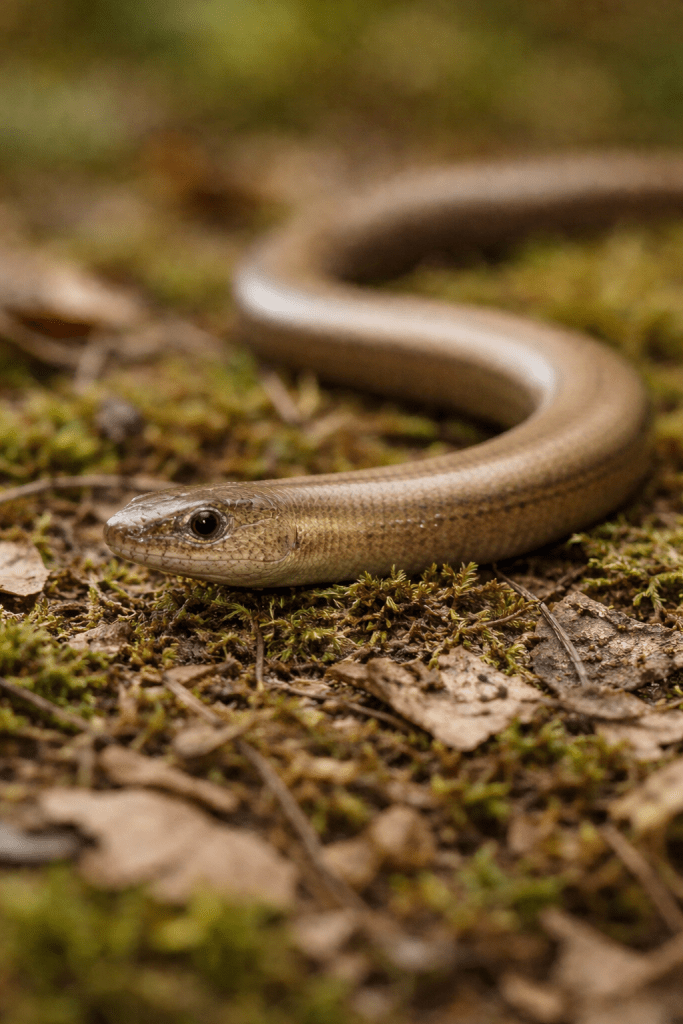
| The Slow Worm Quietly sliding beneath long grass, basking briefly on a warm path, or vanishing under a log the moment it is noticed, the slow worm lives a life shaped by discretion. Often mistaken for a snake and frequently misunderstood, this remarkable reptile is neither aggressive nor rare in spirit — it is simply subtle. The slow worm survives not by speed or force, but by timing, cover, and a deep understanding of the spaces humans tend to ignore. It is a master of margins: compost heaps, hedgebanks, rough grass, and the quiet edges of gardens and countryside. To understand the slow worm is to understand how much life depends on places we are tempted to tidy away. |
| Not a Snake at All Despite its appearance, the slow worm is a legless lizard. This distinction matters, not for labels, but for how it lives. Unlike snakes, slow worms: Have eyelids and can blink Can shed their tails as a defence Move with a smoother, more deliberate motion. Rely heavily on shelter rather than speed. Their bodies are cylindrical and glossy, often grey, brown, bronze, or silvery. Males are usually plainer in colour, while females often have darker sides and a distinct stripe running down the back. The sheen of their skin reflects light beautifully when basking, giving them a metallic appearance that catches the eye — briefly. A Body Designed for Burrowing and Balance The slow worm’s body is built for moving through dense ground cover. Its smooth scales reduce friction, allowing it to: Slide through grass and leaf litter. Move easily under debris. Navigate soil gaps and compost. Its movements are unhurried but purposeful. The name “slow worm” is misleading — when startled, it can move quickly enough to disappear in an instant. Speed, however, is not its main defence. That role belongs to stealth. Where Slow Worms Live Slow worms are widespread but localised, appearing wherever the right conditions exist. They favour: Rough grassland Garden compost heaps Allotments Railway embankments Brownfield land Heathland and woodland edges Wildlife-friendly gardens The key requirements are simple: Warmth Shelter Undisturbed ground They avoid open, exposed spaces and heavily managed land. Short lawns, frequent mowing, and constant disturbance remove the very features they need to survive. Messy places are not messy to a slow worm. They are home. Living by Heat and Timing As a reptile, the slow worm relies on external heat to function. Its day revolves around temperature: Basking to warm up Foraging during optimal conditions Retreating to shelter when it’s too hot or cold You are most likely to see a slow worm in spring or autumn, when temperatures are mild. In summer, they often remain hidden to avoid overheating. In cooler weather, they bask more openly. This careful temperature management allows them to conserve energy and avoid unnecessary risk. What Slow Worms Eat Slow worms are carnivorous, feeding primarily on soft-bodied invertebrates. Their diet includes: Slugs Snails Earthworms Insect larvae They hunt slowly and deliberately, following scent trails rather than chasing prey. This makes them particularly effective slug controllers in gardens — quietly reducing numbers without chemicals. Because of this diet, slow worms depend on healthy soil life. Where soil is compacted, dry, or chemically treated, their food supply dwindles. Good soil equals good slow worm habitat. Shelter: The Difference Between Survival and Absence Slow worms spend much of their lives hidden. They rely on: Log piles Compost heaps Stones and rubble Dense vegetation Corrugated sheets or boards left on the ground These features provide warmth, protection from predators, and places to rest or give birth. Gardeners sometimes unknowingly create a perfect slow worm habitat simply by leaving things alone. Ironically, well-meaning “tidying up” is one of the biggest threats they face. Reproduction and Live Young Slow worms give birth to live young rather than laying eggs. In late summer, females produce small, fully formed young that emerge from thin membranes shortly after birth. These young must fend for themselves immediately. This reproductive strategy allows slow worms to survive in cooler climates, where egg incubation would be unreliable. Young slow worms are tiny, shiny, and dark, often with golden stripes. They disappear quickly into cover, beginning the same hidden life as their parents. Winter: Long Stillness Underground As temperatures fall, slow worms enter hibernation. They retreat to frost-free places such as: Deep compost heaps Beneath tree roots Underground cavities Dense vegetation mats They may hibernate alone or in small groups, remaining inactive for months. Disturbance during this time — digging, clearing, or moving compost — can be fatal, forcing them to wake when food is unavailable. Winter survival depends entirely on an undisturbed refuge. Predators and Risks Slow worms are prey for many animals, including: Birds Foxes Badgers Hedgehogs Domestic cats Their primary defence is avoidance. If caught, they may shed their tail, which continues to wriggle and distracts the predator while the slow worm escapes. This tail does regrow, but never perfectly — a reminder that survival often leaves marks. Human activity poses a far greater risk than natural predators. Strimmers, mowers, digging, and habitat removal account for many slow worm deaths each year. Why Slow Worms Are Often Misjudged Slow worms suffer from misunderstanding more than rarity. They are: Mistaken for snakes Feared unnecessarily Killed out of confusion Overlooked because they are quiet In reality, they are harmless, non-aggressive, and beneficial. They do not bite in defence, do not chase, and pose no threat to people or pets. Their only demand is space to live quietly. What the Slow Worm Tells Us About a Place The presence of slow worms is a sign of something important. It suggests: Low disturbance Healthy soil life Structural diversity Tolerance of untidy spaces They are not animals of pristine gardens or manicured land. They belong to places where natural processes can continue. When slow worms disappear, it is often because the land has become too controlled. Lessons from a Master of Stillness The slow worm teaches us that: Stillness is a survival strategy. Cover matters more than visibility. Not all wildlife thrives in neat spaces. Gentle coexistence is possible. Protecting slow worms often requires doing less, not more. Leaving the compost heap. Leaving the log pile. Leaving the long grass. A Life Just Beneath the Surface Most people will never see a slow worm clearly. If they do, it will be fleeting — a shimmer in grass, a movement under a board, a brief bask in the sun. But their presence is significant. They are quiet allies of healthy gardens and landscapes, living proof that some of the most resilient wildlife does not shout for attention. The slow worm survives by slipping between moments. All it asks is that we leave room for those moments to exist. |
 Earthly Comforts