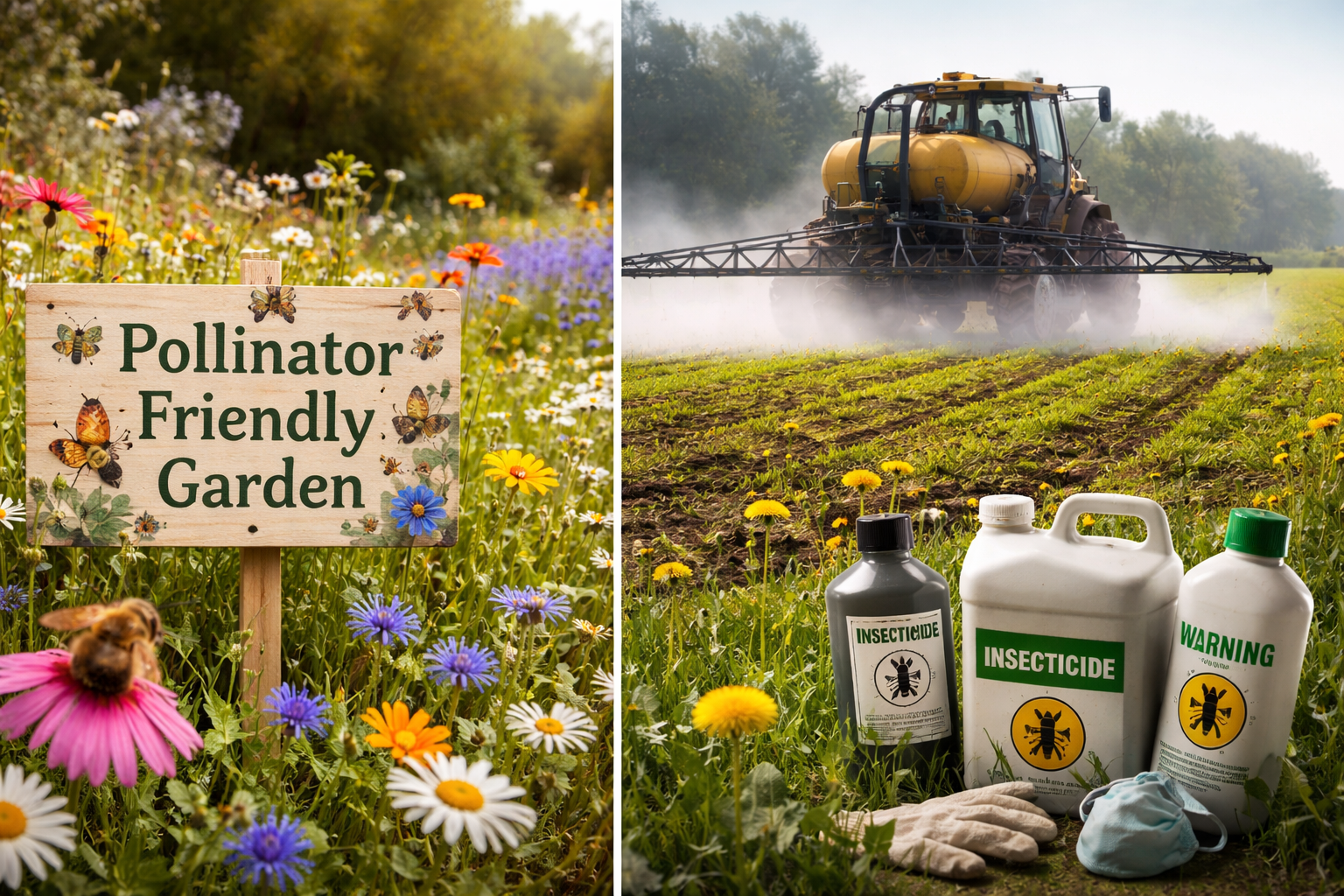
| Walk through any garden centre, scroll a council website, or glance at a roadside verge sign and you will likely see the same message repeated: Save the bees. Pollinator campaigns are everywhere. Wildflower seed packets, bee hotels, awareness weeks, and colourful posters promise hope for declining insects. Yet, just beyond these well-intentioned gestures, a quieter contradiction persists. Many of the same spaces promoting pollinator protection continue to rely on pesticides that actively undermine insect survival. This is the irony at the heart of modern environmental messaging. Pollinators are not declining because of a lack of awareness. Most people now understand that bees, hoverflies, butterflies, moths, and beetles play a vital role in food production and ecosystem health. What is less openly addressed is how deeply embedded chemical control has become in land management, farming, and even domestic gardening. We are often encouraged to help pollinators around the edges of a system that remains fundamentally hostile to them. Pesticides are rarely presented as blunt instruments. They are framed as necessary tools, applied responsibly, selectively, and safely. The language is technical and reassuring. Insecticides are said to target “problem species.” Herbicides are described as weed management. Fungicides are framed as plant protection. The cumulative impact on pollinators, however, is seldom visible in the moment. Bees do not collapse instantly in treated fields. Butterflies do not vanish overnight. Instead, populations weaken slowly through impaired navigation, reduced fertility, contaminated food sources, and habitat simplification. This slow erosion makes contradiction easy to ignore. A strip of wildflowers can be planted while adjacent land is sprayed. A pollinator-friendly logo can sit comfortably on packaging that also promotes chemical solutions. Councils can run bee campaigns while maintaining herbicide contracts. The appearance of care becomes a substitute for meaningful change. There is also a scale problem. Pollinator campaigns often focus on individual action: planting lavender, avoiding one product, or installing a bee house. While these actions are not pointless, they operate at a tiny scale compared to the widespread use of pesticides across agricultural, municipal, and commercial landscapes. A bee may visit dozens of gardens, hedgerows, fields, and verges in a single foraging day. One untreated garden cannot compensate for an environment saturated with chemicals elsewhere. Another overlooked aspect is how pollinator campaigns sometimes oversimplify nature. Bees are often treated as a single group with uniform needs, when in reality, pollinators are extraordinarily diverse. Some nest in soil, others in hollow stems, old walls, or dead wood. Many have short flight ranges and rely on very specific plants. When pesticides remove “weeds” or insects deemed inconvenient, entire food chains unravel quietly. The campaign image of a smiling cartoon bee does little to reflect this complexity. There is also an uncomfortable economic truth. Pesticides are profitable. They offer predictable outcomes in systems designed for efficiency and control. Pollinator campaigns, by contrast, are cheap. A sign, a packet of seeds, or a press release costs very little and generates positive attention. In this context, campaigns can function as a form of environmental reassurance, allowing institutions and businesses to appear responsible without confronting deeper dependencies on chemical management. This does not mean pollinator campaigns are meaningless. They have shifted public awareness significantly over the past decade. Fewer people now see insects as disposable or irrelevant. Many gardeners are questioning long-held habits. Some councils and landowners are experimenting with reduced spraying, meadow planting, and ecological management. These are genuine steps forward. The irony arises when campaigns are used as cover rather than catalysts. Real support for pollinators requires a shift from symbolism to systems thinking. It means accepting more mess, more variability, and less control. It means tolerating weeds, imperfect lawns, and insects that do not fit neatly into categories of “good” or “bad.” It means understanding that pollinators need entire landscapes to function, not isolated pockets of friendliness. There is also a cultural adjustment required. Modern land management has been shaped by an expectation of tidiness and uniformity. Pesticides offer an easy route to that aesthetic. Pollinators, by contrast, thrive in complexity: overlapping flowering times, decaying matter, unmanaged corners, and living soils. Supporting them challenges deeply ingrained ideas about what a “well-kept” space looks like. The irony, then, is not just chemical. It is philosophical. We celebrate pollinators while resisting the ecological humility required to coexist with them. We ask nature to perform services while limiting its freedom to behave naturally. Until this tension is acknowledged, pollinator campaigns will continue to sit awkwardly beside pesticide use, offering comfort without coherence. If pollinators are to recover meaningfully, campaigns must evolve from awareness tools into invitations for genuine change. That change may be slower, less tidy, and harder to measure than a sprayed solution. But unlike irony, it would be honest. |
The Irony of Pollinator Campaigns Alongside Pesticide Use
 Earthly Comforts
This is a great post, Rory, bringing awareness to the downside of pesticides.
LikeLiked by 1 person
Thank you Eugenia 🙂
LikeLike
You’re welcome, Rory. 😊
LikeLiked by 1 person