
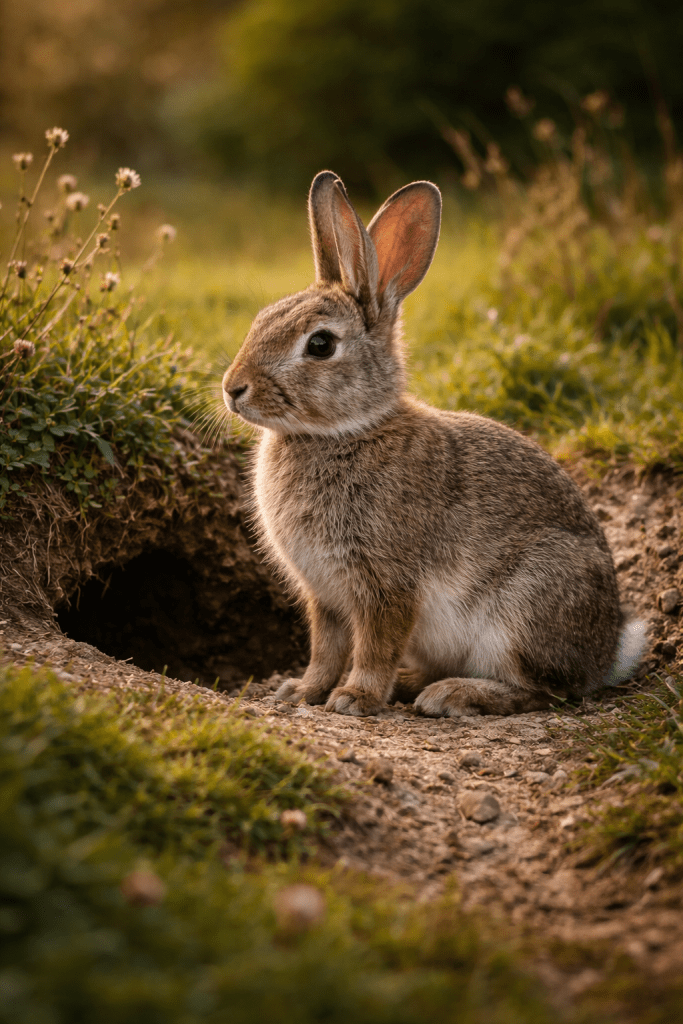
| A Complete, Ground-Level Understanding The European rabbit is a small, social mammal that has quietly shaped landscapes, ecosystems, farming practices, folklore, and even human economies for thousands of years. Though often thought of as simple or commonplace, the rabbit is anything but. It is a highly specialised animal, finely tuned to survival, reproduction, and cooperation, and its presence — or absence — can radically alter the land it inhabits. Origins and Natural Range The European rabbit evolved in the Iberian Peninsula, where dry soils, open scrub, and patchy woodland created ideal conditions for burrowing animals. From this relatively small origin point, rabbits spread gradually with human assistance, first across Europe and later across much of the world. Their adaptability allowed them to thrive in environments ranging from coastal dunes to farmland, grassland, and woodland edges. What makes rabbits particularly distinctive is that they are not simply surface-dwelling animals. Their relationship with the land is three-dimensional: they shape what grows above ground and what exists below it. Physical Characteristics and Senses European rabbits are compact, light-boned animals built for speed and alertness rather than strength. Their long hind legs are designed for sudden acceleration, allowing them to zigzag at high speed when fleeing danger. Their ears are large and highly mobile, capable of detecting faint sounds from multiple directions and helping regulate body temperature. Their eyes are positioned high and to the sides of the head, giving them an exceptionally wide field of vision. This allows a rabbit to monitor almost everything around it without turning its head — an essential adaptation for an animal preyed upon by many predators. Despite this vigilance, rabbits rely less on confrontation and more on avoidance. Everything about their body plan says the same thing: notice danger early, and disappear fast. Burrows and Social Structure Unlike hares, European rabbits live underground in complex tunnel systems known as warrens. These burrows provide protection from predators, weather, and temperature extremes. A warren may be home to multiple family groups, and its layout often reflects generations of digging, expansion, and reuse. Rabbits are deeply social animals. Within a warren, there is a clear hierarchy, especially among females. Dominant individuals gain priority access to the safest nesting chambers and the best feeding areas. Social bonds are maintained through grooming, scent marking, and subtle body language. This social structure reduces conflict and increases survival. A well-organised group can detect threats faster, raise young more efficiently, and recover more quickly after losses. Diet and Grazing Behaviour European rabbits are strict herbivores. They feed primarily on grasses, herbs, young shoots, bark, and agricultural crops when available. Their grazing style is selective rather than indiscriminate: they repeatedly crop the same plants close to the ground, which can keep vegetation permanently short in heavily populated areas. This feeding behaviour has a powerful ecological effect. In moderate numbers, rabbits create diverse, low-growing habitats that benefit wildflowers, insects, and ground-nesting birds. In excessive numbers, however, they can strip land bare, prevent regeneration, and contribute to erosion. One of the rabbit’s most remarkable adaptations is its digestive system. Rabbits re-consume specially produced droppings to extract maximum nutrients from fibrous plant material. This process allows them to survive on food that many other animals could not utilise efficiently. Reproduction and Population Growth Rabbits are famous for their reproductive ability, and with good reason. They mature quickly, breed frequently, and can produce multiple litters in a single year. This strategy evolved as a counterbalance to high predation: many young do not survive, but enough usually do to sustain the population. Females prepare carefully constructed nesting chambers lined with fur. The young are born blind, hairless, and entirely dependent, hidden safely underground during their most vulnerable stage. This rapid reproduction means rabbit populations can increase dramatically under favourable conditions — mild winters, abundant food, and reduced predation all contribute to population booms. Predators and Survival Strategy European rabbits sit near the base of the food chain. Foxes, birds of prey, stoats, cats, and humans have all relied on rabbits as a food source. As a result, rabbits have evolved a survival strategy based on early warning, group vigilance, and explosive escape. Rather than fighting, rabbits freeze, assess, and flee. A sudden flash of movement into a burrow entrance is usually all a predator ever sees. Their famous foot-thumping is a warning signal, alerting others in the area to danger. Relationship with Humans Humans have had a complicated relationship with rabbits. They have been hunted for food, fur, and sport, farmed commercially, and blamed for agricultural damage. In some regions, they are protected; in others, they are controlled aggressively. Domesticated rabbits descend from the European rabbit and retain many of its instincts, including burrowing behaviour, social needs, and alertness. Even pet rabbits are not far removed from their wild ancestors. The rabbit also occupies a strong place in human culture — symbolising fertility, vulnerability, cleverness, and resilience depending on context. Ecological Importance Rabbits are a keystone species in many ecosystems. Their grazing influences plant composition, their burrows provide shelter for other animals, and their presence supports predator populations. Removing rabbits entirely from a landscape can cause as much disruption as allowing them to overpopulate it. In balanced systems, rabbits help maintain open habitats that would otherwise revert to scrub or woodland. In this way, they quietly shape the character of the land. A Species of Extremes The European rabbit is neither simply a pest nor merely a prey animal. It is a species defined by balance — between abundance and scarcity, impact and vulnerability. When conditions are right, rabbits thrive. When conditions shift, populations can collapse just as quickly. Understanding rabbits properly means recognising their role not in isolation, but as part of a wider living system that includes soil, plants, predators, and people. |
 Earthly Comforts