
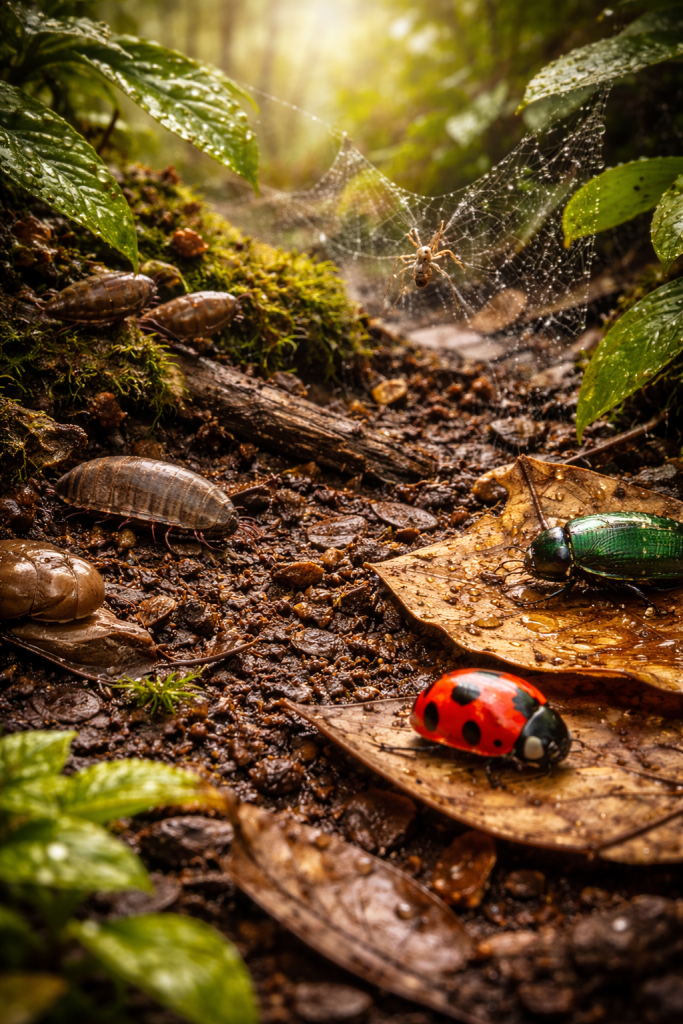
| Coming Home to Smaller Worlds I returned to England in 1977. I had left the UK in 1965, when I was two and a half years old — too young to remember what I was leaving behind. By the time I came back, just shy of my fourteenth birthday, I was already shaped by elsewhere. Australia and Malaysia had set the scale of my expectations, my instincts, my sense of what “alive” looked like. England felt quiet. Not empty — just restrained. There were insects, of course, but they no longer dominated space. They didn’t announce themselves with size or sound. They didn’t force awareness. They required it. If you weren’t paying attention, you could walk through an English landscape and believe, genuinely, that nothing much was happening at all. At first, that felt like a loss. Where were the vast wings, the constant motion, the sense that the ground itself was alert? Instead, there were woodlice beneath stones, ladybirds small enough to disappear into a fingertip, beetles that slipped away the moment they were noticed. Everything felt scaled down, toned down, subdued. I thought the life had thinned out. What I hadn’t realised yet was that the volume had changed, not the complexity. British insects are specialists in restraint. They live in margins, seams, and pauses. They wait for conditions rather than overwhelming them. A hedgerow holds more than it shows. Soil reveals itself only if disturbed gently. Webs exist briefly, perfectly, then vanish again without explanation. Once I learned to slow my looking, the world returned. The ground began to speak — quietly. Leaf litter lifted to reveal entire communities operating in darkness. Soil moved in subtle ways, not frantic ones. Spiders held positions patiently rather than patrolling. Everything worked on the principle of continuity rather than abundance. It was a different discipline. As a gardener now, this difference shapes everything I do. British gardens don’t thrive on spectacle. They thrive on stability. On shelter left intact. On corners allowed to soften. On decay permitted to happen without interference. The life here is not showy, but it is stubbornly persistent. Behind the spade, I learned that “smaller” does not mean “less alive.” It means more easily overlooked. The reward comes not from excitement, but from familiarity — from recognising the same beetle week after week, the same web rebuilt after rain, the same quiet resilience playing out season after season. Coming home taught me this: Some landscapes don’t ask to be admired. They ask to be understood. And once you understand them, you realise that the British garden is not a retreat from wildness — it is a quieter expression of it. One that doesn’t shout, doesn’t threaten, doesn’t dazzle. It simply endures. |
| 10 True Facts About British Garden Insects Most British garden insects are small but numerous Their populations rely on large numbers rather than large body size, which makes them easy to overlook. Many species spend most of their lives hidden. Soil, leaf litter, bark, and compost heaps are where much of their activity actually happens. British insects are strongly seasonal. Temperature and daylight, rather than rainfall, largely control their life cycles. Leaf litter is one of the richest habitats in a garden It supports insects, spiders, larvae, fungi, and the predators that depend on them. Spiders play a major role in British gardens They help regulate insect populations without the need for chemicals. Many insects rely on hedgerows and garden edges. These transition zones provide shelter, food, and safe movement between habitats. Some insects are active only at dawn or dusk. This timing reduces predation and explains why gardens can seem quiet during the day. Soil insects are essential for healthy ground They aerate soil, break down organic matter, and support plant growth. British gardens can support surprising biodiversity. Even small gardens can host dozens of insect species if managed thoughtfully. A quiet garden is not an empty garden. Much of British insect life operates out of sight and at a slower pace than in tropical systems. |
 Earthly Comforts