| A Seven-Part Exploration of Resilience, Climate, and the Future of Earthly Comforts |
| Part V — Experimental Plants and Living Laboratories |
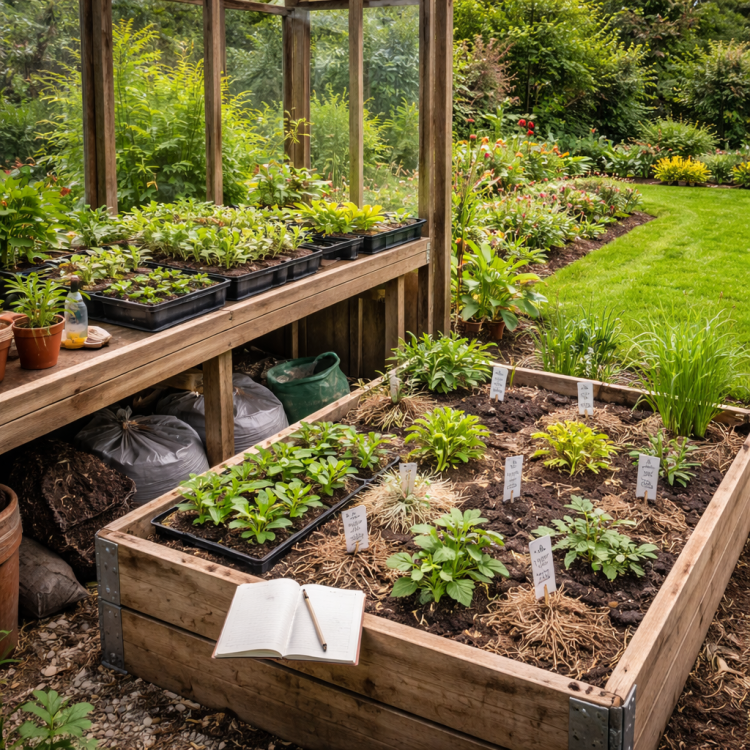
| Propagation, performance testing, and building climate-aware knowledge If Part III explored modular beds as climate infrastructure and Part IV examined the financial logic of diversification, Part V turns to something quieter but equally structural: experimentation. In periods of environmental stability, gardeners can rely on inherited plant wisdom. Traditional planting lists, familiar varieties, and established seasonal patterns provide dependable guidance. When climate volatility increases, that inherited knowledge becomes less certain. Plants that once performed reliably may struggle. Others, previously marginal, may thrive. A professional gardening service operating within this uncertainty must decide whether to rely solely on commercial availability and historical habit, or to develop its own site-specific knowledge. Experimental planting and propagation offer a path toward the latter. This is not experimentation for novelty’s sake. It is structured testing in response to environmental variability. It asks measured questions: Which perennials tolerate intermittent drought in this soil profile? Which annuals withstand sudden heat spikes without excessive watering? Which mulching strategies retain moisture longest under wind exposure? Which varieties resist fungal stress during humid, wet summers? Answers rarely emerge from catalogues. They emerge from observation over time. Micro garden spaces and modular beds provide ideal environments for this form of applied research. Contained soil volumes allow variation in composition. Plantings can be grouped deliberately. Performance can be monitored closely without risking large ornamental borders. Failures remain localised and instructive rather than costly and visible. Propagation deepens this capacity. When a gardening business grows a portion of its own stock — even modestly — it gains control over selection, timing, and quality. Seed trays and cuttings become tools of resilience rather than hobbyist indulgence. Growing plants in-house reduces dependence on last-minute purchases and allows earlier preparation for seasonal demand. The economic dimension of propagation is often understated. Purchased plants represent direct cost and supply-chain exposure. In years of high demand or disrupted logistics, availability may fluctuate. By contrast, propagated stock — whether perennial divisions, cuttings, or seedlings — offers partial insulation from external variability. This does not eliminate commercial purchasing. It supplements it. The aim is not self-sufficiency in the romantic sense, but partial autonomy. There is also an authority dimension. A business that trials plants in local conditions accumulates knowledge grounded in place. Observations about drought tolerance or flood resilience carry greater credibility when they arise from lived testing rather than second-hand recommendations. Over time, this builds a performance library specific to geography. In a town such as Sandwich, where soil types, wind exposure, and rainfall patterns have local character, this knowledge becomes valuable. Clients are less interested in global plant fashion than in what will thrive in their own gardens. Experimental plots provide evidence-based answers. It is important to define experimentation clearly. Structured trials differ from casual planting. Variables should be intentional. Soil composition might vary between beds. Mulch depth might be adjusted deliberately. Watering regimes may be controlled to test tolerance. Performance should be recorded seasonally. Without discipline, experimentation drifts into distraction. With discipline, it becomes applied research. There are limits. Trial plots occupy time and space. Not every small business can dedicate large areas to testing. Yet micro systems allow small-scale trials without major resource allocation. A single pallet collar can serve as a seasonal comparison bed. A greenhouse bench can host a limited propagation run. The broader horticultural sector increasingly acknowledges the importance of climate-responsive planting. Botanical gardens and horticultural institutions conduct formal research into drought-tolerant and flood-resilient species. At a domestic scale, professional gardeners can replicate aspects of this inquiry in simplified form. The advantages are cumulative rather than immediate. In the first season, results may be inconclusive. In the second, patterns begin to emerge. By the third, certain plants demonstrate consistent resilience under variable conditions. That cumulative knowledge informs future installations and strengthens advisory conversations. Propagation also supports aesthetic continuity. When a particular perennial performs well in a trial bed, divisions can be introduced into client borders. This creates a subtle ecosystem of plants proven locally. Replacement stock becomes available without reliance on retail cycles. Furthermore, experimental micro beds provide training environments for staff. New gardeners learn how soil blends affect drainage, how watering regimes influence root development, and how mulching moderates temperature. Lessons absorbed in contained spaces transfer outward into broader maintenance work. There is an educational dimension for clients as well. Inviting clients to observe trial beds or receive propagated plants introduces them to the logic of resilience. Rather than prescribing change abstractly, the gardener demonstrates performance through example. The concept of the “living laboratory” may sound grand for a small-town practice, yet it captures the intent. A garden becomes not only a site of maintenance but a site of observation and learning. Each season contributes data — informal yet meaningful. Climate volatility makes such learning necessary. Reliance on static planting lists assumes stability. When seasons shift unpredictably, adaptability becomes a competitive advantage. However, restraint remains essential. Experimentation must align with core service capacity. Trial plots should not displace revenue-generating work beyond sustainable limits. The purpose is to inform and strengthen practice, not to transform the business into a research institution. Within these boundaries, experimental plants and propagation represent a form of quiet resilience. They reduce supply-chain dependence, enhance local knowledge, and provide structured opportunities to test climate adaptation strategies. Over time, this layered knowledge base sets the business apart. Clients benefit from plant selections that have been observed under comparable conditions. Maintenance becomes more targeted. Replacement decisions become evidence-informed rather than reactive. In a climate that is becoming less predictable, the ability to learn systematically from each season is invaluable. Part VI shifts from experimentation to identity, examining how soil-first thinking, rewilding principles, and ecological stewardship reshape the professional gardener’s role. |
| About our writing & imagery Most articles reflect our real gardening experience and reflection. Some use AI in drafting or research, but never for voice or authority. Featured images may show our photos, original AI-generated visuals, or, where stated, credited images shared by others. All content is shaped and edited by Earthly Comforts, expressing our own views. |
 Earthly Comforts