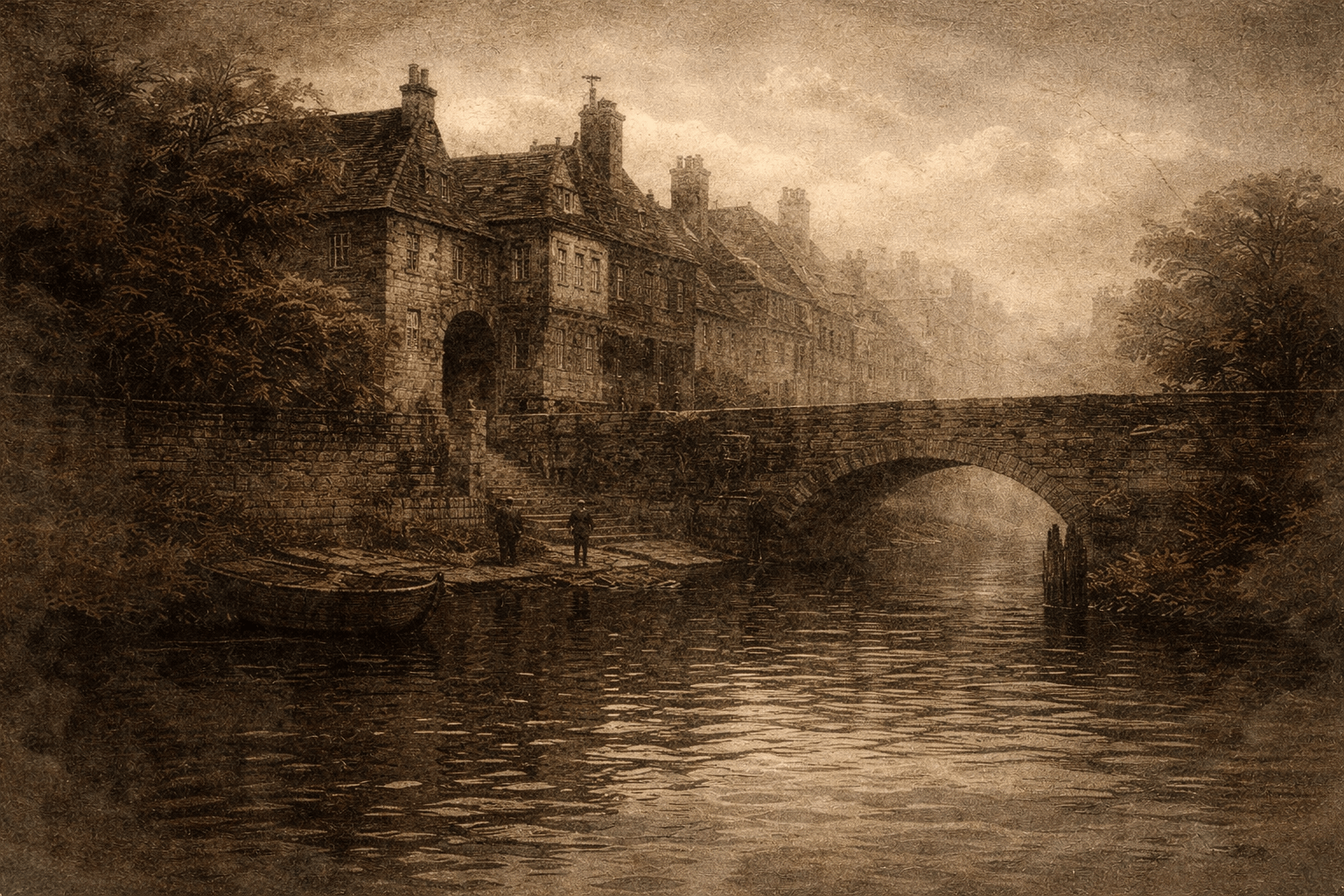
| I’ve always loved history, and Sandwich has long fascinated me. Perhaps because, despite its depth and complexity, finding a truly concise account of the town is surprisingly difficult. There are many books written about Sandwich, and many good ones, but none that feel easy to hold in the mind. The story resists simplification. This series is not a concise history either — and that is intentional. Rather than trying to compress Sandwich into a neat timeline, I wanted to explore it in a different way. I wasn’t interested in dates laid out in order or a list of events moving from one century to the next. I wanted to understand how the town has felt over time and how land, water, and ordinary human effort have quietly shaped it rather than dramatically. Sandwich is not a place defined by single moments. It is defined by long accommodation. A note on how this series was written This series has been written by me, in collaboration with ChatGPT, as part of an intentional decision to work in a non-conventional style. I used AI as a writing partner — a way to test ideas, shape language, and keep the tone steady while thinking through a reflective approach. The voice, interpretation, and direction are mine; the process was shared. The result is not a traditional history, but a reflective one. It’s written slowly and deliberately, in much the same way the town itself has changed — through adjustment, attention, and time rather than through sudden moments. How to read this series Although each part stands on its own, the series is intended to be read as a single arc. It follows Sandwich from possibility to endurance, not through events, but through conditions — land, water, work, belief, authority, memory, and time. Chronology still matters here, but it sits quietly beneath the surface rather than driving the structure. Some parts overlap in time. Others compress centuries into a single phase. This reflects how places actually change: unevenly, gradually, and without clear turning points. Parts One and Two are closely linked and will appear together in the next episode, forming the environmental foundation for the rest of the series. This is a history told sideways, shaped by consequence rather than chronology. It asks not what happened next, but what stayed, what adjusted, and what endured. |
| Part | Theme | What this part explores | Chronological alignment* |
|---|
| Part 1 | Why the town exists | The environmental conditions that made Sandwich possible: land, water, and allowance rather than planning | Pre-Roman – c. 800 |
| Part 2 | The river as condition | The River Stour as both enabler and long-term constraint | Early medieval c. 800 – 1100 |
| Part 3 | Work and ordinary life | Labour, land use, and everyday effort in a working port town | Medieval peak c. 1100 – 1350 |
| Part 4 | Power and governance | The growth of authority, regulation, and oversight as trade increased | High to late medieval c. 1200 – 1450 |
| Part 5 | Belief as structure | Religion as organiser of time, behaviour, and continuity | Medieval to early modern c. 1100 – 1550 |
| Part 6 | Pressure and adjustment | Narrowing advantage, rising maintenance, and the shift from growth to endurance | Late medieval to early modern c. 1350 – 1600 |
| Part 7 | Endurance becomes habit | Survival normalised; continuity without prominence | Early modern c. 1500 – 1700 |
| Part 8 | Memory and identity | Living with the past without being governed by it | Early modern to modern c. 1650 – 1800 |
| Part 9 | Living with time | Slowness, patience, and endurance as defining rhythms | Modern c. 1750 – 1900 |
| Part 10 | Care and stewardship | Maintenance, repair, and attention as the work of continuity | Modern lived experience c. 1800 – 1950 |
| Part 11 | Coherence over prominence | Alignment with limits; identity rooted in proportion | Modern to present c. 1900 – present |
| Part 12 | A town allowed | Reflection on endurance, acceptance, and lasting within limits | Timeless conclusion |
| *Chronological alignment is indicative only. The series is written reflectively rather than as a date-led history. |
 Earthly Comforts
I look forward to reading more about Sandwich, Rory.
LikeLiked by 1 person