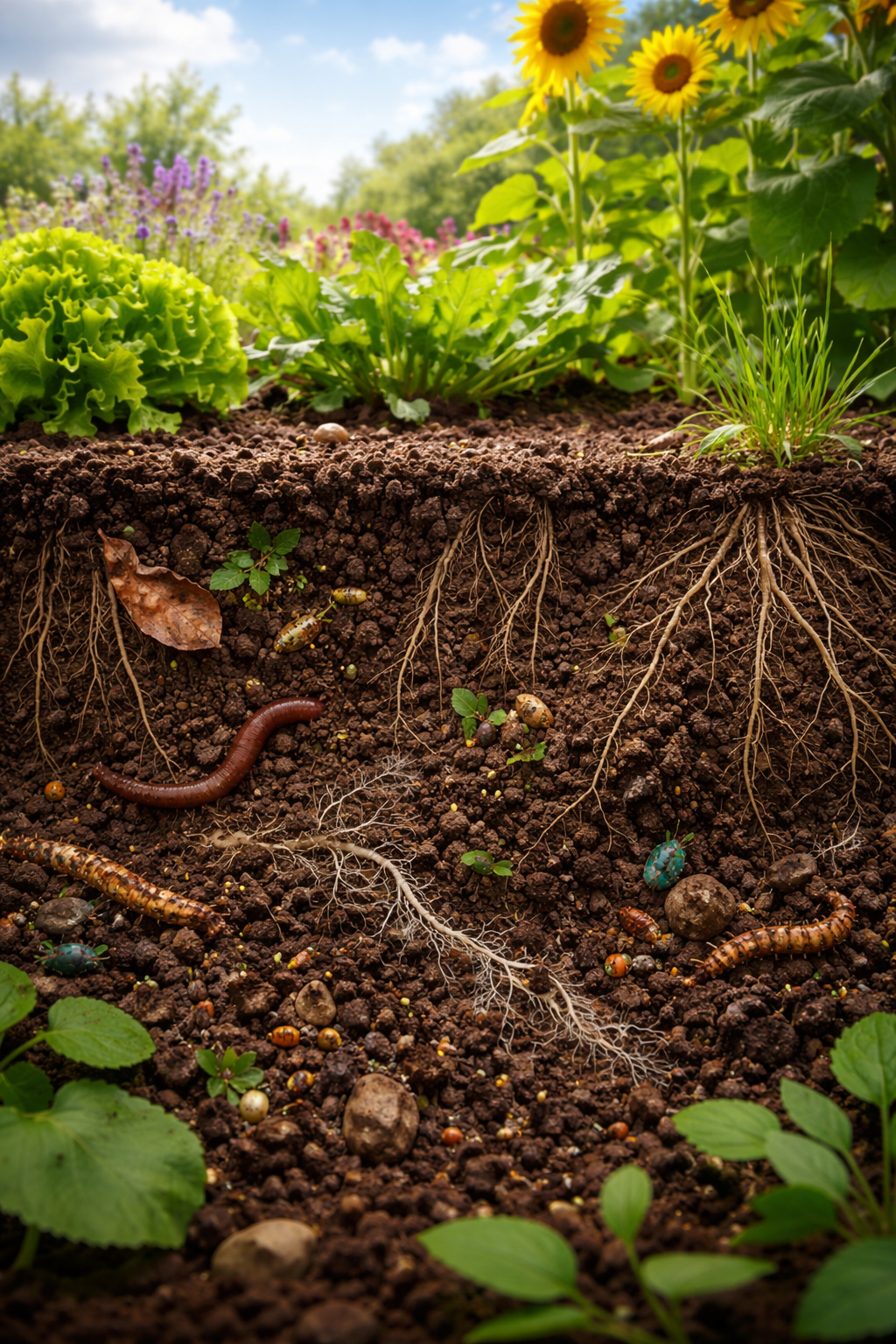
| Soil is often treated as a backdrop to gardening rather than the main event. It gets dug, turned, compacted, fed, stripped, and ignored, all in the name of what grows above it. Yet soil is not an inert material. It is a living system, constantly changing, responding, and interacting with plants, water, air, and climate. When we understand soil as alive, the way we garden shifts from control to care. Healthy soil is not just dirt with nutrients mixed in. It is a complex community made up of minerals, organic matter, water, air, and an astonishing range of living organisms. Bacteria, fungi, protozoa, nematodes, insects, earthworms, and plant roots all play active roles. Together, they form what is sometimes described as a soil food web, where energy and nutrients move through many interconnected pathways rather than a single chain. At the heart of this system is organic matter. Leaves, stems, roots, mulch, compost, and decaying plant material feed the soil community. As organisms break this material down, nutrients are slowly released in forms that plants can use. This process does not happen overnight, and that slowness is part of its strength. Living soil provides steady nutrition, buffering plants from feast-or-famine conditions that often result from synthetic fertilizers. Microorganisms are the quiet workforce beneath our feet. Bacteria help convert nitrogen into plant-available forms, while fungi extend the effective reach of plant roots through networks of fine threads known as hyphae. Mycorrhizal fungi, in particular, form partnerships with plants, trading nutrients and water for sugars produced through photosynthesis. This relationship increases plant resilience, improves nutrient uptake, and strengthens resistance to stress. Soil structure is another critical feature of a living system. Healthy soil contains aggregates, small clumps held together by organic compounds and fungal threads. These aggregates create pore spaces that allow air and water to move freely. When soil is compacted or repeatedly disturbed, these structures collapse. Water either runs off or stagnates, roots struggle to breathe, and beneficial organisms decline. Structure matters just as much as chemistry. Roots themselves are active participants in soil life. They release sugars, amino acids, and other compounds into the surrounding soil, effectively feeding microorganisms in their immediate zone. In return, those microbes mobilise nutrients, protect roots from pathogens, and help regulate moisture. This exchange means that plants are not passive recipients of soil health; they are contributors to it. A living soil also acts as a sponge. Organic matter increases the soil’s ability to hold water while still draining excess away. This is particularly important as weather patterns become more extreme, with longer dry spells followed by heavy rainfall. Soils rich in life cope better with both drought and flood, protecting plant roots and reducing erosion and runoff. When soil life is damaged, the effects ripple outward. Excessive digging, chemical fertilisers, pesticides, and bare soil all disrupt biological balance. Over time, soil becomes less responsive, requiring more inputs to achieve the same results. Plants may grow quickly but weakly, becoming dependent on constant feeding and more vulnerable to pests and disease. What looks efficient in the short term often proves fragile in the long term. Working with soil as a living system means changing priorities. Feeding the soil becomes more important than feeding the plant directly. This can be as simple as leaving fallen leaves to break down, adding compost regularly, mulching bare ground, and avoiding unnecessary disturbance. Even small changes, repeated consistently, can restore biological activity surprisingly quickly. No-dig or low-disturbance approaches are one practical response to this understanding. By keeping soil structure intact and allowing organisms to organise themselves, these methods support healthier root development and stronger microbial networks. Instead of turning soil over, organic matter is layered on top and allowed to integrate naturally. Worms and microbes do the mixing far more gently and effectively than tools. Weeds, often seen as enemies, can also be indicators of soil conditions. Certain plants appear where soil is compacted, depleted, or imbalanced, acting as early responders to disturbance. Observing which weeds dominate can offer clues about what the soil needs, whether that is aeration, organic matter, or simply time to recover. Soil life does not work in isolation from the wider environment. It plays a role in carbon storage, water filtration, and overall ecosystem stability. Healthy soils store significant amounts of carbon underground, helping moderate atmospheric levels. They also filter pollutants from water as it moves through the ground, protecting waterways and wildlife beyond the garden boundary. Understanding soil as a living system encourages patience. Results are not always immediate, and progress is not always visible. Yet beneath the surface, changes are happening constantly. Diversity increases, resilience builds, and plants begin to show steadier growth and improved health. The garden becomes less about constant intervention and more about guidance. Ultimately, soil care is an act of stewardship. Whether tending a small town garden or a larger landscape, the principles remain the same. Protect life below ground, provide organic inputs, minimise disturbance, and allow natural processes to function. When soil is treated as alive, it responds in kind, supporting healthier plants, stronger ecosystems, and more sustainable gardening practices overall. |
Soil as a Living System
 Earthly Comforts