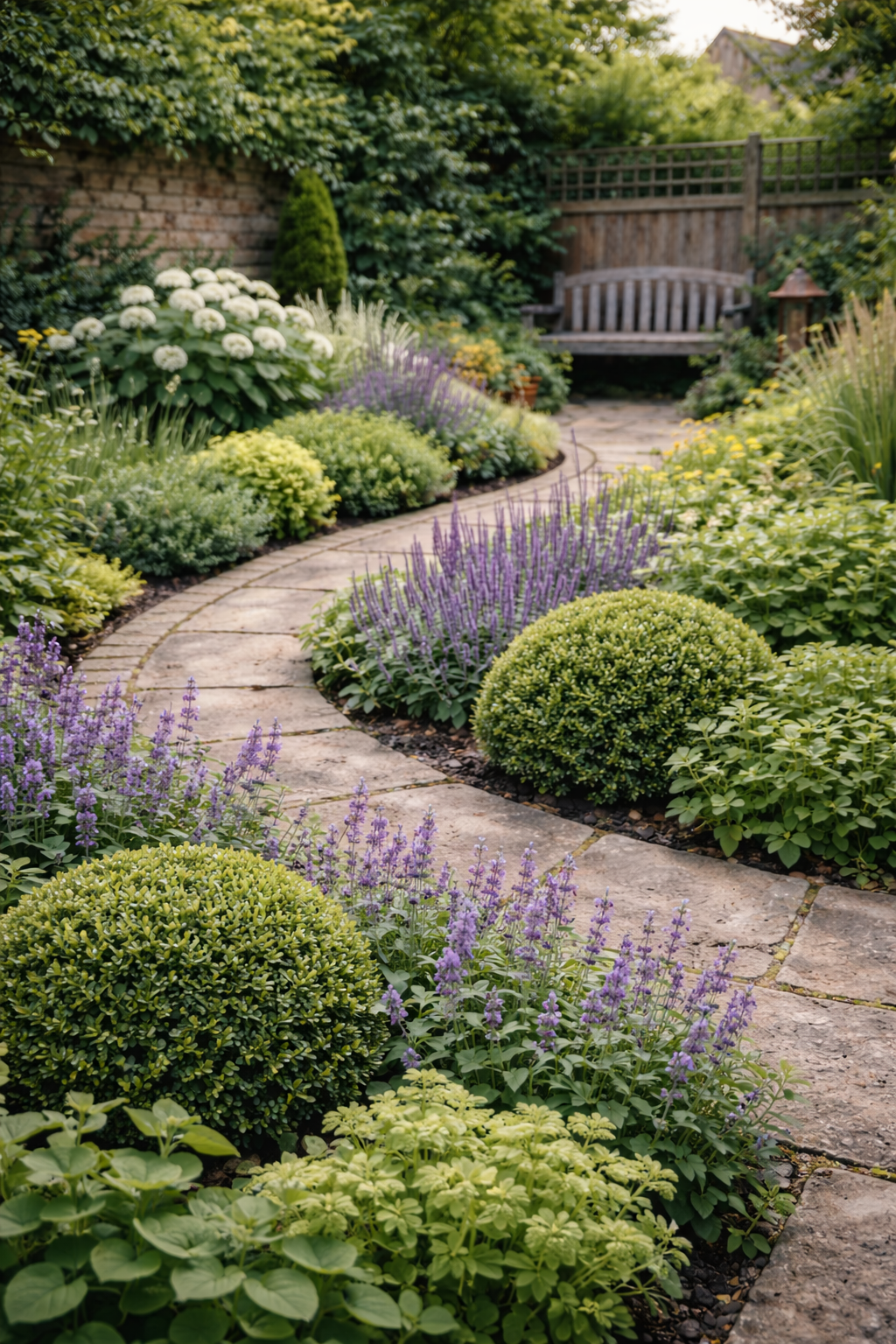
| Part 8 The Power of Repetition in Planting In small gardens, repetition is often misunderstood. It’s mistaken for playing it safe, for limiting choice, or for a lack of imagination. In reality, repetition is one of the most powerful tools available in compact spaces — not just visually, but practically as well. When space is limited, repeating what works creates calm, resilience, and ease. Repetition gives the eye somewhere to rest. Small gardens can overwhelm quickly. With little distance between elements, the eye is forced to process everything at once. Repetition slows that process down. When the same plant appears more than once, the eye recognises it and moves on without effort. The garden becomes easier to read. Instead of jumping from feature to feature, the space begins to flow. This is one of the main reasons repeated planting feels calm rather than dull — it reduces visual decision-making. Repetition makes intention visible. In a small garden, nothing goes unnoticed. A one-off plant can look accidental, even if it’s attractive. Repetition, by contrast, signals choice. It tells the viewer — and the gardener — that something has been done deliberately. When plants reappear, even subtly, the garden starts to feel composed rather than assembled. It gains coherence without needing extra features or decoration. Repetition is how a garden quietly shows its logic. Fewer plant types mean fewer problems. Every plant has its own habits, timings, and demands. In small gardens, too many different plant types quickly multiply maintenance complexity. Each new species adds another set of rules to remember — when to cut, when to feed, when to leave alone. Repeating a smaller number of plants simplifies everything. Maintenance becomes predictable. Problems are easier to spot. Success is easier to repeat. In compact spaces, consistency is a form of kindness. Repetition strengthens wildlife value. Wildlife responds to reliability. When the same plants appear in multiple places, food sources become easier to find and return to. Flowering times are reinforced rather than scattered. Shelter is repeated, not isolated. This doesn’t require large numbers. Even repeating a plant two or three times can significantly increase its usefulness to insects and birds. Repetition turns individual plants into a system. Repetition allows plants to grow into their role. Plants look different at different stages of their lives. When a plant is repeated, you can observe how it behaves across the garden — in shade and sun, in shelter and exposure. Over time, this builds understanding. Adjustments become informed rather than reactive. Instead of constantly introducing new plants, repetition allows the garden to mature with confidence. The garden improves by refinement, not replacement. Not all repetition has to be exact. Repetition doesn’t always mean uniformity. It can be created through: Similar leaf shapes A consistent plant height A repeated colour tone A familiar texture These softer forms of repetition still create rhythm, while allowing variation to sit comfortably within it. In small gardens, subtle repetition often works better than obvious patterning. Repetition reduces the urge to keep adding. One of the quiet benefits of repetition is that it satisfies the need for completeness. When a garden feels coherent, there’s less temptation to “just add one more thing.” The space begins to feel resolved, even though it’s still evolving. This reduces clutter, saves money, and protects the calm that small gardens rely on. A repeated planting scheme gives the garden permission to stop growing outward and start settling inward. Repetition supports long-term care. Over time, repetition makes gardens easier to live with. It shortens learning curves. It reduces surprises. It allows maintenance to be carried out steadily, even when time or energy is limited. In small gardens, especially, repetition turns care into habit rather than effort. In the next post, I’ll look at when hard surfaces help rather than harm — and how paths, paving, and structure can support planting rather than compete with it. Because a small garden done properly doesn’t rely on constant novelty. It relies on understanding what works — and doing it again. |
The Small Garden
 Earthly Comforts