
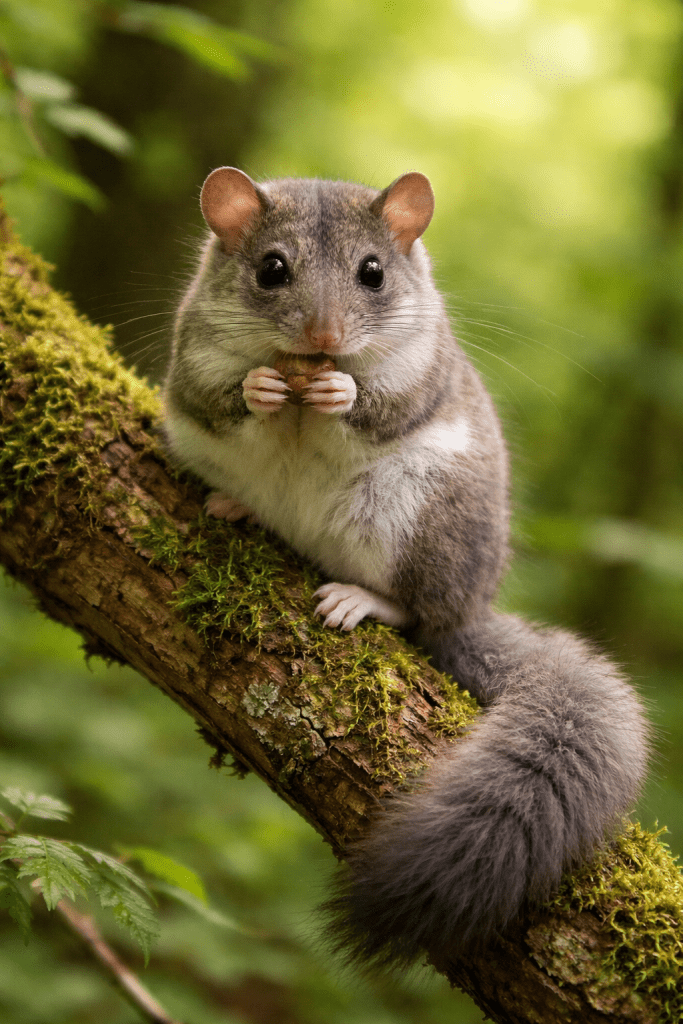
| The Secret Life of the Edible Dormouse in the UK The edible dormouse is one of the UK’s most unusual mammals—not because of how it looks, but because of how it arrived, how it lives, and how quietly it has established itself. Often mistaken for a large mouse or squirrel, and rarely seen despite living close to people, the edible dormouse occupies a strange position in Britain’s wildlife story. It is not native, yet it is not invasive in the usual dramatic sense. It is secretive, long-lived, and intensely specialised. To understand the edible dormouse in the UK is to explore woodland canopies, ancient trees, roof spaces, and the delicate line between coexistence and conflict. What Is an Edible Dormouse? The edible dormouse is a large, arboreal rodent with soft grey fur, a pale underside, big dark eyes, and a long, bushy tail similar in shape to a squirrel’s. It is significantly larger than the native hazel dormouse and more robustly built, with a rounded head and strong limbs adapted for climbing. Despite its name, the edible dormouse has nothing to do with modern British cuisine. The name comes from ancient history, when the species was once considered a delicacy elsewhere in Europe. In the UK today, it is valued—or resented—purely for its presence. Its appearance is gentle and almost plush-like, which often clashes with the frustration it can cause when it moves into human structures. How Did It End Up in the UK? The edible dormouse is not native to Britain. It was introduced in the early 20th century and has since established a small but stable population, mainly in parts of southern England. Unlike many introduced species, its spread has been relatively slow and geographically limited. This is largely due to its specific habitat needs and lifestyle. It has not colonised the entire country, nor does it dominate landscapes. Instead, it has settled quietly into areas that suit it very well—and ignored the rest. A Life in the Trees Edible dormice are highly arboreal. They spend most of their active lives in trees, particularly mature deciduous woodland. Beech, oak, and other nut-producing trees are especially important. They move confidently through the canopy, using branches, trunks, and connected crowns rather than descending to the ground. Their strong grip and excellent balance allow them to forage, travel, and escape predators above ground level. Ground activity is rare and usually limited to moving between trees or accessing nesting sites. Nocturnal and Secretive Edible dormice are nocturnal. They emerge after dark to feed and travel, returning to nests before dawn. This is one reason so few people ever see one, even in areas where they are well established. During the day, they shelter in tree cavities, nest boxes, roof voids, lofts, and wall spaces. These sites provide warmth, safety, and long-term stability—qualities the edible dormouse values highly. Their activity peaks in warm months and almost disappears entirely during winter. Diet: Feast or Sleep The edible dormouse has a highly specialised diet focused on energy-rich foods. Nuts, seeds, fruits, berries, buds, and bark make up the majority of what it eats. Insects and other animal matter may be taken occasionally, but plants dominate. Beech mast years—when trees produce large quantities of nuts—are particularly important. In good food years, dormice breed successfully. In poor years, many may not breed at all. This link between food availability and reproduction is unusually strong and has shaped one of the species’ most remarkable traits. Masters of Long Sleep Edible dormice are true champions of dormancy. They hibernate for exceptionally long periods—often six to seven months of the year, and sometimes even longer. As autumn approaches, they rapidly build fat reserves. Once temperatures drop and food becomes scarce, they retreat into underground or well-insulated shelters and enter deep hibernation. During this time, their heart rate, breathing, and body temperature drop dramatically. Waking during hibernation is costly and dangerous, so stable, undisturbed shelter is critical. This extreme reliance on sleep is central to their survival strategy. Breeding: Only When Conditions Are Right Edible dormice do not breed every year. In fact, in years when food is scarce—particularly when trees fail to produce nuts—many adults will skip breeding altogether. When breeding does occur, it usually happens in summer. Females give birth to litters of several young, raised in secure nests high above ground. The young grow slowly and remain dependent for some time. This cautious, energy-efficient reproductive strategy contrasts sharply with that of many small mammals and helps explain the dormouse’s long lifespan. Long Lives for a Small Mammal Edible dormice are surprisingly long-lived. Individuals can live well over ten years, far longer than most rodents of similar size. This longevity is linked to their slow pace of life: long hibernation, selective breeding, low predation risk, and arboreal habits. They do not rush, reproduce endlessly, or expend energy unnecessarily. They are, in many ways, the opposite of high-turnover species like mice or voles. Edible Dormice and Buildings One of the main reasons edible dormice come into conflict with people is their fondness for buildings. Roof spaces, lofts, and wall cavities mimic natural tree hollows—warm, dry, and safe. Once inside, dormice may cause noise at night, chew insulation, or damage stored items. Their presence can be persistent, as they show strong loyalty to chosen nesting sites. This creates a unique challenge: the species is protected, meaning lethal control is not permitted, and management must focus on exclusion and prevention rather than removal. Protected but Not Native Despite being non-native, the edible dormouse is protected under UK law. This reflects ethical considerations around animal welfare and the long-established nature of the population. Protection does not mean problems cannot be managed—it means they must be handled responsibly. Exclusion methods, proofing buildings, and careful timing of works are essential to avoid harm. This legal status places the edible dormouse in a rare category: an introduced species that must still be treated with care and respect. Predators and Ecological Role In the UK, edible dormice have relatively few predators. Owls, foxes, and mustelids may take them occasionally, but their arboreal habits and nocturnal activity offer significant protection. Ecologically, they interact mainly with woodland systems—feeding on seeds and buds, and using tree cavities that might otherwise remain empty. Their impact is local rather than widespread. They do not displace native dormice directly, largely because their distributions rarely overlap in meaningful ways. Why Their Range Remains Limited Despite being present for over a century, edible dormice have not spread widely across the UK. This is due to a combination of factors: Strong reliance on mature woodland Limited ground movement High site loyalty Specific food and nesting requirements They are not adaptable generalists. They succeed where conditions suit them—and fail where they do not. This natural limitation has prevented explosive spread. Public Perception: Cute or Controversial People who encounter edible dormice often react in one of two ways: fascination or frustration. Their appearance is undeniably appealing, but their behaviour can be inconvenient. This contrast highlights an important truth about wildlife: aesthetic appeal does not always align with easy coexistence. The edible dormouse forces us to think carefully about how we live alongside animals that do not fit neatly into “welcome” or “unwelcome” categories. Understanding helps reduce conflict. Surprise rarely does. Why Edible Dormice Matter Edible dormice matter not because they are rare or native, but because they challenge assumptions. They remind us that wildlife stories are not always simple, and that responsibility does not end at labels like “introduced” or “protected.” They also remind us of the value of mature woodland—places with age, structure, and continuity. Where edible dormice thrive, trees have been allowed to grow old. That alone is worth noticing. Learning to Live with the Unexpected The edible dormouse was neither planned, invited, nor entirely welcome—but it is here. And after more than a century, it is part of the ecological conversation whether we like it or not. Living with it requires patience, understanding, and practical boundaries rather than fear or eradication. It is a reminder that nature does not always follow our intentions. A Quiet Resident of the Canopy Most people will never see an edible dormouse. It will live above them, sleep beneath them, or pass through unseen at night—leaving only faint sounds or traces behind. Its life is slow, deliberate, and largely hidden. It does not announce itself or spread aggressively. It simply sleeps, eats, climbs, and sleeps again. |
 Earthly Comforts