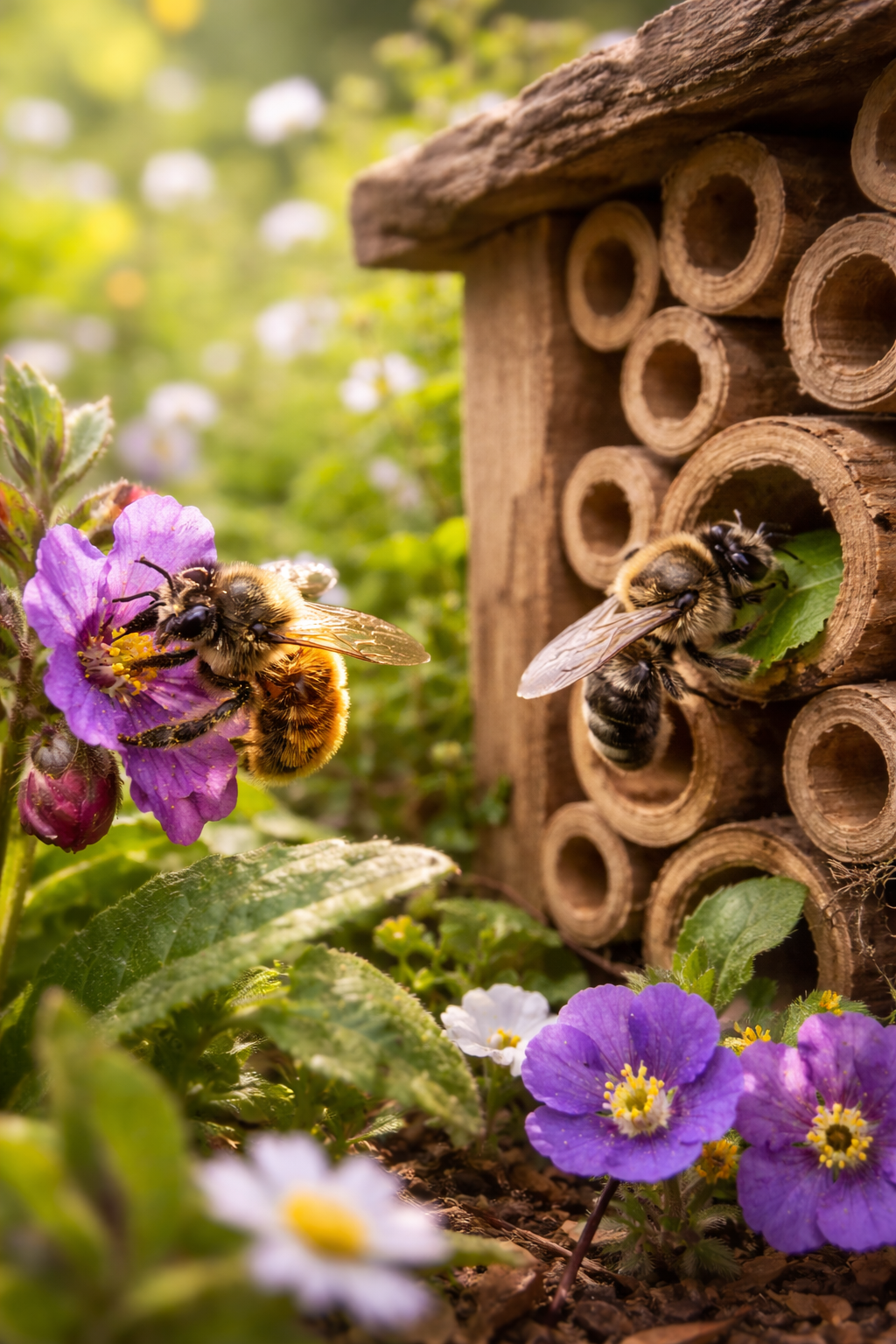
| Why solitary bees matter just as much When most people think of bees, they picture a hive. There is a comforting sense of order to that image: neat wooden boxes, a queen at the centre, workers moving with shared purpose. Honeybees have become the symbol of pollination — visible, organised, and familiar. But in the quiet corners of the spring garden, far from any hive, another story is unfolding. The vast majority of bees in the UK are solitary bees. They do not live in colonies. They do not make honey. They do not attract much attention. And yet, without them, spring would look very different indeed. As gardens begin to flower and warmth returns to the soil, solitary bees are among the earliest and most important pollinators to emerge. They work quietly, efficiently, and often unnoticed — asking very little, and giving an extraordinary amount in return. |
| The unseen majority There are over 270 species of bees in the UK, and only one of them is the honeybee. The rest are solitary or loosely social species — including mining bees, mason bees, leafcutter bees, and many others. Each female builds and provisions her own nest. There is no shared hive, no stored honey, no collective workforce. This independence shapes everything about how these bees live: They are active for shorter periods. They often specialise in certain plants. They nest in small, specific spaces. Their populations rise and fall with local conditions. In early spring, solitary bees are often the first pollinators to appear, emerging as soon as temperatures allow. At this point in the season, few other insects are active, making their role especially significant. |
| Why spring flowers rely on solitary bees Many spring-flowering plants evolved alongside solitary bees. These bees are exceptionally effective pollinators because they: Visit fewer plant species at once Carry pollen loosely across their bodies. Fly in cooler, less settled weather. Focus on nearby resources rather than long-distance foraging. This makes them ideal partners for early-blossoming fruit trees, shrubs, bulbs, and native wildflowers. A single solitary bee can pollinate far more flowers in a day than a honeybee, simply because of how it moves and feeds. In gardens, this means that fruiting, seed-setting, and early growth often depend on insects most people never notice. |
| Nesting in unexpected places Solitary bees do not need hives — but they do need somewhere to nest. Different species have different preferences: Mining bees nest in bare or lightly vegetated soil. Mason bees use holes in walls, stems, or old wood. Leafcutter bees line nests with neat sections of leaves. Some species nest in hollow plant stems left standing. These nests are small, discreet, and easy to disturb without realising they are there. Spring tidying — clearing stems, filling gaps, covering bare soil — can unintentionally remove nesting opportunities just as bees are becoming active. A garden that allows for variety — patches of bare ground, standing stems, old wood, and textured surfaces — quietly supports a much wider range of pollinators than one where everything is smoothed and sealed. |
| The value of imperfection Solitary bees thrive in gardens that resist uniformity. They favour: South-facing walls and banks Old mortar gaps and cracks Untidy edges Areas left undisturbed for weeks at a time What we often interpret as “unfinished” can be exactly what they need. Perfectly mulched beds, tightly clipped borders, and spotless lawns may look tidy, but they offer little in the way of nesting or feeding opportunities. By contrast, gardens with mixed structure — where plants age naturally, and surfaces vary — provide niches that solitary bees can use immediately. Spring is not the time these bees are searching for abundance. They are searching for access. |
| Short lives, precise timing Many solitary bees are active for only a few weeks each year. They emerge, mate, gather pollen, provision nests, and die — all within a narrow seasonal window. Their entire lifecycle depends on: Flowers open at the right moment. Nesting sites are available when needed. The garden remained relatively stable for a short period. This precision makes them particularly sensitive to disruption. A sudden removal of flowers or habitat during their active phase can have an outsized impact on local populations. It also means that what happens in one spring can shape what appears — or doesn’t — in the next. |
| Not all bees need flowers in bloom. While flowers are essential, solitary bees also rely on continuity. Early in spring, when blossoms are limited, even small flowering plants matter: Dandelions Dead-nettles Early bulbs Native hedgerow flowers These are often the first food sources available. Removing them too quickly — or viewing them as weeds to be cleared — reduces options at a time when alternatives are scarce. Later in spring, diversity becomes more important than density. A mix of shapes, colours, and flowering times supports a broader range of species. |
| Quiet pollination, lasting effects Solitary bees rarely draw attention to themselves. They do not swarm. They are generally non-aggressive. Many species are so small or fast-moving that they go unnoticed unless you stop and look closely. Yet their work underpins much of what we value in gardens — blossom, fruit, seed, and structure. When solitary bees are present, gardens tend to feel more resilient. Plants set better. Self-seeding increases. Balance begins to establish itself without intervention. Their success is rarely dramatic — but it is cumulative. |
| Rethinking who the garden is for Bees challenge us to think beyond the obvious. A garden designed solely for visual impact may still flower — but a garden that quietly supports bees is one that functions as part of a living system. It becomes a place where processes continue even when no one is watching. Solitary bees ask us to leave some things unfinished. To allow time. To notice small movements on warm walls or low over soil in early spring. They remind us that life does not need to be large, loud, or organised to be essential. |
| Spring seen through smaller eyes As spring deepens, solitary bees come and go without ceremony. You may see one hovering briefly near a wall, disappearing into a stem, or dusted with pollen before vanishing again. That moment may be the entirety of your shared experience — but its impact extends far beyond what is visible. When gardens make space for these quieter lives, spring becomes not just a season of growth, but a season of continuity. And sometimes, the most important work in the garden is being done by those we barely notice at all. |
 Earthly Comforts