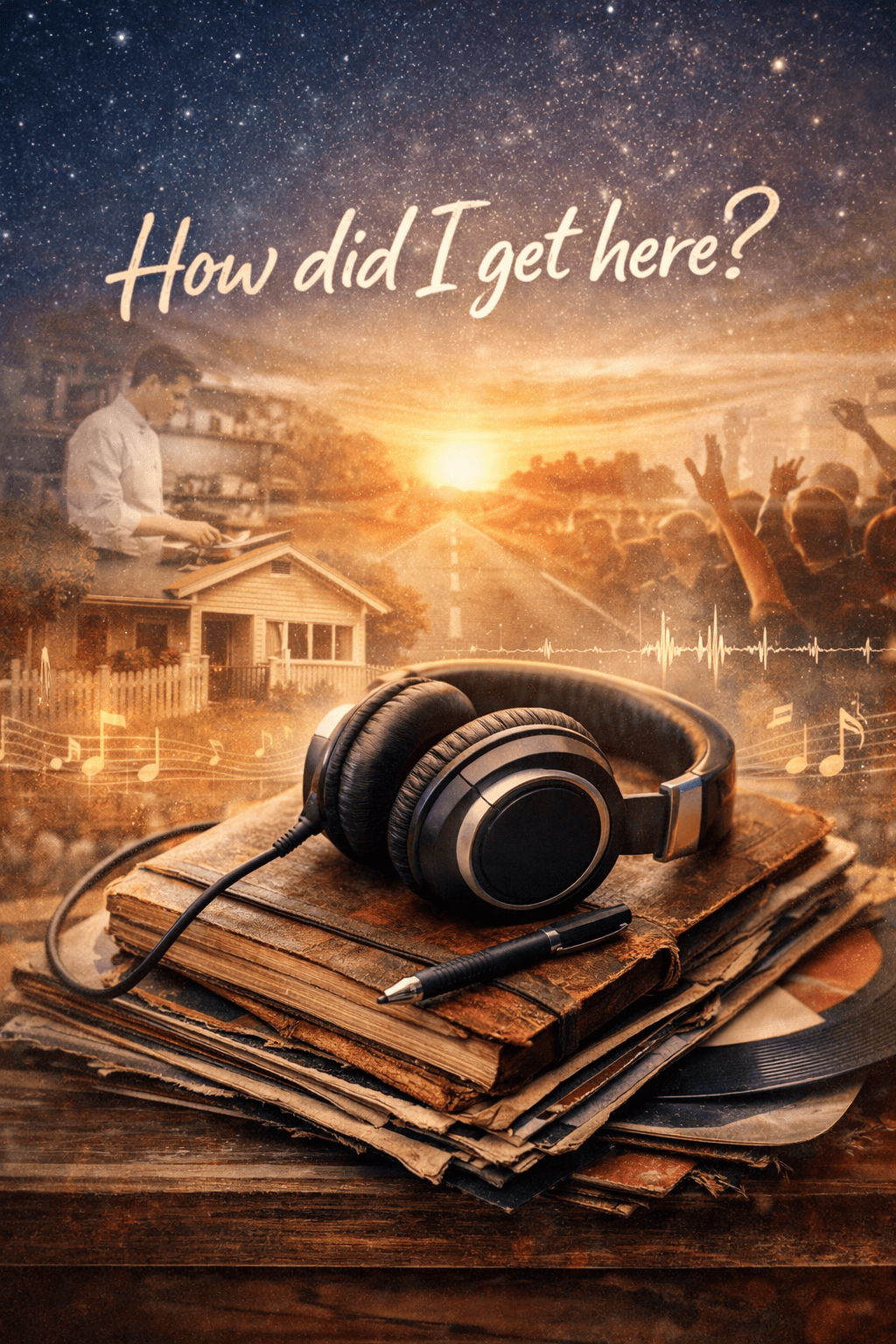
| How Music Taught Me to Stay Awake in My Own Life Every so often, without drama or crisis, a question surfaces quietly: How did I get here? Not as regret or longing for a different life, but as awareness arriving mid-stream. You realise you are standing inside a life built gradually, through momentum, habit, choice, and tolerance. The question isn’t asking for escape. It’s asking for presence. For me, that question has always arrived through sound. I don’t remember my life primarily as a story; I remember it as places. Rooms, streets, countries, ages. Music is how I access them. A song doesn’t remind me of a time so much as return me to a precise location, complete with the internal weather I had then. This is how my memory works: long-distance, positional, sensory. Think of a year and a song follows. Hear a song and the year opens itself. The first time I remember that question landing, I was in college, training as a chef. The plan was sensible. Learn the craft, progress, and move into management. I was already thinking in timelines: five years, ten years. Would I be married? Would I have the job I imagined I should want? Around that time, I heard Once in a Lifetime. I didn’t hear it as a hit, or even as a song in the usual sense. I heard it as a question set to rhythm. Well… how did I get here? It struck a chord not because I was lost, but because I was already projecting myself forward from the beginning. That lyric became an internal check-in, one that has returned at different stages of life, each time with a slightly different meaning. Earlier memories sit further back, anchored just as clearly. When I think of being ten years old, I’m not reaching for a story; I’m back in Australia, in Springvale, at 21 Serpentine Road. It’s 1973. The light is different, the air feels different, and the music that fixes that time in place comes from slightly earlier: Stairway to Heaven and Riders on the Storm. Hearing either now opens that space immediately. Not as nostalgia, but as a location. Music is my index. As I grew older, the world itself began to feel louder and less stable. There was a sense of systems overheating, of pressure building without release. When I think of that feeling, it carries the urgency of London’s Burning. Not rebellion as fashion, but alarm as signal. Something is wrong. Pay attention. That music didn’t comfort; it sharpened awareness. Once you hear that kind of urgency properly, some part of you stays alert. Emotional honesty followed, stripped of romance. Love Will Tear Us Apart allowed a difficult truth to be stated plainly: love can be real and still damage the people in it. No melodrama, no blame, just accuracy. It separated feeling from fantasy and normalised contradiction. Intimacy could be necessary and destructive at the same time, and that understanding stayed with me. Once awareness switches on, it rarely stays quiet. There was a period when everything felt like a signal. Ordinary life became dense with information, detail, irony, and repetition. When I think of that state now, it has the texture of Senses Working Overtime. Attention accelerated. The senses felt permanently engaged, sometimes overloaded. It wasn’t calm, but it was formative. I stopped consuming culture passively and started reading it. Patterns became visible, and once you see layers, you don’t unsee them. Eventually, thought became too loud. That’s when rhythm took over. Blue Monday doesn’t explain anything; it steadies. Repetition becomes grounding, pulse replaces narrative. Beat stopped being entertainment and became a regulation. House and electronic music weren’t an escape but an alignment. The body finds a way to stay present without commentary. I learned that consciousness doesn’t always arrive through insight; sometimes it arrives through tempo. There was also a moment when feeling stopped being something to manage and became something I was willing to inhabit fully. When I think of that shift, it carries the weight and colour of Purple Rain. Nothing excluded: joy, grief, sex, belief, ego, surrender. No irony, no distance, just commitment. Fragmentation softened there. Feeling became something to live inside rather than decode. Later still, a connection came without explanation. Movement without narrative. Presence without ideology. Show Me, Love represents that state for me. Not optimism or answers, just being here, in the body, with others. Music is togetherness. And then, much later, came clarity. Not disappointment, not cynicism, but discernment. Snakeblood, from The Beach, carries that feeling. The understanding that even freedom can become a system, even ideals can harden, even utopias have shadows. The dream dissolves, but awareness remains. This isn’t loss; it’s maturity. Looking back, I don’t see a neat progression. I see landmarks. Places where I looked up and noticed myself becoming someone else. Music didn’t tell me who to be, didn’t save me, didn’t give me answers. What it consistently did was train my attention. It taught me when to wake up, when to feel, when to move, when to pause, and when to look again. Legacy isn’t about being remembered. It’s about how attentively you live while you’re here. How often do you notice? How willing you are to stay awake, even when life becomes repetitive, disillusioning, or unresolved. I still hear that question sometimes—How did I get here? Not urgently, not anxiously, just as a check-in. Music didn’t give me a destination. It gave me a way of travelling. And for me, that’s enough. |
How Did I Get Here?
 Earthly Comforts