
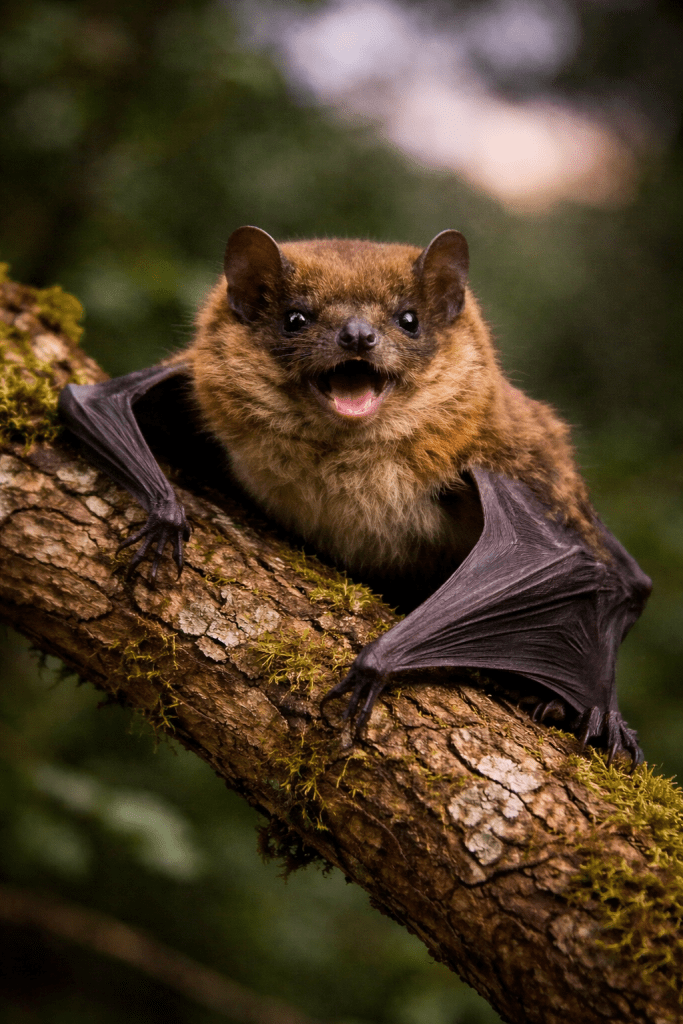
| The Noctule Bat: The Bold Flier of the Open Evening Sky As daylight softens and the first stars begin to appear, most bats wait. They emerge cautiously, hugging hedges and trees, testing the air before committing to the night. The noctule bat does the opposite. It rises early, often while the sky is still blue, flying high and fast across open space. To watch a noctule is to witness confidence — long wings cutting clean arcs through the evening, unbothered by exposure, unafraid of height or distance. This is a bat shaped not by secrecy, but by reach. Big, Powerful, and Built to Fly The noctule bat is one of the largest bats found in the UK, with long, narrow wings designed for speed and endurance. Its body is solid and muscular, its fur a warm golden-brown that can catch the last light of day as it flies. In silhouette, the noctule looks almost bird-like. Its wingspan is broad, and its flight purposeful, covering large distances with ease. This bat is not built for tight woodland manoeuvres or cluttered spaces. It is built for the open air. Everything about its form — from wing shape to muscle mass — speaks of long-range movement and efficient travel. An Early Riser in the Bat World One of the most striking things about the noctule bat is when it appears. While most bats wait until full dusk or darkness, noctules often emerge early, sometimes visible against a bright sky. This timing gives them access to insect species active before night fully settles. It also makes them one of the easiest bats to see, if you know where to look. Their bold timing reflects their lifestyle. They hunt in open skies, often high above trees, buildings, and fields, where light levels matter less than open airspace. Hunting at Height The noctule bat is an aerial hunter. It feeds on: Large flying insects Beetles Moths Flies carried on evening air currents. Rather than gleaning insects from surfaces or weaving through vegetation, noctules patrol wide areas, detecting prey from a distance and intercepting it at speed. Their echolocation calls are powerful and long-ranging, designed to scan open space rather than cluttered environments. This allows them to hunt efficiently across large territories, sometimes several kilometres from their roost. For the noctule, scale is everything. Where Noctule Bats Live Despite their love of open skies, noctule bats are deeply dependent on trees. They typically roost in: Old woodpecker holes Deep tree cavities Cracks in mature trunks Ancient and veteran trees are especially important. These provide the depth and insulation noctules need for roosting and raising young. They are often found in: Mature woodland Parkland with old trees Tree-lined rivers Large estates and historic landscapes Unlike many bats, noctules rarely roost in buildings. Their reliance on trees makes them particularly vulnerable to the loss of mature woodland and parkland. Roosting High and Changing Often Noctule bats do not usually stay in one roost for long. They frequently rotate between multiple tree roosts, moving as conditions change. This behaviour helps them manage parasites, temperature, and disturbance, but it also means they need networks of suitable trees rather than isolated specimens. A single old tree is not enough. A landscape of old trees is required. In summer, maternity groups form in suitable cavities, where females raise their young. These roosts are often high off the ground, warm, and difficult to access — safe places for a species that values height. Seasonal Movements and Wider Horizons Noctule bats are among the more mobile bat species. While many remain within familiar regions, some individuals travel significant distances between summer and winter areas. Their strong flight allows them to cross open land, rivers, and even coastal areas with ease. In winter, noctules hibernate in: Tree cavities Rock crevices Occasionally buildings They often choose places that remain cool but not freezing, with minimal disturbance. Even in winter, their preference for height and depth remains. A Different Relationship with the Landscape The noctule bat experiences the world differently from most bats. Where others see barriers, noctules see routes. Roads, rivers, and open fields do not stop them. They simply fly over. However, this freedom depends on a specific condition: the continuity of roosting trees. Without old trees to return to, even the most capable flier has nowhere to rest, raise young, or survive winter. The noctule’s strength in the air is matched by vulnerability on the ground. Why Noctule Bats Are Often Missed Despite their size and bold flight, noctule bats are often overlooked. They: Fly high above eye level. Move fast and directly. Appear briefly at dusk. Resemble birds to the untrained eye. Many people have seen noctules without realising what they were watching. Once recognised, however, their presence is unmistakable — confident shapes cutting across the evening sky while other bats are still hidden. Pressures Facing a High-Flying Species Noctule bats face challenges that are less visible than those affecting more building-dependent bats. Key pressures include: Loss of mature and veteran trees Woodland fragmentation Over-management of parkland Removal of dead and decaying trees Declining insect populations Modern landscapes often value neatness and safety over age and complexity. Unfortunately, noctules rely on exactly the features most likely to be removed. Their decline is quiet, happening high above and deep within trees. What the Noctule Bat Represents The noctule bat stands for something increasingly rare: space. It represents: Open skies free from clutter Landscapes with depth and age Confidence born from continuity The ecological value of big, old trees Protecting noctules means thinking vertically as well as horizontally — valuing what exists high in the canopy and above the land, not just at ground level. Watching the Evening Open To see a noctule bat is to watch the night begin differently. While smaller bats wait in the hedges, the noctule is already airborne, claiming the sky before darkness fully arrives. Its flight feels assured, almost effortless, shaped by generations that have known how to use space fully. The noctule bat does not hide from the night. It meets it head-on — wings wide, horizon open, trusting that somewhere below, an old tree is waiting. |
 Earthly Comforts