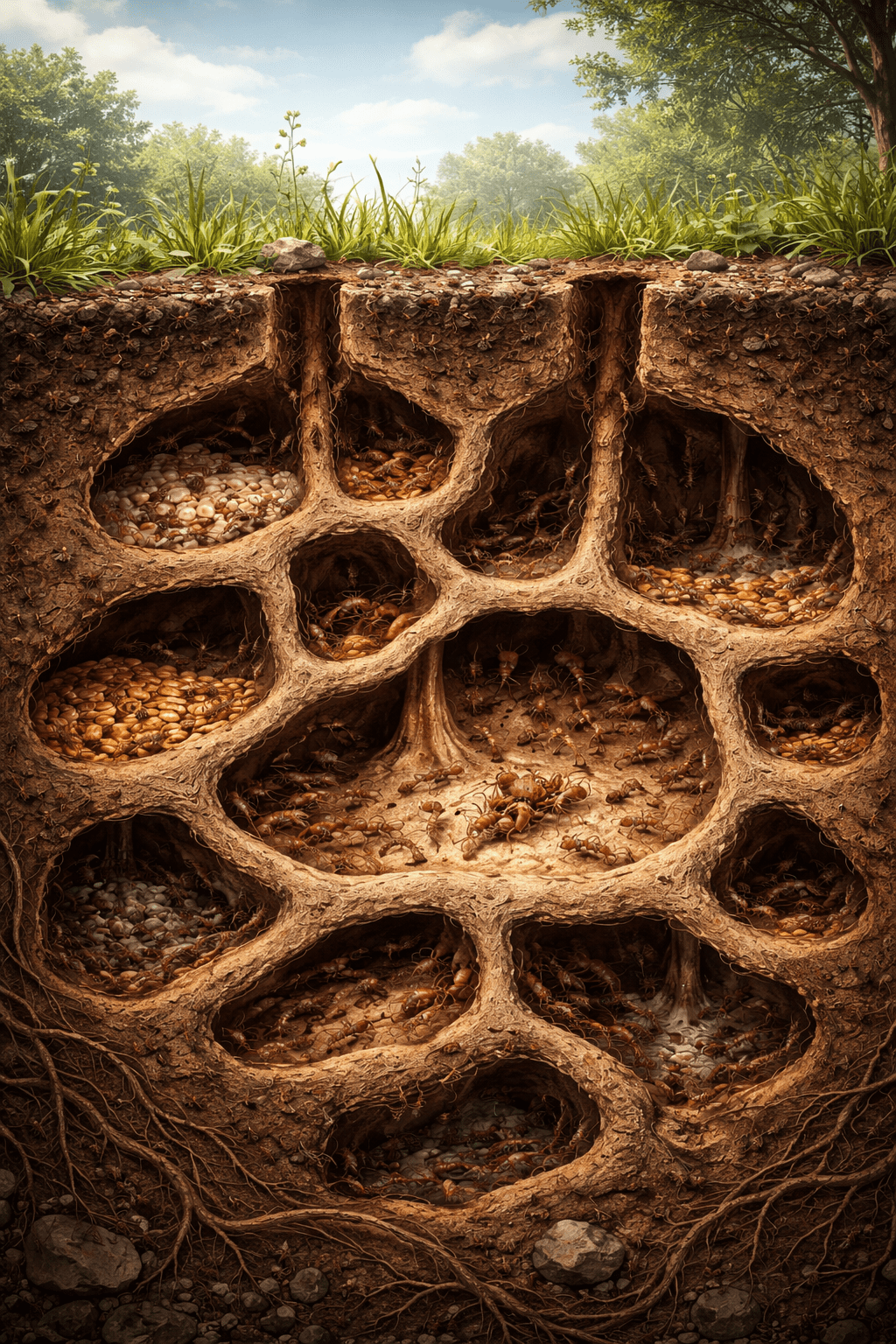
| How Ants Build Complex Underground Cities When we think of architecture, we picture blueprints, cranes, scaffolding, and long meetings around tables. Ants, of course, have none of these. And yet beneath our feet, they construct cities that rival human design in complexity, efficiency, and longevity. Ant nests are not random holes in the ground. They are living systems, shaped by instinct, experience, and constant adjustment, and they work astonishingly well. An ant colony begins without a plan. There is no master architect issuing instructions. Instead, each ant follows simple rules: dig where the soil feels right, deposit material where others have done the same, and respond to temperature, moisture, and pheromones. From these small actions, large structures emerge. This is one of the most compelling aspects of ant architecture: complexity arising from simplicity. The underground city grows organically. Tunnels branch, chambers expand, dead ends are abandoned, and new routes appear. Over time, the nest becomes a layered environment with different zones performing different roles. There are nurseries maintained at stable temperatures for larvae, food storage chambers with easy access, waste areas carefully separated from living quarters, and ventilation shafts that regulate airflow. None of this is accidental. Soil choice matters. Ants are highly sensitive to texture and moisture, selecting ground that can hold shape without collapsing. Clay-rich soils support long-lasting chambers, while sandier soils are reinforced through compacting and constant maintenance. The nest is never finished. Ants are always adjusting, repairing, and refining as conditions change. Rainfall, drought, temperature shifts, and colony growth all trigger structural responses. Ventilation is one of the most impressive features. Many ant species create chimney-like shafts that allow warm air to rise and escape while drawing cooler air down through lower tunnels. This passive airflow system regulates temperature and oxygen levels without energy expenditure. In hot environments, nests may extend deeper underground where temperatures are more stable. In cooler climates, chambers are positioned to capture warmth from the sun-heated surface. Strength comes from shape rather than materials. Curved tunnels distribute pressure evenly, reducing the risk of collapse. Chambers are often domed rather than flat-roofed, a principle used in human architecture for centuries. Even without conscious design, ants repeatedly arrive at structurally sound forms because weak designs simply fail and are rebuilt differently. Communication is central to construction. Ants leave chemical trails that guide others to dig or reinforce certain areas. If a tunnel becomes too crowded or unstable, traffic patterns change, and the structure adapts. This feedback loop allows the colony to respond quickly to problems. There is no ego in the system, no attachment to “how it’s always been done. If something doesn’t work, it is altered or abandoned. What makes ant cities particularly remarkable is their efficiency. There is no wasted space. Everything serves a function, and functions shift as the colony grows. A chamber used for brood one season may later become storage. Pathways widen or narrow depending on traffic flow. The nest is a flexible organism rather than a fixed structure. Ant architecture is also deeply sustainable. Materials are local, energy use is minimal, waste is managed internally, and nothing is built beyond what is needed. Expansion happens incrementally, matching population and resources. Collapse is rare because the system is resilient rather than rigid. Damage to one area does not bring down the whole structure. There is a quiet lesson here. Ants succeed not because they are clever in the human sense, but because they are responsive. They build by listening to their environment rather than imposing themselves on it. Their cities are shaped by cooperation, constant maintenance, and acceptance of change. For gardeners, land managers, and anyone interested in how systems work, ants offer a different way of thinking about construction and organisation. Start small. Pay attention. Adjust often. Build with the conditions, not against them. What emerges may be stronger than anything designed on paper. Next time you notice an ant trail disappearing into the ground, it’s worth pausing. Beneath that unassuming entrance lies a city that has solved problems of ventilation, structure, sustainability, and growth without ever drawing a line on a plan. There’s something quietly humbling about that. |
| Unless stated, featured images are my own work, created independently or with the assistance of AI. |
 Earthly Comforts