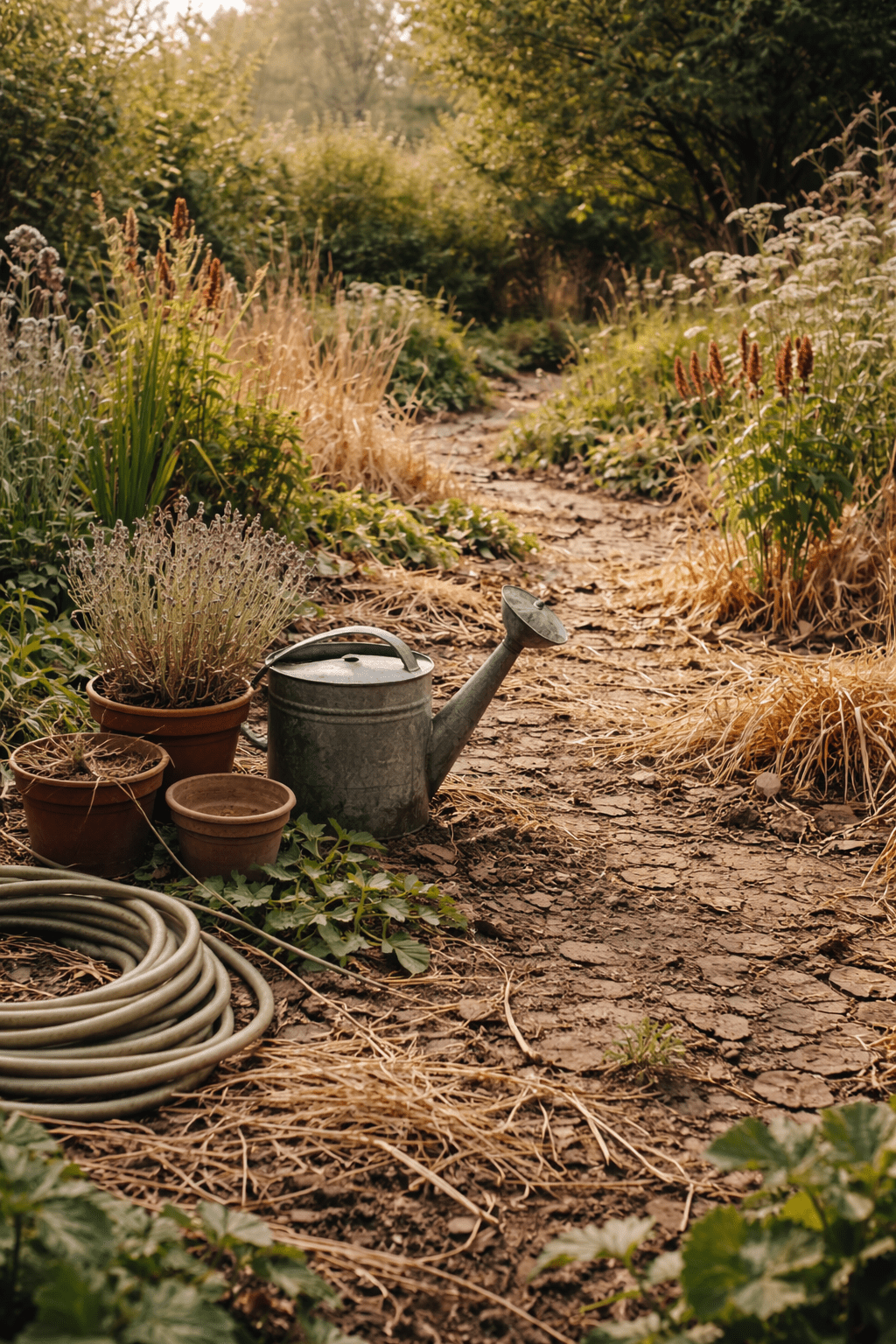
| Choosing survival, not show — and accepting loss Water restrictions change the rules of gardening. They strip away choice, ambition, and sometimes pride. What remains is reality. In dry summers, gardens don’t respond to effort alone. They respond to limits. This is the point where gardening stops being decorative and becomes ethical. Under restrictions, the question is no longer how good the garden can look, but what deserves to survive. That shift is uncomfortable for many people because it forces them to make decisions rather than rely on habits. You can’t maintain everything. You can’t save everything. And pretending otherwise wastes water, time, and energy. Summer drought exposes priorities. The instinctive response is often to spread water thinly across everything. A bit here, a bit there. It feels fair. It feels caring. It is also one of the least effective approaches. Light, frequent watering encourages shallow roots and dependence. Plants look temporarily better but become weaker. In dry conditions, fairness is not the same as efficiency. Survival gardening requires choosing. Some plants get deep, infrequent watering. Others get none. Lawns are usually the first to be sacrificed, though people often resist this longer than they should. Grass recovers. Trees, shrubs, and established perennials often don’t recover if stressed repeatedly. A brown lawn is not a crisis. A stressed tree can be. Summer restrictions reveal how much of gardening culture is built around appearance. Green equals success. Brown equals failure. But drought flips that logic. Green achieved through constant watering is often fragile. Brown achieved through restraint can be temporary and harmless. The garden’s long-term health matters more than its seasonal image. One of the hardest lessons during dry summers is accepting loss. Plants die. Borders thin. Growth stalls. This is not neglect. It is a consequence. Trying to fight that reality leads to frustration and waste. Gardens are not exempt from the climate. Some losses are predictable. Shallow-rooted annuals struggle first. Newly planted specimens suffer without consistent moisture. Containers dry out faster than soil in the ground. These aren’t surprises. They are known vulnerabilities. Accepting them early prevents panic later. Planning for loss is part of responsible gardening. This doesn’t mean abandoning care. It means concentrating on it. Deep watering at the right time does more than daily sprinkling. Early morning or evening watering reduces evaporation. Mulch becomes essential, not optional. Shade is suddenly valuable. Soil structure matters more than ever. Summer gardening under restriction is less about doing more and more and more about doing precisely. Another difficult adjustment is letting go of the idea of recovery within the same season. Some damage won’t reverse until autumn or even the following spring. Expecting an immediate bounce-back creates disappointment. Plants often survive stress quietly, then show recovery later. Patience becomes part of the work. There’s also an emotional element people rarely talk about. Gardens carry effort and identity. Watching them decline feels personal. It can trigger guilt, even when restrictions are imposed externally. That guilt often leads to overwatering, bending rules, or pushing beyond sensible limits. Gardens do not need guilt. They need realism. Working within restrictions also reveals which plants genuinely belong in a space. Drought-tolerant species cope. Others struggle year after year. Summer exposes mismatches between planting and conditions that wetter seasons conceal. These observations are valuable. They inform future choices. Another common mistake during restricted summers is trying to maintain growth rather than maintain life. Feeding, pruning, and encouraging new growth increase water demand. In drought, restraint supports survival better than stimulation. Stillness can be protective. Containers deserve special mention. They dry faster, heat up more, and offer little margin for error. Under restrictions, not all containers are worth saving. Prioritising a few and letting others go is often the sensible option, even if it feels harsh. Containment is kinder than constant struggle. Heat also changes how gardeners work. Early starts become necessary. Midday work becomes counterproductive. Fatigue increases faster. Dehydration affects judgment. Summer gardening asks more while giving less feedback. Knowing when to stop matters as much as knowing what to water. Another shift during restricted summers is the role of maintenance. Tidying becomes secondary. Clearing debris to reduce evaporation, protecting soil surfaces, and leaving shade where it falls become more important than neatness. Mess can be functional. There’s a temptation to treat drought as a temporary interruption before normal gardening resumes. Increasingly, it isn’t. Dry summers are becoming part of the pattern. Gardens that rely on constant water input will continue to struggle. Adapting is not pessimism. It’s practicality. This adaptation doesn’t require abandoning beauty. It requires redefining it. A summer garden under restriction can still be alive, textured, and resilient. It may not be lush. It may not be even. But it can be honest. Honest gardens last longer. Accepting loss also creates space. Dead plants make room for future decisions. Bare patches become opportunities rather than failures. What survives proves its value. Gardens are always editing themselves. Drought accelerates the process. There’s also a quiet dignity in choosing survival over display. It reflects care that extends beyond appearances. It respects shared resources. It acknowledges limits without resentment. This kind of gardening is less about control and more about stewardship. When rain eventually returns, the garden responds differently depending on how it was treated. Deep roots recover. Compacted soil doesn’t. Mulched beds bounce back faster. Overwatered, shallow-rooted plants often don’t. Summer choices echo forward. Water restrictions are uncomfortable because they remove illusion. They make clear that gardens are not separate from climate, infrastructure, or community. They force gardeners to think beyond individual plots. That perspective is not a loss. It’s maturity. Gardening through restricted summers teaches clarity. What matters. What lasts. What can be let go of? It strips away performance and leaves the relationship. Choosing survival over show is not giving up. It’s choosing continuity. |
Summer Gardens Under Water Restrictions
 Earthly Comforts