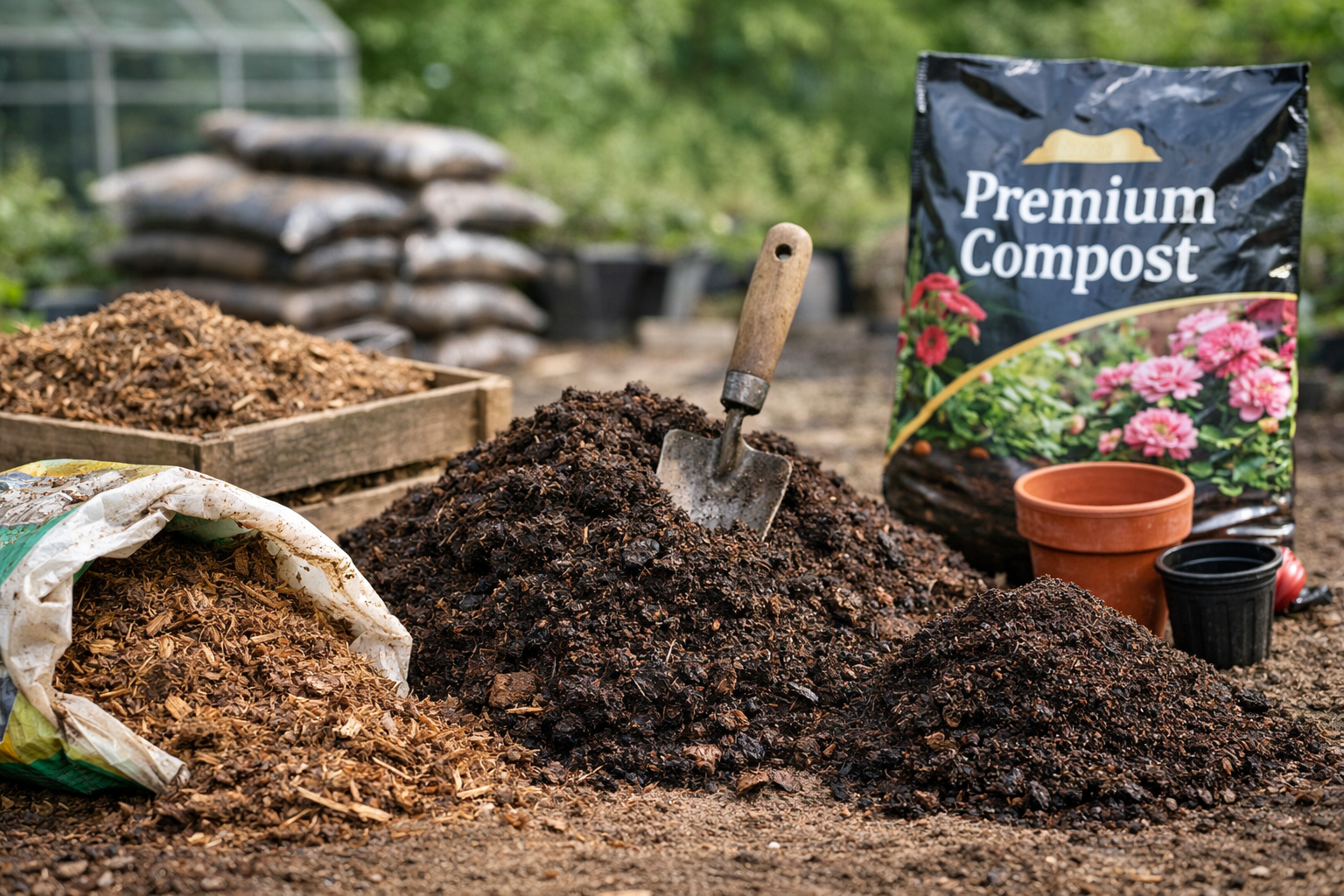
| One of the most frequent questions I get asked—often mid-conversation, usually with a bag already half open—is this: “Is there really any difference between the fancy composts and the basic ones? And which compost should I actually buy?” It’s a fair question with a quiet expectation that a clear answer is on the shelf—a brand, a price, something that removes uncertainty. Compost is sold as the foundation of gardening, so it’s natural to think that choosing the right one matters. My answer, more often than not, is slightly disarming. For most situations, I suggest a basic compost will do just fine. Not always, and not without thought, but often enough to surprise people. The hesitation that follows is understandable. It rarely aligns with what people have been told. What people mean by “fancy” compost When people refer to “fancy” compost, they usually mean branded products, specialist blends, or products marketed for a specific purpose—seed compost, ericaceous mixes, or traditional John Innes formulations. These products convey a sense of refinement, as though they have been carefully refined to deliver better results across the board. In reality, these composts offer consistency, not superiority. They behave predictably, with known structure, drainage, and nutrient balance. That reliability is valuable in controlled situations, but it does not always make them richer or more beneficial. There is a subtle but important distinction here. Fancy composts are often more precise, not inherently better. They are tools designed for particular uses rather than universal solutions. What people mean by “basic” compost Basic compost usually means multi-purpose blends that are less expensive and less refined. They are often peat-free, made from green waste, wood fibre, or other organics. These can appear coarse and uneven, and are often dismissed as inferior without even being tried. In practice, they are often entirely capable. They may lack finesse, but they can still perform well in the right context. The keyword is adequacy. They do not need to excel in every category to be useful. The assumption that cheaper compost is automatically poor does not hold up particularly well in real gardens. While quality can vary, many basic composts are perfectly serviceable for a wide range of tasks. The difference is not where you think it is When choosing compost, focus on where and how it will be used. Select basic compost for general garden beds and more refined types where precision matters, like in pots or for specialist plants. In a garden bed, the soil provides structure, microbes, and resilience. Compost supports that system, not replaces it. Here, a basic compost adds organic matter and improves moisture retention—it doesn’t need fine-tuning. In containers, things are different. Compost becomes the environment, handling drainage, moisture, and nutrients in a confined space. Structure and consistency matter more here, and refined composts can make a clear difference. Understanding this distinction shifts the conversation away from better versus worse and towards appropriate versus inappropriate. A quieter shift that needs acknowledging It would be incomplete to discuss compost today without acknowledging how much it has changed. Since the move away from peat, many bagged composts have become more variable in both structure and performance. Some remain perfectly usable, but others can be coarse, woody, or inconsistent, even within the same bag. It is not uncommon to open one and find a workable mix, only to encounter another that feels fibrous or only partially processed. This variability is about the materials now being used, not price. Wood fibre and green waste need time and careful handling to make good compost. Commercial production often can’t achieve this balance consistently. Many gardeners notice the result. Compost may dry out too quickly, resist wetting, or act unpredictably in pots. Plants can struggle for no clear reason, even when all else seems fine. Choosing compost has therefore become less straightforward. It is no longer simply a question of selecting cheap or expensive, but of recognising quality in front of you. Where basic compost genuinely works Most garden tasks do not demand perfection. When compost is used to mulch beds, improve soil, or support planting in borders, it becomes part of an existing system. The soil carries much of the responsibility, and the compost acts as a supplement rather than a foundation. In these situations, a basic compost can perform well. It adds organic matter, supports moisture retention, and gradually integrates into the soil. Provided it is reasonably stable, it does not need to be particularly refined. Over time, repeated applications of even modest compost can significantly improve soil. The cumulative effect matters more than the individual product, and this is where a practical approach often proves more effective than seeking out the ideal. Where it’s worth being more selective There are situations where compost plays a more central role and quality becomes more noticeable. Containers are the clearest example. Without the support of the underlying soil, the compost must manage water, air, and nutrients on its own. Poor structure will show quickly, either through excessive drying or water retention. Seed sowing also benefits from consistency. Fine texture and reliable moisture balance contribute to successful germination and early growth, where variability can be more disruptive. Specialist plants introduce further considerations. Certain species require specific conditions, whether that is acidity, drainage, or nutrient balance. In these cases, using a compost designed for the purpose is a sensible decision rather than an indulgence. This is where more refined composts have their place—not as a default, but as a considered choice. The memory of proper compost There is another layer to this discussion that sits slightly outside the commercial conversation. For a time, I produced substantial quantities of compost from garden waste that was left to mature properly. What resulted was something quite different from anything available in a bag. It was dark, crumbly, and balanced, holding moisture without becoming heavy and integrating naturally into the soil. People noticed the difference. Plants responded. The soil improved steadily and reliably. Properly matured compost has a depth and completeness that’s tough to replicate in commercial products. That experience tends to stay with you, shaping how you view everything that follows. A gentle challenge to the assumption There is a common belief that better compost leads directly to better gardening. While there is some truth in this, it is often overstated. In practice, soil condition, understanding the space, and consistent care matter far more. A well-managed garden with basic compost often outperforms a poorly managed one using premium products. This is not to dismiss the value of quality, but to place it in proportion. Gardening is shaped by practice as much as by materials, and the two cannot be separated entirely. What I actually say to clients My recommendation is straightforward: for most gardening tasks, a basic compost is sufficient because it supplements existing soil. Use refined compost for containers, seedlings, or specialist plants, where consistency and structure are more important. And then, usually, I add that the best compost I have used was homemade, as nothing quite matches it. This reframes the conversation, shifting focus away from products and toward understanding compost’s role. All of this leads to the real question: Is there a meaningful difference? There is a difference between fancy composts and basic ones, but it is not a straightforward scale of quality. Basic compost can be entirely adequate for most garden tasks, while more refined composts are useful in situations where consistency and structure matter more. Beyond both of these sits properly matured compost, which improves soil in a way that bagged products rarely achieve. The distinction is not about better or worse, but about suitability and context. A quieter way of choosing Before buying, check the compost’s texture and balance. For general garden use, choose a basic compost that isn’t overly coarse or uneven. For pots and specialist uses, look for finer, more consistent blends. Let the intended use guide your selection. Experience plays a role here, and over time, that judgment becomes easier. Compost is not just a product but a material, and like most materials in the garden, it reveals its quality through use rather than description. |
| Why Homemade Compost Still Outperforms Everything Else There is a moment, often between turning a pile and spreading finished compost, when you realise what you are handling differs from anything bagged. It arrives quietly. Unbranded, unrefined, yet complete. Settled. Finished. Everything necessary has already happened. That sense of completeness—the result of time, careful process, and diversity—is what truly distinguishes homemade compost from anything manufactured. For years, I produced compost in volume—23,000 litres total. Made from garden waste—ordinary, but given time. Turned when needed, left alone when not, allowed to mature fully. What emerged needed no explanation. It spoke for itself. Dark, crumbly, and balanced, it held moisture without becoming heavy and broke apart without effort. It did not dry out abruptly or resist water once it had done so. It behaved in a way that felt natural, almost cooperative. Plants responded accordingly. Growth was steady rather than forced. Soil improved gradually, becoming easier to work and more resilient over time. There was a sense that things were aligning rather than being managed. It is hard to match that with bagged compost—not for lack of materials, but due to different conditions. Homemade compost benefits from time in a way commercial compost rarely does. Commercial compost is often rushed to meet schedules and price points, while homemade compost matures at its own pace, resulting in greater stability. There is also diversity in what goes into it. Homemade compost includes garden waste, leaves, clippings, and more, creating a mixture that contrasts with the uniformity of commercial blends. Here, variability creates strength, producing broader, more balanced compost. Another contrast is in integration. Homemade compost merges into the soil quickly, forming a unified whole. Bagged compost often remains a separate layer longer. It would be easy to suggest that everyone should simply make their own compost, but that is not always practical. Space, time, and consistency all play a role, and not every garden can accommodate it. But understanding the difference still matters. It resets expectations. Bagged compost, regardless of price, is typically a growing medium designed for controlled contexts: it supports. Properly matured homemade compost is more like soil itself: it improves. That is the essential difference between supporting and enhancing your garden. This is ultimately why even modest homemade compost can outperform commercial products. Its superiority lies not in appearance or uniformity, but in having reached true completion—something bagged compost rarely achieves. A quieter point emerges over time. Gardens respond well to materials that have settled. To processes that have not been rushed. Homemade compost carries that quality. It brings with it a sense of continuity, linking what has been removed from the garden back into what is growing within it. This makes homemade compost fundamentally different: a continuation of the garden’s own cycle rather than just an external input. And that sets it apart. Not because it is perfect, but because it is whole. |
| About our writing & imagery Many of our articles are written by us, drawing on real experience, reflection, and practical work in gardens and places we know. Some pieces are developed with the assistance of AI as a drafting and research tool. Featured images may include our own photography, original AI-generated imagery, or—where noted—images kindly shared by other creators and credited accordingly (for example, via Pixabay). All content is shaped, edited, and published by Earthly Comforts, and the views expressed are our own. |
 Earthly Comforts